The Best AI Design Tools for Agencies in 2026
An honest look at AI design tools agencies actually use in 2026 — Stitch, Figma AI, Uizard, Visily, TapUI — and which fits which job.
TL;DR: There's no single best AI design tool for agencies — the category covers three different jobs. Use a text-to-UI generator (Stitch, Uizard, Visily, TapUI) to compress the front of the process, Figma AI for real product work and handoff, and Locofy when a finished design needs to ship as code. Most agencies winning with AI run a small stack, not one tool.
A creative director I know described her week like this: three pitches due Friday, one client who wants to "see options" before they'll commit budget, and a junior designer out sick. The work that wins the pitch isn't the polished final file — it's the rough, convincing version of an idea, made fast enough that the client can react to it in the room.
That's the real job AI design tools do for agencies. Not "replace designers." Not "60% faster" (a number nobody can actually back up). They shorten the distance between a brief and something a client can look at and respond to. The trick is that no single tool owns that whole distance, and the marketing copy rarely tells you where each one stops being useful.
This is a practitioner's map of the AI design landscape as it stands in 2026 — what each tool is genuinely good at, where it falls down, and how the pieces fit together. TapUI (the product behind this blog) is in here too, and I'll be straight about what it does and doesn't do.
The tools at a glance
| Tool | Best for | Key strength | Figma/code export | Notes |
|---|---|---|---|---|
| Google Stitch | Free, fast exploration; pitch variations | Free, multi-screen generation | ✅ Figma + HTML/CSS | ⚠️ Generic output; Google Labs experiment, no committed roadmap |
| Uizard | Non-designers mocking something up | Lowest learning curve; screenshot-to-design | ⚠️ Limited exports | Generations capped on lower tiers |
| Visily | Fast wireframes, idea-to-flow speed | Clean screenshot → wireframe → Figma | ✅ Figma | Not for production-ready components |
| TapUI | Polished mobile app screens for client pitches | Mobile-focused, presentable output | ⚠️ Designs to hand devs; no native code export | Free tier; Starter/Pro paid plans |
| Figma (AI) | Real product work, design systems, handoff | Industry standard; best dev handoff | ✅ Best-in-class | Steep curve; AI credits burn fast |
| Locofy | Turning finished designs into code | Broad framework support incl. mobile | ✅ Code out | ❌ Not a generator; needs hi-fi input |
First, separate three jobs that get lumped together
"AI design tool" covers three distinct jobs, and most agency disappointment comes from buying a tool built for one and expecting it to do another:
- Generating UI screens from a description — you type or sketch an idea, you get app or web screens back. This is the text-to-UI space: TapUI, Uizard, Visily, Google Stitch.
- AI inside a professional design environment — the AI assists, but the real work still happens on a mature canvas with components, variables, and collaboration. This is Figma AI's territory.
- Turning finished designs into code — a handoff problem, not a generation problem. This is where Locofy lives.
Below, I'll go through the tools that matter for each.
Text-to-UI generators: the closest tools to "describe it, get screens"
Google Stitch
Best for: free, high-volume prompt-to-UI exploration when you need lots of variations fast.
Stitch is the strongest free option in this space — and it's free outright, not freemium, with a generous daily credit allowance and no paid tier to upsell you into. It's worth understanding where it came from: Google acquired Galileo AI in mid-2025 and relaunched it as Stitch, so if you've read older posts praising "Galileo AI" as a standalone product, that product no longer exists. Existing Galileo conversations were migrated into Stitch but became view-only. If a comparison site still lists Galileo AI with its own pricing, it's out of date.
As of mid-2026, Stitch runs in beta through Google Labs and is powered by Gemini models. It does text-to-UI and image-to-UI, generates several screens at once, and offers an infinite canvas, interactive prototyping, voice input, and IDE integration via MCP. Crucially for agencies, it exports to both Figma and HTML/CSS, so there's a path from generation into a real handoff.
Pros: it's free — not freemium, free, with a generous daily credit allowance and no paid tier to upsell you into. Great for rapid prompt-to-UI exploration and throwing multiple variations at a client.
Cons: the output tends toward generic — "a modern app" but not this client's brand. Coherence slips once you push past three or four screens, and flows start to drift. The Figma export exists but produces poorly structured layers, so a designer ends up cleaning up first. The bigger strategic risk: it's a Google Labs experiment with no committed roadmap and no enterprise pricing, which means it could be changed or shut down with little notice.
Uizard
Best for: account managers, PMs, and other non-designers who need to mock something up without bothering a designer.
Uizard has the lowest learning curve of anything in this list — it's built for speed and for non-designers, not for designers who want fine-grained control. Owned by Miro since 2023 and still run under its own brand, its Autodesigner turns a text prompt into a multi-screen project, and its standout trick is screenshot-to-design: feed it a screenshot and it reconstructs an editable version. It also does sketch-to-wireframe and has AI UX heatmaps that predict where attention will land.
Pros: the screenshot-to-design feature is genuinely useful for "make me something like this, but ours."
Cons: design precision is well below Figma. It's not where you build a production-ready design system, export options are limited, and AI generations are capped on the free and lower tiers — which matters if you're iterating heavily on a pitch.
Visily
Best for: teams without dedicated design expertise who need a clean flow fast.
Visily's pitch is time-to-first-flow — you go from idea to a wireframe quickly, and the screenshot → wireframe → Figma pipeline is clean. It does screenshot-to-wireframe, AI UI generation, unlimited boards, and exports to Figma. Pricing is competitive and there's a free tier.
Cons: like Uizard, it's not built for advanced visual design or production-ready components. It gets you a structured starting point, not a finished deliverable.
TapUI
Best for: generating polished mobile app screens to put in front of a client early — before a designer commits real hours.
TapUI produces polished mobile app UI screens from a plain-text description, with output that leans toward presentable rather than rough — a different emphasis than Visily's wireframe-first approach or Stitch's broad-but-generic output. It's built for founders, product managers, and designers who want working app UI fast, without doing the manual design labor by hand.
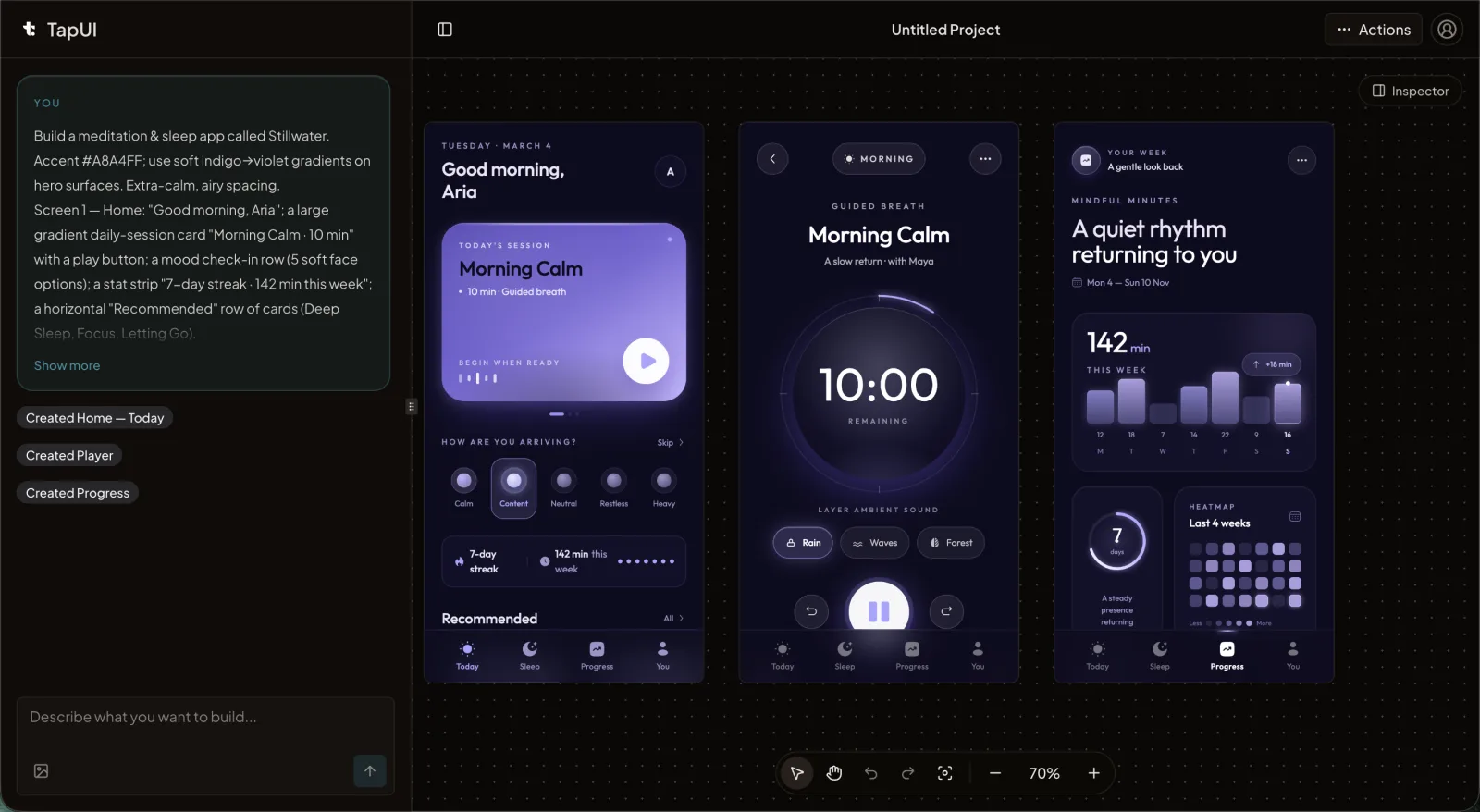 The TapUI editor turns a plain-text app description into presentable mobile UI screens.
Pricing: there's a free tier, plus Starter at $20/mo ($17/mo billed yearly — 100 screen generations/mo, project history and exports, email support) and Pro at $40/mo ($27/mo billed yearly — 650 generations/mo, everything in Starter plus priority support).
Pros: mobile-focused with output that's most useful early: generating presentable app screens for a pitch, or giving a client something concrete to react to.
Cons: the focus is narrow (mobile app UI), and it does not generate native platform code. Project history and exports exist for handing designs to your developers, but TapUI does not export React Native, Swift, or Flutter code — so don't promise a client native code straight out of the tool.
Figma AI: the professional standard, with AI bolted into a real workflow
Best for: serious, ongoing product work — building and maintaining design systems with best-in-class developer handoff.
For agencies doing serious, ongoing product work, Figma is the center of gravity — and its AI features are a different proposition from the text-to-UI generators above. Figma AI isn't a standalone "describe it and walk away" tool; it's AI woven into the environment where the actual design happens.
The pieces worth knowing: First Draft turns a prompt into wireframes and mockups for components and screens; Figma Make is an AI app builder aimed at taking an idea toward production inside Figma; and Code-to-Canvas lets you paste React, HTML, or SwiftUI and get an editable Figma component back. There are also Dev Mode AI descriptions, AI layer renaming, and integrations with GitHub Copilot and Cursor.
Pros: it's the industry standard, full stop — near-universal adoption among large companies, thousands of plugins, real-time collaboration, and the best developer handoff in the business. If your agency builds and maintains design systems for clients, this is the floor, not the ceiling.
Cons: the learning curve is steep, which is exactly why the simpler text-to-UI tools exist. AI features run on credits that get consumed quickly on lower-tier plans, and agentic features like Figma Make burn variable amounts. For a large team, Figma gets expensive. And First Draft, while capable of basic app wireframes, isn't a mobile-first generator the way a dedicated tool is — it's a generalist.
So the realistic agency pattern isn't "Figma vs. an AI generator." It's both: generate fast and rough in a text-to-UI tool, then bring the direction into Figma to make it real.
Handoff and adjacent tools that aren't really competitors
These tools appear on "best AI design tool" lists but solve a different problem — worth knowing so you don't mis-buy:
- Locofy is design-to-code, not design generation. Best for turning existing high-fidelity Figma (or Penpot/Adobe XD) files into production frontend code across a wide range of frameworks — including React Native and Flutter for mobile. It has real enterprise adoption, but it requires finished designs as input and is developer-facing, so it belongs after the design phase, not during it.
- Framer AI generates live, publishable websites in one tool — not mobile app UI screens. Best for a fast marketing site; wrong tool for app design.
- Adobe Firefly generates images and assets inside Creative Cloud. Best for graphics — it's commercially safe (trained on licensed content) — but it does not generate UI screens or components.
If a client needs the actual app shipped, Locofy is the bridge from design to code. If they need a website live this afternoon, Framer. If they need imagery, Firefly. None of them replaces a UI generator.
How to choose: route by the moment, not the winner
There's no single winner — match the tool to the job in front of you:
- Need free, fast exploration with multiple variations for a pitch? → Google Stitch (accept generic output and platform risk).
- Need a non-designer to mock something up? → Uizard or Visily (lowest learning curve; screenshot-to-design is the standout).
- Need polished mobile app screens to put in front of a client early? → TapUI (mobile-focused, presentable output, free tier to start).
- Need real product work, design systems, and best-in-class handoff? → Figma with its AI features (everything ends up here eventually).
- Need to turn finished designs into shippable code? → Locofy (broad framework support including mobile; needs hi-fi input).
The agencies getting the most out of AI aren't standardizing on one product. They're using a generator to compress the front of the process — the part where speed wins pitches and saves designers from speculative work — and a mature environment like Figma for the part where craft and maintainability matter. AI is good at the first draft. People are still better at the decision about which draft is right.
How to introduce AI design tools without burning the team
Two things consistently go wrong when agencies adopt these tools.
Treating generated output as finished work. Every tool here produces a starting point, not a deliverable. The generated screen is the cheap part; the judgment about whether it's the right screen is the expensive part, and that still belongs to a designer. Budget for cleanup, especially with Stitch's loosely structured Figma exports.
Over-promising to clients. Don't sell speed you can't reliably hit, and don't claim capabilities the tool doesn't have — telling a client they're getting native code out of a design generator is the kind of promise that comes back to bite you. Position AI honestly: it lets your team spend less time on production busywork and more on strategy and creative direction. That's a real benefit and it survives contact with reality.
FAQ
Is there a single best AI design tool for agencies?
No — the category covers three different jobs (generating screens, professional design work, and code handoff), so there's no universal winner. Most agencies use a small stack: a text-to-UI generator for speed, Figma for depth, and a code tool like Locofy when something needs to ship.
Will AI design tools replace designers at agencies?
No, not currently. These tools automate the repetitive front of the process — first drafts, variations, layout starting points — but they don't make creative or strategic decisions or manage clients. Agencies doing well with AI use it to free designers for higher-value work, not to remove them.
What's the difference between TapUI, Uizard, and Visily?
All three are text-to-UI generators with free tiers, but they lean different directions. Uizard and Visily emphasize fast wireframes with very low learning curves; Uizard's screenshot-to-design feature is a particular strength. TapUI focuses on polished mobile app UI screens ready for client pitches. Try them all to find what fits your workflow.
What happened to Galileo AI?
Google acquired Galileo AI in mid-2025 and folded it into Google Stitch. The standalone product is gone, and old conversations are view-only. If you're evaluating it, look at Stitch instead.
Can TapUI export native code?
No. TapUI generates designs to hand to developers through its project history and exports, but it does not export React Native, Swift, or Flutter code. For code export, Locofy is purpose-built for that job; Figma offers strong developer handoff within the design environment.
What's the TapUI pricing?
TapUI has a free tier, plus Starter at $20/mo ($17/mo billed yearly—100 screen generations/mo, project history and exports, email support) and Pro at $40/mo ($27/mo billed yearly—650 generations/mo, everything in Starter plus priority support).