The Best AI Design Tools for Android App UI in 2026
A practical, honest comparison of AI tools that turn text prompts into Android app UI — where each one wins, and where it falls short.
TL;DR: The best AI design tool for Android depends on the job. For a free, broadly generative starting point, use Google Stitch. For collaborative wireframing, use Uizard or Visily. For an actual buildable native Android app, use Google AI Studio. For turning a plain-text description into polished mobile UI screens you can share or hand to a developer, use TapUI.
Type "a fitness app home screen with a weekly streak, a start-workout button, and a stats card" into the right tool today, and you'll get a usable Android layout back in under a minute. That sentence would have sounded like marketing fluff two years ago. It isn't anymore — the category got genuinely good, and crowded, in a hurry.
The catch is that "AI design tool for Android" now covers at least three different jobs, and most comparison posts blur them together. Some tools draw mockups. Some generate working Kotlin. Some sit somewhere in between as a fast wireframing layer for people who don't design for a living. Pick the wrong category and you'll either fight a tool that's too technical or outgrow one that's too shallow.
I work on TapUI, so treat the section about our own product with appropriate skepticism. The rest of this is an honest map of what's actually worth your time in 2026, including the places where competitors flatly beat us.
The tools at a glance
| Tool | Best for | Key strength | Pricing | Buildable app? |
|---|---|---|---|---|
| Google Stitch | Free, broad generative range | Google-backed, mobile + web output, multi-screen | Free | ❌ (designs only) |
| Uizard (by Miro) | Collaborative wireframing | Beginner-friendly, sketch/screenshot to UI | Free tier (tight) + paid | ❌ (designs only) |
| Visily | Non-designers, template-driven | Generous free tier, 1,000+ templates | Generous free tier + paid | ❌ (designs only) |
| Google AI Studio | A working native Android app | Emits Kotlin / Jetpack Compose / Material 3 | Free (Labs) | ✅ |
| TapUI | Polished UI screens from text | Fast text-to-mockup, no design background needed | Free + Starter/Pro | ❌ (designs only) |
None of these is a universal winner. The rest of this post walks each one and where it honestly fits.
First, decide which job you're hiring a tool for
The single most important question to answer before comparing tools is: do you want a picture of an app, or a running app? Most frustration in this category comes from grabbing the wrong kind.
- You want polished UI screens to react to, share, or hand to a developer. This is the design and mockup lane — fast iteration on layouts, flows, and look-and-feel, no build environment required. Most founders and PMs live here.
- You want compileable Android code. This is the code-generation lane — tools that emit Kotlin, Jetpack Compose, or a full project you open in Android Studio. Powerful, but they assume you intend to ship the output as software.
Sort that out first; the tool choice gets easy afterward.
Google Stitch — the default starting point for most people
Best for: anyone who wants one free, broadly generative tool to start with.
If you're going to try one thing for free, start with Stitch. It's Google Labs' text-to-UI tool, and a substantial rework in early 2026 ("Stitch 2.0") pushed it well past its original single-screen generator: it now generates several interconnected screens at once, runs on an infinite Figma-style canvas, supports interactive prototyping and voice commands, and adds a portability format for moving designs out. It launched at Google I/O in May 2025.
Pros:
- It's free, with Google's infrastructure behind it.
- It outputs mobile and web UI and exports code across multiple frameworks, so design-to-handoff is short.
- It's evolving fast, which is both the appeal and the risk.
Cons:
- It's a Labs experiment, not a committed Google product. There's no long-term availability promise, no enterprise SLA, and generation limits apply.
The risk is real, so weigh it honestly. For a weekend project or early exploration that's a non-issue. For a team that needs to know a tool will still exist and be supported in eighteen months, "experimental Google Labs project" is a sentence worth re-reading. Tools in this part of Google's portfolio have been folded or sunset before.
One bit of housekeeping that trips people up: Galileo AI, which used to show up on every "best AI UI design" list, no longer exists as a standalone product. Google acquired it in mid-2025 and folded it into Stitch; both founders went to Google. If an older article points you to Galileo, that's where it went. You can import old Galileo conversation history into Stitch, but only to view it.
Uizard (by Miro) — fast multi-screen prototypes for teams
Best for: small teams sketching a flow together and ending up with something editable.
Uizard is the strongest option for beginner-friendly, collaborative wireframing. Acquired by Miro in 2024 and running as "Uizard by Miro Labs," its headline feature Autodesigner turns a text prompt into multi-screen, editable wireframes in seconds. It also converts hand sketches and screenshots into UI and targets phone (iOS and Android), tablet, and desktop viewports.
Pros:
- Beginner-friendly and collaborative — comfortable for non-designers working together.
- Converts hand sketches and screenshots into editable UI.
Cons:
- Output can look generic; it isn't built for pixel-perfect professional design.
- The free tier is tight (a small number of projects and monthly AI generations), and exports on it are limited.
It's a fast prototyping and wireframing layer, not a finishing tool. Paid tiers unlock more projects, generations, and exports.
Visily — the strongest free tier for non-designers
Best for: PMs, developers, and founders who want a low-commitment, template-driven mockup tool.
Visily offers the most generous free tier of any tool in this category, making it the natural choice for non-designers who want structure over raw generative range. It's an independent, browser-based tool aimed at PMs, developers, and founders rather than career designers. It does text-to-UI, screenshot-to-design, and sketch conversion, and leans on a large template library (well over a thousand templates) plus real-time collaboration.
Pros:
- A generous free tier — unlimited projects with basic AI credits.
- Large template library and real-time collaboration.
Cons:
- Less AI-generative than Stitch — it's a template-and-wireframe tool with AI assistance, not a system that conjures novel layouts from a sentence.
If you value structure, templates, and collaboration over raw generative range, that trade is fine. If you want the model to surprise you, it's the wrong pick. Paid plans add substantially more AI credits.
Google AI Studio — when you actually want a working Android app
Best for: developers who want a running native Android prototype on a phone today.
Google AI Studio is the right choice when you need a buildable app, not a design mockup — it generates native Android code (Kotlin, Jetpack Compose, Material 3) from a text prompt, which puts it in an entirely different lane from the other tools here. Announced at Google I/O in May 2026, it runs an in-browser emulator, can install to a physical device over ADB, supports hardware APIs like GPS and Bluetooth, and can publish straight to a Google Play internal test track or export a ZIP for Android Studio.
Pros:
- Produces working software, not mockups — remarkable for a fast running prototype.
- Emits Material 3 directly and runs on real devices.
Cons:
- Overkill for pure design work — there's no visual design surface to push pixels around in.
That's not a design canvas. It's closer to vibe-coding an app: the output is working software. For a designer iterating on layout and hierarchy without any intent to write code, it's the wrong shape of tool.
So: bookmark it for the day your question changes from "what should this screen look like?" to "can I get a working build of this?"
Where TapUI fits
Best for: turning a plain-language description into polished mobile UI screens, fast, with no design background.
TapUI's job is to get you from a sentence to a polished, shareable screen as fast as possible. It lives firmly in the design-and-mockup lane: you describe an app in plain language and it generates polished mobile app UI screens — the kind of thing a founder, PM, or designer uses to get from idea to something concrete and shareable without doing the layout work by hand.
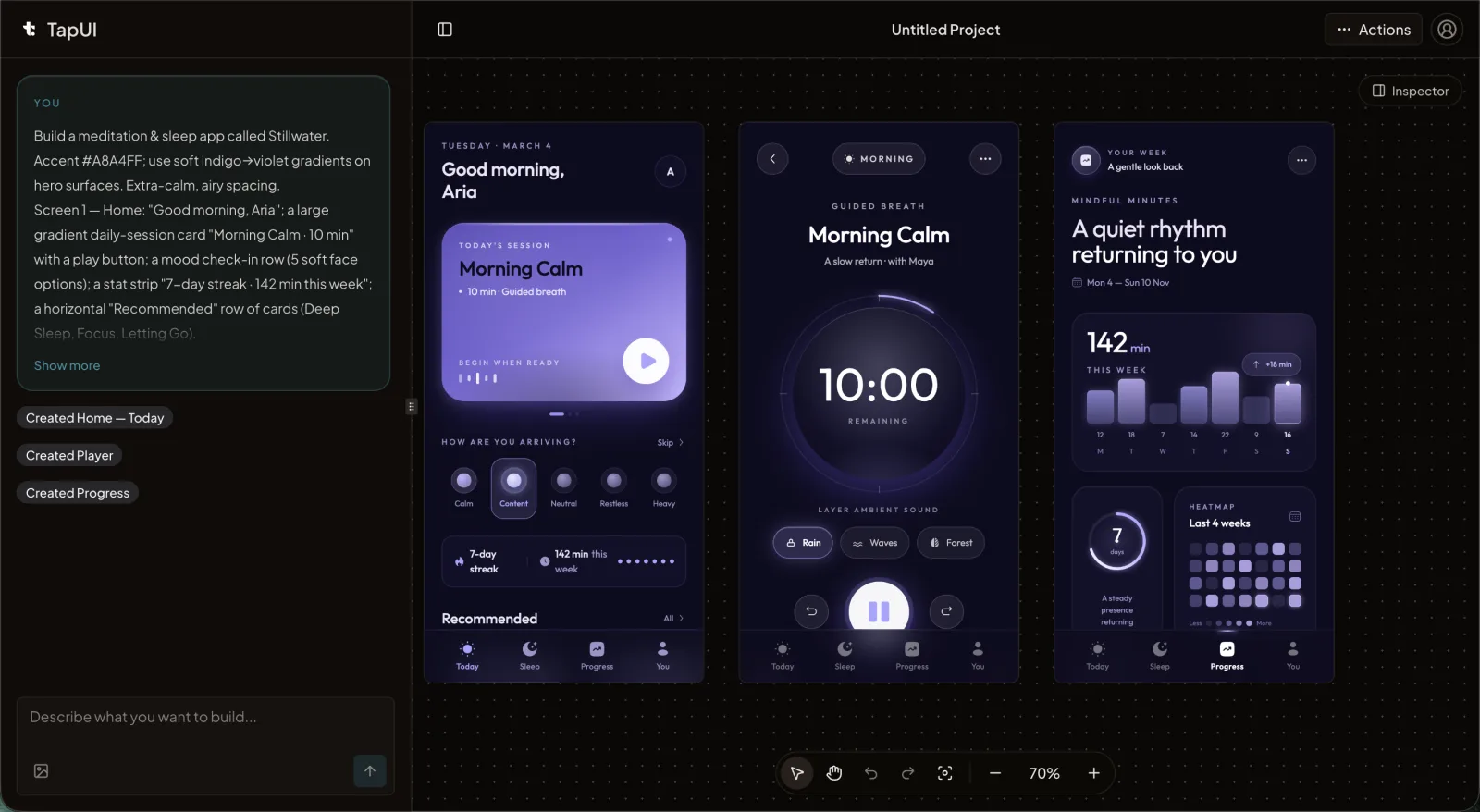 The TapUI editor: describe an app in plain language and get polished mobile UI screens back.
Pros:
- Goes from a sentence to a screen you can react to. The fastest way to find out a flow is wrong is to look at it. TapUI shortens that loop.
- Produces UI you can put in front of stakeholders or hand to your developers as a visual reference for what to build.
- Iterating without a design background — working app UI, fast, without manual design work.
Cons:
- It's a design-and-mockup tool only. It does not generate buildable native Android code — if you need a running app, that's a different lane (see Google AI Studio).
Pricing is straightforward: there's a free tier to try it, then Starter at $20/mo ($17/mo billed yearly — 100 screen generations per month, project history and exports, email support) and Pro at $40/mo ($27/mo billed yearly — 650 generations per month, everything in Starter plus priority support). Start on free; move up only if you hit its limits.
Now the honest part. If you want a free, Google-backed tool with the broadest generative range, Stitch is the stronger starting point — I'd tell you that even though it competes with us. If you need an actual buildable Android app rather than UI screens, that's Google AI Studio's job, not ours. And if your team's center of gravity is collaborative wireframing, Uizard and Visily are built for exactly that. TapUI's case is narrower and specific: turning a description into clean, polished app UI quickly, for people who'd rather not design it themselves.
A quick way to choose
Match the tool to the job — there's no single winner across all use cases. Here's the shortlist:
- Need a free, broadly generative tool to start with? → Google Stitch.
- Need collaborative, beginner-friendly wireframing? → Uizard.
- Need the strongest free tier and template-driven structure? → Visily.
- Need a working, buildable native Android app? → Google AI Studio.
- Need polished UI screens from a plain-text description? → TapUI.
Any post that tells you one tool beats every other for every job is selling something. Sort the job out first — picture of an app versus running app, solo versus collaborative, free experiment versus supported product — and the shortlist gets very short.
FAQ
Do these tools replace an Android developer?
No — none of these tools replaces an Android developer. The mockup tools produce designs, not shipping software — someone still has to build the app, wire up logic, and handle the parts a layout can't express. Even the code-generation tools (Google AI Studio) get you a strong starting point, not a finished, edge-case-hardened product. They remove grunt work; they don't remove engineering judgment.
What happened to Galileo AI?
Google acquired Galileo AI in mid-2025 and merged it into Stitch. It no longer exists as a standalone tool, and both founders joined Google. You can import old Galileo history into Stitch in a view-only mode. If a guide still recommends Galileo, it's out of date.
Is a free tool good enough, or do I need to pay?
For exploration and early flows, free tiers go a long way — Stitch is free outright, and Visily's free tier is unusually generous. You typically start paying when you need higher generation limits, more projects, better exports, or team features. Try the free option first; you'll quickly learn whether you're hitting walls that a paid plan removes.
Which one handles Material Design best?
Google's own tools — Stitch and Google AI Studio (which emits Material 3 directly) — have the closest relationship to current Android design conventions and tend to produce more on-pattern results than general-purpose design tools. That said, "looks like Material" still warrants a human check before anything ships — automated output gets you most of the way, not all of it.