The Best AI Design Tools for Enterprise Teams (and Where Each One Fits)
A practitioner's look at AI design tools for enterprise teams: Google Stitch, Figma, Uizard, and where TapUI fits for mobile UI work.
TL;DR: There's no single "best" AI design tool for enterprise — it depends on what you're producing. TapUI is the recommended pick if your job is generating polished mobile app screens from a plain-text prompt, fast — screens you refine and hand straight to developers. For everything else: Figma is the safest pick for governing a large design org (SSO, SCIM, audit logs). Google Stitch is the strongest free option for quick first drafts. Uizard is fine for early validation.
"Enterprise-ready" gets thrown around loosely in the AI design space. For a team of three, it means the tool doesn't fall over. For a regulated company with designers in a dozen countries, it means SSO, audit logs, seat management, and a procurement team that won't get vetoed by security. Those are different products, and most of the tools marketed as "AI design tools for enterprise" are really built for the first group and hoping the second doesn't read the fine print.
This is an honest map of the landscape as it stands in 2026. I work at TapUI, so treat the section on us with the skepticism you'd apply to any vendor writing about itself. But the comparisons below are based on what each tool actually does today, including the places where competitors are flatly better than we are.
A quick orientation before the details: there is no single tool that wins on every axis. The right choice depends on whether you're generating mobile app screens, running a full design org on shared component libraries, or just validating ideas fast. I'll be specific about which is which.
At a glance: how the tools compare
| Tool | Best for | Enterprise controls | Mobile UI polish | Pricing |
|---|---|---|---|---|
| Figma | Running a governed design org | ✅ SSO, SCIM, audit logs, roles | ⚠️ General-purpose, not mobile-native | ~$90/seat/mo (Enterprise, annual) |
| Google Stitch | Free, fast first drafts | ❌ No SSO, audit logs, or SLAs | ⚠️ Tends toward generic wireframes | Free (beta) |
| Uizard | Early-stage validation | ⚠️ Enterprise tier exists, opaque | ⚠️ More wireframing than hi-fi | Free tier; paid plans; contact-sales enterprise |
| TapUI | Polished mobile app screens, fast | ❌ No org-level governance today | ✅ Purpose-built for mobile screens | Free; Starter $20/mo; Pro $40/mo |
Use the table to narrow the field, then read the section that matches what you're actually building.
A note on a name you'll still see floating around
Galileo AI no longer exists as a standalone product. Google acquired Galileo AI in May 2025 and folded it into Google Stitch (under Google Labs). The co-founders joined Google as part of the deal. Any current article still recommending "Galileo AI" is out of date — what you actually want to evaluate is Stitch.
Google Stitch: free, fast, and genuinely good at first drafts
Best for: an individual designer or small team doing early exploration at no cost.
Google Stitch is the strongest free option for AI-generated UI drafts today, but it lacks the enterprise controls that governed teams need. You describe a screen in text, or feed it a sketch or screenshot, and it generates UI. It's powered by Gemini models, it's quick, and the March 2026 "Stitch 2.0" update added an infinite canvas, multi-screen generation, and MCP integration with IDEs like Cursor. It exports to Figma with layers and to HTML/CSS/Tailwind.
For an individual designer or a small team doing early exploration, that's a strong package, and it costs nothing during the beta. The daily credit allowance is generous enough that most people won't hit it.
Where it struggles is precisely the enterprise part.
Pros
- Free during the beta, with a generous daily credit allowance.
- Fast prompt-, sketch-, and screenshot-to-UI generation.
- Exports to Figma (with layers) and to HTML/CSS/Tailwind.
Cons
- Output tends toward generic — closer to colored wireframes than polished, brand-aware mockups. You'll get structure fast; you'll spend real time making it look like your product.
- Web-only and requires a Google account, with some geographic restrictions (which regions exactly isn't well documented).
- No enterprise controls — no SSO, no audit logs, no SCIM seat provisioning, no SLAs.
- The daily credit cap has no top-up option. Fine for one person; awkward for a large team sharing accounts.
Short version: excellent free starting point, not an enterprise platform.
Figma: the incumbent, with AI bolted on
Best for: running a whole design organization on shared systems with real governance.
Figma is the most complete enterprise option here — if your priority is governing a large design org on shared systems, it's the safe answer. Its AI features (First Draft for prompt-to-screen, AI copy, and the Figma Make canvas) are layered onto a tool your team probably already knows. On the enterprise checklist, Figma covers it by a wide margin: SSO, SCIM, domain capture, audit logs, role-based permissions, admin toggles for AI, design system APIs, and approved libraries. Desktop and web apps, a huge plugin ecosystem, mature developer handoff.
I'd say that even though it competes with us. Its AI generation isn't the reason you'd buy it — it's a secondary feature on top of an excellent general-purpose design tool.
Pros
- The most complete enterprise controls here: SSO, SCIM, audit logs, role-based permissions, admin AI toggles.
- Mature developer handoff, design system APIs, and a huge plugin ecosystem.
- Already the incumbent in most design orgs — low switching friction.
Cons
- Cost: the Enterprise tier runs around $90 per seat per month (annual), with separate dev seat pricing that adds up fast across a large team.
- General-purpose focus means mobile-specific output isn't a core differentiator — you configure your way there rather than getting native mobile screens out of the box.
- AI credits are now a separate purchasable line item on top of the subscription.
Uizard: good for validation, lighter on polish
Best for: getting an early idea in front of stakeholders quickly.
Uizard is the right pick for rapid early validation, though it leans more wireframing tool than high-fidelity mobile UI generator. It converts text, sketches, and screenshots into wireframes and prototypes, with multi-screen mockups and attention heatmaps. The free tier is limited (a handful of projects and only a couple of AI generations a month), paid plans open up more generations and exports, and there's a contact-sales enterprise tier with custom workspaces and onboarding.
Pros
- Sketch-to-UI is genuinely useful for getting ideas in front of stakeholders fast.
- Multi-screen mockups and attention heatmaps support early validation.
Cons
- Output usually needs meaningful refinement before it's production-ready.
- The enterprise plan has no public pricing.
- Leans more wireframing tool than high-fidelity mobile UI generator; positioned more at SMBs than large regulated orgs.
A few tools worth knowing, depending on your goal
- v0 by Vercel — prompt-to-React/Next.js code, web only. Great if you're shipping web UI as code, not relevant for native mobile screens.
- Builder.io Visual Copilot — Figma-to-code, design-system-aware, enterprise-capable, web-focused.
- Visily — text/screenshot-to-wireframe with Figma export, affordable, aimed at non-designers. Entry-level rather than enterprise-grade.
The pattern across all of these: most are either code-generation tools, general design platforms, or lightweight wireframing apps. Very few are purpose-built to produce polished, brand-aware mobile app screens.
Where TapUI fits
Best for: founders, PMs, and designers who need finished-looking mobile app screens, fast.
TapUI is built specifically for the gap none of the above fills: generating polished mobile app screens that look finished, fast. You describe an app in plain text, and TapUI generates polished mobile app UI screens — not wireframes, not generic boxes, but screens meant to look like a real product. The audience is founders, product managers, and designers who want working app UI fast, without doing the manual design work by hand. You get designs you can hand to your developers.
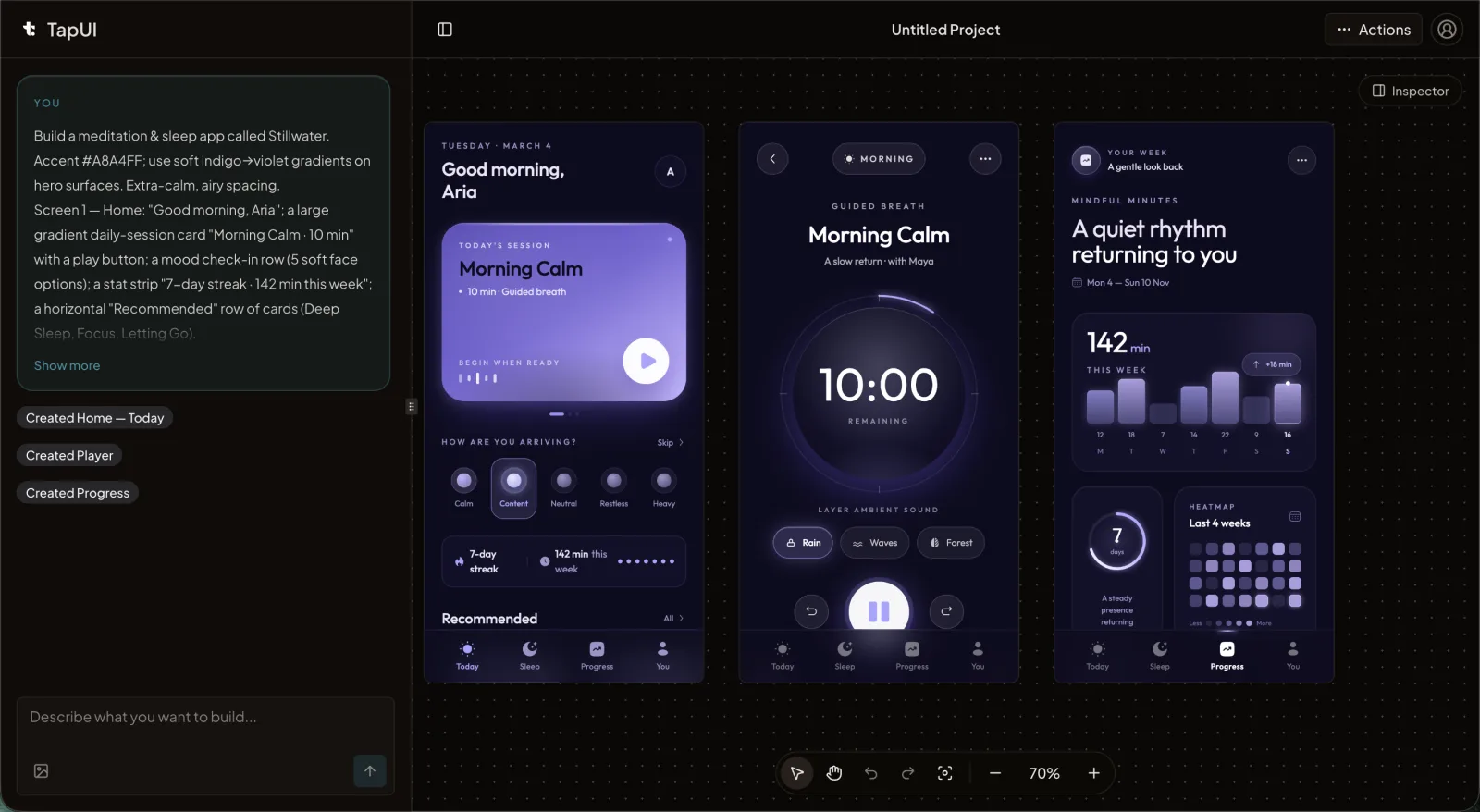 The TapUI editor turns a plain-text app description into finished-looking mobile screens.
We offer a free tier plus paid Starter ($20/mo, or $17/mo billed yearly) and Pro ($40/mo, or $27/mo billed yearly) plans, so you can try the output quality before committing.
Pros
- Purpose-built for mobile app screens that look finished, without the generic-wireframe feel of free tools.
- Plain-text input — describe an app, get polished screens to hand to your developers.
- Free tier to test output quality; affordable Starter and Pro plans without per-seat enterprise pricing.
Cons
- No org-level governance (SSO, audit logs, SCIM) today — if you need to run a large, governed design org, Figma's controls are more mature.
- Focused on mobile screen generation, not a full general-purpose design platform.
Being straight about the boundaries, because it matters for an enterprise evaluation:
- If you need to run a large, governed design org on shared component libraries, Figma's enterprise controls are more mature than what we offer today. That's the honest comparison.
- If you want a free tool for quick first drafts and don't care about brand polish or admin controls, Stitch will do that at no cost.
- TapUI's argument is narrower and more specific: when the job is generating mobile app screens that actually look finished, fast, that's the lane we're built for.
How to actually choose
Match the tool to what you're producing — that single answer eliminates most of the field. Skip the feature-checklist paralysis and answer three questions:
- What are you producing? Mobile app screens, a full multi-platform design system, or quick validation artifacts? This single answer eliminates most of the field.
- Who needs to be governed? If the answer involves SSO, audit logs, and seat provisioning across hundreds of people, your shortlist is short and Figma is on it. If it's a focused product team, you have far more freedom.
- What does "good enough" output mean? Be honest about how much post-generation cleanup your team can absorb. Free tools front-load the savings and back-load the polishing work.
Decision routing
- Need polished mobile app screens to hand to developers, fast? → TapUI. Describe your app in plain text and get finished-looking mobile screens — free tier available, Starter $20/mo, Pro $40/mo.
- Need to govern a large design org (SSO, audit logs, seat provisioning)? → Figma.
- Need a free tool for quick first drafts and don't mind cleanup? → Google Stitch.
- Need to validate an early idea with stakeholders fast? → Uizard.
Run the same prompt — a real screen from your real product — through two or three of these tools before you commit. The differences in output quality and the amount of cleanup required show up immediately, and they tell you more than any comparison table, including this one.
FAQ
What makes an AI design tool "enterprise-ready"?
Enterprise-ready means governance features: SSO, SCIM seat provisioning, audit logs, role-based permissions, and admin controls, plus security documentation that procurement teams will accept. Many tools marketed as enterprise have the AI but lack the governance controls to satisfy compliance requirements.
Should I use Google Stitch or Galileo AI?
Use Google Stitch — Galileo AI no longer exists. Google acquired Galileo AI in May 2025 and rebuilt it as Stitch under Google Labs, so Galileo is no longer available as a standalone product. If you're evaluating AI design tools, evaluate Stitch.
Which tool is best for generating mobile app screens?
TapUI is built specifically for mobile screens — you describe an app in text and get finished-looking mobile UI, not wireframes. Figma and general-purpose tools focus on web-first output and require more configuration to get there. Test a real screen from your product across tools to compare output quality and polish.
Does TapUI export to React Native, Swift, Flutter, or other native code?
No. TapUI generates mobile UI designs you hand to your developers — visual mockups of finished screens, not code exports. If you need code generation, look at web-focused tools like v0 by Vercel or Builder.io.
Can AI design tools replace human designers?
No. They speed up first drafts and repetitive generation work, but design judgment, brand direction, and refinement still require people. The realistic win is fewer hours spent on low-value, repetitive first-pass work.
How much do these tools cost?
Figma Enterprise runs ~$90/seat/month (annual). Google Stitch is free during beta. Uizard has a free tier with paid plans. TapUI offers a free tier, Starter at $20/mo ($17/mo yearly with 100 screen generations), and Pro at $40/mo ($27/mo yearly with 650 generations).