Best AI Design Tools for Expo Apps in 2026
A practitioner's comparison of AI design tools for Expo React Native apps, where each one wins, and how TapUI fits in.
TL;DR: "AI design tool for Expo" hides two different jobs. If you need polished UI screens to validate or hand off, use a design-first tool (Google Stitch for free/fast, TapUI for app-shaped screens with a paid path). If you need a running Expo project, use a code-first builder (RapidNative or Rork). No single tool nails both — many teams use one of each.
Here's the thing most "best AI design tool" roundups skip: Expo isn't a design product. It's the React Native framework you ship to iOS, Android, and web with. So when people search for an AI design tool "for Expo," they usually mean one of two different jobs — and choosing the right tool depends entirely on which one you're actually doing.
Job one: you need screens. A polished, on-brand UI for an app that lives in your head, fast, before you've committed a developer's week to it. Job two: you need running code — components wired into Expo Router that you can preview on a device and keep building on.
Those are not the same problem, and no single tool nails both. This guide walks through the tools worth knowing in 2026, where each genuinely shines, and where it falls short — including ours.
At a glance: the tools compared
| Tool | Camp | Best for | Expo code output | Pricing |
|---|---|---|---|---|
| Google Stitch | Design-first | Free, fast visual exploration | ❌ (HTML/CSS, Tailwind, Vue, Angular, Flutter, SwiftUI) | Free |
| TapUI | Design-first | App-shaped UI screens for validation + handoff | ❌ (designs/screens, not code) | Free; Starter $20/mo; Pro $40/mo |
| RapidNative | Code-first | Expo SDK + NativeWind + Figma input | ✅ (React Native + Expo) | Free tier; paid plans |
| Rork | Code-first | Full-app generation with GitHub export | ✅ (React Native + Expo) | Free tier; credit-based paid |
| a0.dev | Code-first | RN + Expo with included backend | ✅ (React Native + Expo) | See vendor |
| Expo Agent | Native (official) | Staying inside Expo's own ecosystem | ⚠️ (beta) | See vendor |
The lay of the land
The AI tools in the Expo ecosystem split cleanly into two camps, and picking the wrong one is the most common mistake. Design-first tools turn a prompt into a high-fidelity UI you can look at, react to, and iterate on — Google Stitch and TapUI live here. Code-first builders turn a prompt into an actual React Native + Expo project — RapidNative, Rork, and a0.dev live here.
The Expo ecosystem itself moved fast this year. Expo SDK 54 is current, Expo Router remains the recommended file-based navigation approach, and Expo even shipped its own AI agent — Expo Agent — that builds native Expo apps from natural language. As of mid-2026 it's still in beta, so it's promising but not yet something to bet a deadline on.
The distinction between camps matters because the failure modes are different. A design tool that produces beautiful screens you can't ship is fine if your next step is handing them to a developer — and frustrating if you expected a runnable app. A code builder that scaffolds a whole project is great until you spend an afternoon untangling its architecture to match yours.
Google Stitch: free, fast, and not built for Expo
Google Stitch is the best free option for fast visual exploration — but it does not export React Native or Expo code. You give it a text prompt, a sketch, or a screenshot, and it returns high-fidelity UI designs plus usable front-end code. The March 2026 "Stitch 2.0" update added multi-screen generation, an infinite canvas, voice input, and interactive prototyping — the canvas now covers a lot of what you'd reach for Figma basics to do.
It is genuinely fast (a first screen in well under a minute, a short multi-screen flow in a few minutes) and it is completely free through Google Labs, with a generous monthly generation allowance and no paid tier at all.
So what's the catch for Expo developers? Its code targets HTML/CSS, Tailwind, Vue, Angular, Flutter, and SwiftUI. For an Expo project, that's a real gap — you'd use Stitch to design and prototype, then rebuild the UI in React Native by hand or with another tool. A few other rough edges: you can't edit individual elements the way you would in Figma, you often have to re-specify your design preferences on each generation, and there's no paid path if you outgrow the free limits. It's also experimental, and Google Labs has a mixed track record on keeping experiments alive.
- Best for: zero-cost, fast visual exploration when you're comfortable that the code won't drop straight into Expo.
- Pros: free, very fast, multi-screen + infinite canvas, multiple input modes.
- Cons: no React Native/Expo export, limited per-element editing, no paid path, experimental.
RapidNative and Rork: when you want code, not comps
If your actual goal is a running Expo app, RapidNative and Rork are built squarely for that — and are the tools to reach for instead of a design-first option.
RapidNative converts plain English, sketches, or Figma files into production React Native code on Expo SDK 54+, with TypeScript, NativeWind, and Expo Router. You preview over a QR code in Expo Go and export the full project — no vendor lock-in. It's strong precisely where Stitch is weak: explicit Expo versioning, Tailwind-style styling baked in, and multiple input modes including Figma-to-code. It runs a free tier with daily credits and paid plans above that.
- Best for: generating a real Expo project with explicit SDK versioning, NativeWind, and Figma input.
- Pros: production RN code, full project export, no lock-in, multiple input modes.
- Cons: you inherit its architecture and styling choices.
Rork takes a prompt and generates a full React Native + Expo app — navigation, screens, components — exports real source, and integrates with GitHub. In early 2026 it added Rork Max, a premium tier that generates native SwiftUI apps for the Apple ecosystem (iPhone, iPad, Watch, Vision Pro) instead of React Native — worth knowing, but Apple-only. Rork runs on a credit model where each AI interaction costs a credit and credits don't roll over, which can pinch if you iterate heavily on design. There's a free tier with daily caps and several paid steps above it.
- Best for: full-app generation with GitHub export.
- Pros: complete app scaffold, real source export, GitHub integration.
- Cons: credit model doesn't roll over; reshaping output is real work; Rork Max is Apple-only.
Both are legitimately good at producing a working project. The trade-off is the one you always make with code generators: you inherit their architecture and styling decisions, and reshaping a generated project to fit your conventions is real work. (There's also a0.dev, YC-backed, generating React Native + Expo with a Convex/Supabase backend, if a backend-included approach fits your build.)
Where TapUI fits — and where it doesn't
TapUI is a design-first tool that takes you from a text prompt to polished mobile app UI screens — the kind of work that otherwise eats a designer's week. We make it, so take this section as informed but interested.
The audience we built it for is founders, product managers, and designers who need credible app UI quickly without doing manual design work, and who want designs they can hand to their developers to build.
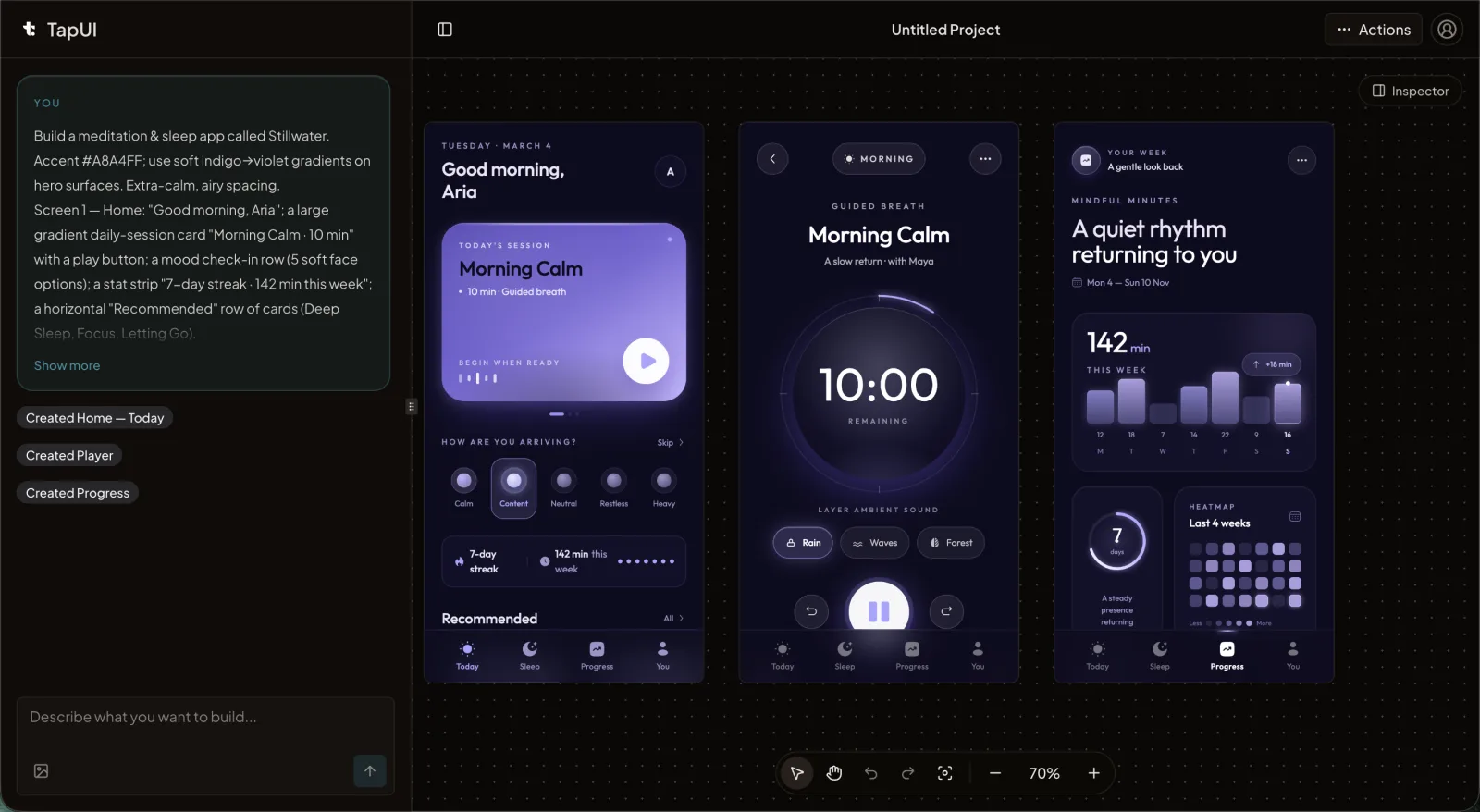 The TapUI editor: describe an app in plain text and get polished mobile UI screens you can validate and hand off.
On pricing, there's a free tier to start, then Starter at $20/mo ($17/mo billed yearly) for 100 screen generations a month with project history, exports, and email support, and Pro at $40/mo ($27/mo billed yearly) for 650 generations a month plus priority support. Note that TapUI's exports are designs and screens you hand to developers — it does not generate React Native, Swift, or Flutter code.
- Best for: founders, PMs, and designers who need credible app UI fast to validate, pitch, or brief a developer.
- Pros: sentence-to-screens speed, app-shaped output, project history and exports, paid path as you scale.
- Cons: no runnable Expo project and no platform code generation — it's a design and handoff step, not a code builder.
Where TapUI is a good fit: you have an app concept and need to see it well enough to validate it, pitch it, or brief a developer — without learning a design tool or hiring out. Where it isn't the right pick: if what you actually want is a generated, runnable Expo project on day one, a code-first builder like RapidNative or Rork is the more direct route.
I'd rather you pick the tool that matches your job than oversell ours. Honestly, plenty of teams use two: something design-first to lock the look, and a code builder to scaffold the implementation.
A quick way to choose
The fastest way to choose is to ask yourself one question: what do I need to walk away with?
- Need a picture you can react to and hand off? → a design-first tool. TapUI if you want app-shaped UI quickly with a paid path as you grow; Stitch if free and fast matters more than Expo-ready output.
- Need a running Expo project? → a code-first builder. RapidNative for explicit Expo SDK + NativeWind + Figma input; Rork for full-app generation with GitHub export (mind the credit model).
- Need to stay fully inside Expo's own ecosystem? → keep an eye on Expo Agent, with the caveat that it's still beta.
The honest summary
There is no universal winner for "AI design tool for Expo," because "for Expo" hides two different jobs. Stitch is the easiest free starting point for visuals but won't give you Expo code. RapidNative and Rork will give you Expo code but ask you to live with their structure. TapUI gets you from a sentence to shippable-looking screens fast, and is at its best as a design and handoff step rather than a code generator.
Pick by outcome, try the free tiers, and don't be surprised if the right answer is more than one tool. If a fast path from idea to polished app screens is what you're missing, TapUI's free tier is a low-stakes place to start.
FAQ
Which AI design tool is best for Expo apps?
The best tool depends on the job. For polished UI screens to validate or hand off, use a design-first tool like Google Stitch (free) or TapUI. For a runnable Expo project, use a code-first builder like RapidNative or Rork.
Does Google Stitch export React Native or Expo code?
No. Stitch exports HTML/CSS, Tailwind, Vue, Angular, Flutter, and SwiftUI code—not React Native or Expo. You'd use it to design and prototype, then rebuild the UI in React Native by hand.
Does TapUI generate React Native, Swift, or Flutter code?
No. TapUI produces polished mobile UI screens you hand to developers. It exports designs and project history, not code for any platform. If you need a runnable Expo project, use a code-first builder instead.
How much does TapUI cost?
TapUI offers a free tier. Starter is $20/mo ($17/mo billed yearly) for 100 screen generations, project history, exports, and email support. Pro is $40/mo ($27/mo billed yearly) for 650 generations and priority support.
Can I use more than one AI design tool together?
Yes, many teams do. A common pattern is using a design-first tool (TapUI or Stitch) to lock the visual design, then a code-first builder (RapidNative or Rork) to scaffold the Expo implementation.