The Best AI Design Tools for iOS App UI in 2026
A practitioner's comparison of AI tools for designing iOS app screens fast, with honest trade-offs on Stitch, Uizard, Visily, Figma, and TapUI.
TL;DR: There is no single best AI design tool for iOS app UI. Pick Google Stitch for free, fast wireframes; Uizard when your input is a sketch or screenshot; Visily when a team needs to design together; Figma as the place to refine and hand off; and TapUI when you want polished, mobile-native screens from a plain-text description. Match the tool to the job, not to a vendor's claim that it wins everything.
If you are designing iOS screens and you type "AI design tool" into Google, you will get back a list that mixes three very different products: prompt-to-UI generators, design-to-code converters, and big design apps that bolted an AI feature onto the side. They are not interchangeable. Picking the wrong category is the fastest way to waste a weekend.
This piece sorts them out for one specific job: getting from an idea in your head to a polished iPhone screen you can actually show people. I will be upfront about where each tool is strong, where it falls down, and where a competitor genuinely beats the tool I work on.
Related: If you are working across platforms, we also cover Android UI, Flutter, and React Native with Expo.
The tools at a glance
| Tool | Best for | Key strength | iOS-native polish | Free tier | Pricing |
|---|---|---|---|---|---|
| Google Stitch | Free, fast wireframes from scratch | Breadth + multi-screen journeys, no card | ⚠️ Leans Material, generic | ✅ Daily credits | Free (beta) |
| Uizard | Sketch / screenshot input | Whiteboard photo → editable design | ⚠️ General UI, not iOS-first | ⚠️ Very low limit | Free + paid plans |
| Visily | Cross-functional team collaboration | Real-time shared canvas, templates | ⚠️ General UI, not iOS-first | ✅ Generous | Free + paid plans |
| Figma | Refining and handoff | Industry standard everyone exports to | ⚠️ Manual, AI is secondary | ✅ Starter (AI is paid) | Free + paid plans |
| Locofy | Design → frontend code | Best-in-class code conversion | ❌ Not a generator | — | Free + paid plans |
| TapUI | Polished, mobile-native screens from text | Narrow prompt-to-UI focus | ✅ Polished from the start | ✅ Free tier | Starter $20/mo, Pro $40/mo |
First, sort the tools into the right buckets
The single most important move is choosing the right category before you pick a tool — the three types of "AI design tools" are not interchangeable.
- Prompt-to-UI generators take a plain-text description and produce screens. This is the bucket you want if you are starting from nothing. TapUI, Google Stitch, Uizard, and Visily live here.
- Design-to-code tools take an existing design file and emit frontend code. Locofy is the clearest example. These are useless until you already have a finished design, so they are not where you start a project.
- General design apps with AI features are tools like Figma, where AI assists a manual workflow rather than driving it. Powerful, but the AI is the side dish, not the meal.
A couple of names you may remember are simply gone. Galileo AI no longer exists as a standalone product; Google acquired it and folded the technology into Stitch in 2025. Motiff AI, which did mobile-first generation, shut down in mid-2026. If a listicle still recommends either, it is out of date, and that tells you how much to trust the rest of it.
Google Stitch: the free option that is hard to argue with
Best for: going from a vague idea to wireframes you can react to, as cheaply as possible.
Stitch came out of Google Labs and runs on Google's Gemini models. You give it a prompt, a sketch, or a reference image, and it generates multi-screen mobile and web layouts on an infinite canvas, with the screens auto-linked into a rough user journey. It exports editable layers to Figma and code in several frameworks, and there is MCP integration if you live in an IDE like Cursor.
The headline is the price: it is free, with a daily credit allowance generous enough that most people never hit it. No card required.
Pros: unbeatable on cost; excellent at breadth and multi-screen flows; fast from idea to wireframe.
Cons: output tends to look generic and leans toward Material Design rather than feeling native to iOS; no brand identity out of the box, so you do a polish pass anyway; living in Google Labs means its long-term future is not guaranteed. Build a workflow on it knowing that.
Uizard and Visily: the established middle ground
Both are proven, broadly capable UI tools — the honest limitation for this topic is that neither is mobile-first, and neither makes iOS-specific fidelity its focus.
Uizard — Best for: turning sketches and screenshots into editable designs. Acquired by Miro in 2024 and around since 2018, Uizard is strongest when your input is not text. Its sketch-to-UI feature can turn a photo of a whiteboard into an editable design in seconds, and it does screenshot-to-design well too. Its Autodesigner feature builds a multi-screen prototype from a prompt. It supports mobile, tablet, and desktop viewports, and offers developer handoff.
- Pros: best-in-class sketch and screenshot input; multi-viewport support; developer handoff.
- Cons: very low free-tier generation limit you will exhaust almost immediately; web tool with no native iOS app; output usually needs a trip through Figma to feel polished.
Visily — Best for: a mixed team that wants to design together in one file. Visily aims squarely at non-designers and teams. It has a large template library, text-to-screen and screenshot conversion, and real-time collaboration on a single shared canvas, plus built-in diagramming.
- Pros: notably generous free tier; strong real-time collaboration; large template library.
- Cons: not mobile-first by design; iOS-specific fidelity is not its focus.
They are general UI tools that handle mobile, not tools built around how an iPhone screen should feel.
Figma: still the destination, not the generator
Best for: refining generated work and handing off to developers.
Figma is a manual design tool with AI bolted on, not a generator with a design tool attached — and that distinction matters if you want AI to do most of the building. Its AI features, like First Draft, can spin up layouts and components from a prompt, and there is visual search and auto-layout assist. But paying for Figma purely for its AI features is an awkward fit, and the learning curve is real.
- Pros: industry standard; almost every tool above exports to it; the place everyone meets.
- Cons: AI assists rather than generates; real learning curve; poor fit if you want AI to do most of the building.
The realistic workflow for a lot of teams is: generate elsewhere, refine and hand off in Figma. Figma's strength is being the place everyone meets, not the place ideas get born.
Locofy: powerful, but a different job entirely
Best for: converting an existing design into production frontend code.
I mention Locofy only to head off confusion, because it shows up in these searches. Locofy converts an existing Figma or Penpot design into production frontend code, across a wide range of frameworks. For shipping an existing iOS design into code, it is best-in-class and developer-facing.
- Pros: best-in-class design-to-code; wide framework support; built for developers.
- Cons: not a UI generator; cannot help until a design already exists; aimed at developers, not designers or non-coders.
If you are looking for "describe an app and get screens," Locofy is the wrong category.
Where TapUI fits
Best for: turning a plain-text description into polished, mobile-native screens — without manual design labor.
Full disclosure: I work on TapUI, so weigh this accordingly and try the free tier rather than taking my word for it.
TapUI sits in the prompt-to-UI bucket, and its narrow focus is the pitch. You describe an app in plain text and it generates polished mobile app UI screens. The audience it is built for is founders, product managers, and designers who want working app UI quickly without doing the manual design labor themselves. You get designs and screens you can hand to your developers to build from.
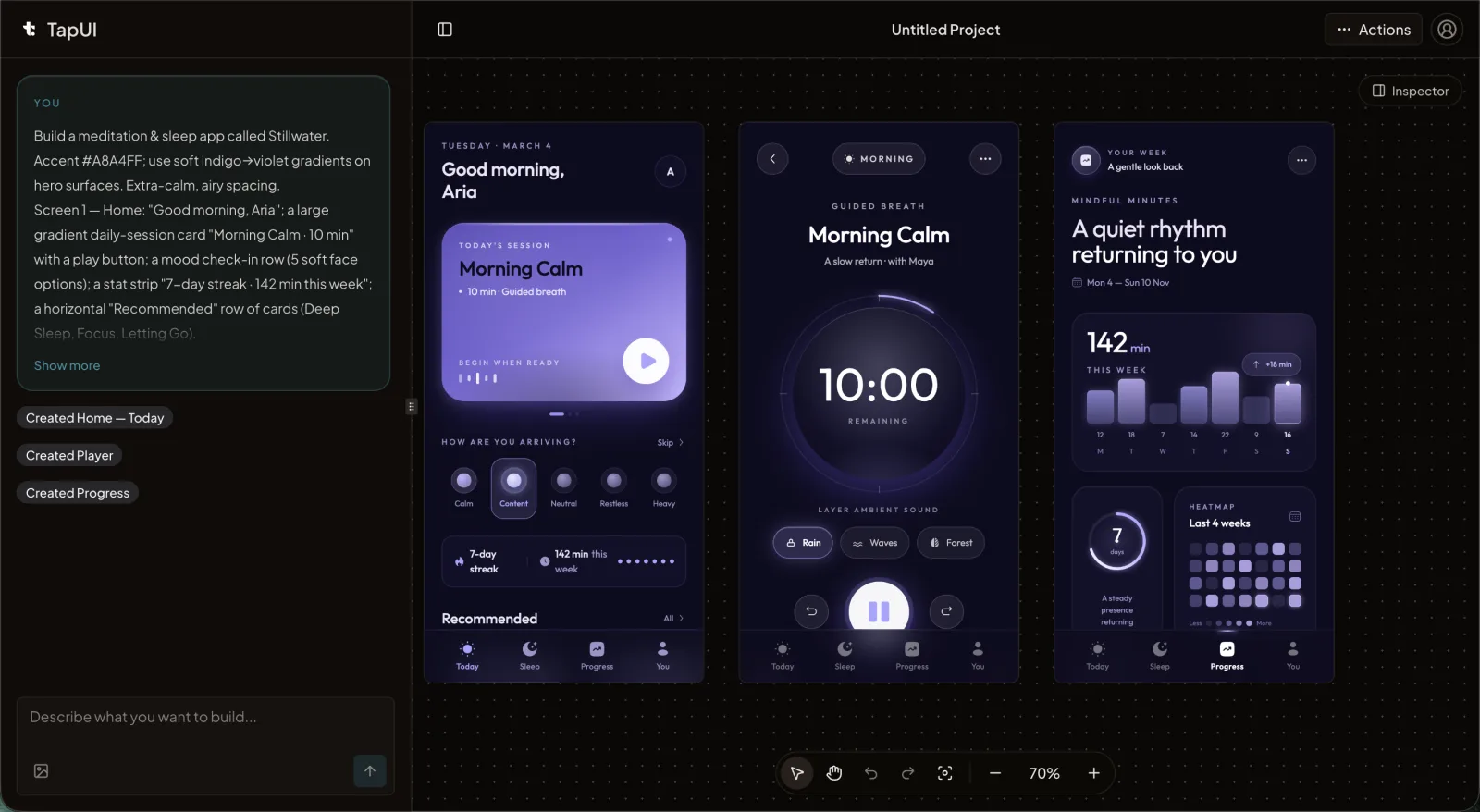 The TapUI editor turns a plain-text app description into polished, mobile-native screens.
On pricing, there is a free tier to try it. Starter is $20/mo ($17/mo billed yearly) with 100 screen generations per month, project history plus exports, and email support. Pro is $40/mo ($27/mo billed yearly) with 650 generations per month and everything in Starter plus priority support.
- Pros: polished, mobile-native output from the start; narrow, focused workflow; built for founders, PMs, and designers; designs you can hand to developers.
- Cons: not the cheapest route to throwaway wireframes; no whiteboard-photo input like Uizard; does not generate native platform code.
Where I would honestly steer you elsewhere: if your only requirement is "free and fast wireframes," Stitch is hard to beat on cost. If you need to drop a whiteboard photo in and get a design out, Uizard's sketch input is purpose-built for that. If your team's bottleneck is collaboration rather than generation, Visily is worth a look. TapUI's case is strongest when you want output that feels polished and mobile-native from the start, rather than a wireframe you will then spend hours dressing up.
How to actually choose
The right tool depends on your situation — there is no single winner across every scenario:
- Need free, fast wireframes and polish can wait? → Google Stitch.
- Need to turn a sketch or screenshot into a design? → Uizard.
- Need a mixed team to design together in one file? → Visily.
- Need polished, mobile-native screens from a text description? → TapUI.
- Already have a design and need code? → Locofy (not a generator).
- Need everyone to converge and hand off? → Figma, usually as the last step.
The mistake to avoid is picking a tool for a job it was not built for, then blaming the tool. A wireframe generator will give you wireframes. A code converter needs a design first. Know which problem you are solving before you open a single tab.
FAQ
Can an AI design tool replace a designer or developer?
No. These tools shorten the path from idea to a working screen, but someone still has to make product decisions, refine the result, and build the real app. The value is in skipping the blank-canvas stage and the repetitive layout work, not in removing the people who exercise judgment.
What's the cheapest way to try these tools?
Google Stitch is the cheapest option — completely free in its Google Labs beta, with a daily credit allowance and no card required. TapUI, Uizard, and Visily all offer free tiers with paid plans above them. Figma has a free Starter tier, though its most useful AI features are in paid plans.
Can TapUI export React Native, Swift, or Flutter code?
No. TapUI generates polished mobile UI designs that you hand to your developers to build. It does not export native platform code—it's a design tool, not a code generator. If you need design-to-code conversion, consider Locofy after you have a finished design.
Why would I use TapUI instead of just using Figma?
TapUI is built for AI to do most of the work; Figma is a manual design tool with AI assist. If your goal is to turn a plain-text description into a polished, mobile-native screen without manual design labor, TapUI's narrow focus gets you there much faster. Figma is usually where you finish and hand off, not where ideas are born.
How much does TapUI cost?
TapUI has a free tier to try. Starter is $20/month ($17/month billed yearly) with 100 screen generations per month, project history, exports, and email support. Pro is $40/month ($27/month billed yearly) with 650 generations per month and priority support. Both paid tiers include everything in Starter.
How polished is AI-generated output really?
It varies by tool and category. Wireframe generators like Stitch produce fast but generic layouts; TapUI and similar finished-screen tools get you closer to presentable, but you should still expect to review and refine before shipping. Treat any first generation as a strong draft, not the final product.
The short version
There is no single best AI design tool for iOS, and any article claiming one tool wins every scenario is selling you something. Stitch wins on free and fast. Uizard wins on sketch input. Visily wins on collaboration. Figma wins on being the standard everyone already uses. TapUI's lane is turning a plain-text description into polished, mobile-native screens. Pick the one that fits the job in front of you.
If that last job is yours, you can try TapUI free and generate a first screen to see whether the output matches what you had in mind.