The Best AI Design Tools for Startup MVPs in 2026
A founder's guide to AI design tools for MVPs: how TapUI, Stitch, Lovable, v0 and others compare on speed, mobile output, and handoff.
TL;DR: If you're building a native mobile MVP, start with TapUI — describe your app in plain text and get polished mobile UI screens you can iterate on and hand to developers in minutes (free tier; Starter $20/mo). For a web MVP, Lovable, Bolt, and v0 are the stronger picks and will beat any mobile-focused tool for that job. Need quick static mockups? Uizard, Visily, and Google Stitch are reasonable fallbacks. The single most useful question: web or native mobile? That one filter eliminates most of the list.
The hardest part of a mobile MVP usually isn't the idea. It's the gap between "I can describe this app in a sentence" and "I have something on a screen I'm willing to show an investor." For a long time, that gap was filled by a designer, a Figma file, and two weeks of back-and-forth. AI design tools have collapsed a lot of that — but the category is messier than the marketing suggests, and most of the popular tools aren't actually built for mobile.
This guide is for founders, PMs, and solo builders who need working app UI fast. I'll be specific about what each tool is good at, where it falls short, and where I think TapUI fits. I work on TapUI, so treat my recommendation accordingly — but I've tried to be honest about the cases where a competitor is the better call, because pretending otherwise wastes your time.
Quick comparison
| Tool | Best for | Key strength | Native mobile output | Pricing |
|---|---|---|---|---|
| TapUI | Native mobile MVP screens | Plain-text prompt → polished mobile UI | ✅ Designs (hand off to devs) | Free tier; Starter $20/mo, Pro $40/mo |
| Lovable | Deployed full-stack web MVP | Ships a working React + Supabase app | ❌ Web-only | Check lovable.dev |
| Bolt.new | Multi-stack web prototypes | Full in-browser IDE, framework-flexible | ⚠️ React Native reported patchy | Credit-based |
| v0 | React components in Next.js | Highest-quality AI React components | ❌ Frontend-only, no mobile | Check vercel.com |
| Google Stitch | Free web mockups | Strong NL understanding, Figma/HTML export | ❌ Web UI (HTML/Tailwind) | Free (Google Labs) |
| Uizard | Beginner-friendly mockups | Text/sketch/screenshot → multi-screen | ⚠️ Mobile mockups only | Free tier; paid per seat |
| Visily | Wireframes + mobile templates | Screenshot-to-UI, Figma export | ⚠️ Mobile mockups only | Affordable |
| Framer AI | Animated web prototypes | Built-in motion design | ❌ Web-first | Cheap entry tier |
| Figma AI | Teams already in Figma | Best design-to-dev handoff (Dev Mode) | ⚠️ Mockups, add-on AI | Free tier; credits add cost |
First, sort tools by what they actually output
The single most useful filter is: does the tool produce web output or native mobile output? Almost everything in the "AI builder" hype cycle right now is web-first. That matters a lot if your product lives on the App Store.
- Web app builders (Lovable, Bolt, v0): generate React/web UI, sometimes a full deployed app. Great for web SaaS, dashboards, and marketplaces. Not built to produce native iOS/Android UI.
- AI design/mockup tools (Stitch, Uizard, Visily, Framer AI, Figma AI): generate UI designs or wireframes. Some export to Figma or HTML. Varying degrees of mobile support, but mostly mockups, not native apps.
- Mobile-first AI design (TapUI): you describe a mobile app in plain text and get polished mobile app UI screens you can iterate on and hand to your developers.
If you're building web, skip ahead — I'll point you to the right web tools below, and a couple of them are genuinely excellent. If you're building a mobile app, the field narrows fast, and that's the gap TapUI is built for.
The web builders (and when they beat everything else)
For web MVPs, this is the strongest part of the AI tools market right now — don't reach for a mobile tool out of brand loyalty when one of these fits better.
Lovable is, by most accounts, the fastest path for a non-technical founder to ship a deployed, full-stack web MVP. It builds a React frontend with a Supabase backend, auth, storage, and hosting wired up through an AI chat interface. The tradeoff: it's web-only and Supabase-centric, with no native iOS/Android output. If you want a working web product live this afternoon, it's hard to beat. (Pricing has moved around — check lovable.dev directly before you commit.)
- Best for: non-technical founders who need a deployed web product today.
- Pros: full-stack output, auth/storage/hosting wired up, very fast.
- Cons: web-only, Supabase-centric, no native mobile.
Bolt.new (StackBlitz) is the most framework-flexible of the bunch, running a full IDE in the browser via WebContainers. It's fast and great for prototypes across multiple stacks.
- Best for: developers prototyping across multiple stacks.
- Pros: full browser IDE, framework-flexible, fast.
- Cons: React Native output reported as patchy; credit system drains quickly on heavier builds.
v0 (Vercel) produces the highest-quality React components I've seen from an AI tool, especially if you're already living in Next.js and the Vercel ecosystem.
- Best for: incremental UI work inside an existing Next.js project.
- Pros: top-tier component quality, deep Vercel/Next.js fit.
- Cons: frontend-only — no backend, no mobile; not built to stand up a whole MVP from zero.
The honest summary: for web MVPs, these tools are excellent and TapUI is not the right tool. The catch is that none of them reliably produce native mobile UI. If you've been trying to force a web builder to give you an iOS app, that friction isn't your fault.
The design and mockup tools
These generate UI designs rather than running apps. Useful for getting something visual quickly, but you'll still need to build the real thing.
Google Stitch is worth understanding because it's where the old Galileo AI ended up — Google acquired Galileo in 2025 and relaunched it as Stitch, powered by Gemini. (If you read an older article praising "Galileo AI," it's out of date; Galileo no longer exists as a standalone product.) Stitch turns a prompt into multi-screen UI, converts sketches to editable designs, auto-wires clickable prototypes, and exports to Figma and HTML/Tailwind. The big draws: it's genuinely free with no credit card, and the Gemini backing gives it strong natural-language understanding.
Stitch's limits are real, though. Output skews generic out of the box, so brand differentiation takes work. Despite the multi-screen pitch, quality tends to degrade past about three connected screens. It outputs web UI (HTML/Tailwind and Figma) — not native mobile code. And because it lives in Google Labs, there's no guarantee about long-term availability; Labs products get sunset.
- Best for: free, fast web mockups with strong prompt understanding.
- Pros: genuinely free, Gemini-backed NL, Figma/HTML export.
- Cons: generic defaults, quality degrades past ~3 screens, web-only, uncertain long-term availability.
Uizard (Copenhagen) is the friendliest on-ramp for non-designers: text, sketch, or screenshot in, multi-screen mockups out. The free tier is limited, and paid plans are modestly priced per seat. It designs both mobile and web mockups — but they're mockups.
- Best for: non-designers who want the gentlest learning curve.
- Pros: text/sketch/screenshot input, mobile and web, affordable seats.
- Cons: mockups only; heavy refinement needed; limited component control vs. Figma.
Visily is similar in spirit — affordable, a good mobile template library, solid screenshot-to-UI, Figma export. It leans toward wireframing, so it's weaker on complex interactions and, again, it's not a code tool.
- Best for: wireframing with a ready mobile template library.
- Pros: affordable, strong screenshot-to-UI, Figma export.
- Cons: weak on complex interactions; not a code tool.
Framer AI is the pick if you want interactive, animated web prototypes with motion design built in, at a cheap entry point. Web-first, though, so it's not where I'd build iOS/Android MVP UI.
- Best for: animated, interactive web prototypes.
- Pros: built-in motion design, cheap entry tier.
- Cons: web-first; not for native mobile UI.
Figma AI deserves a clear-eyed take. Figma is still the best environment for teams that already live in it: collaborative, full design-system support, and the best design-to-dev handoff via Dev Mode. Its AI features — First Draft, text-to-component, auto-layout assists — are genuinely useful add-ons. But they're add-ons, not the core, layered on a tool with a real learning curve. It's not purpose-built for quick AI prototyping, it gets expensive at team scale, and AI credit limits now add variable cost.
- Best for: teams with a designer who already live in Figma.
- Pros: best-in-class handoff (Dev Mode), full design-system support, collaborative.
- Cons: real learning curve, AI is an add-on not the core, costly at team scale, variable AI credit cost.
Where TapUI fits
TapUI is built for one job: describe a mobile app in plain text and get polished mobile UI screens. No Figma proficiency, no design background assumed. The audience is founders, PMs, and designers who want working app UI quickly without doing the manual design labor — and specifically for mobile, which is exactly the gap the web builders leave open.
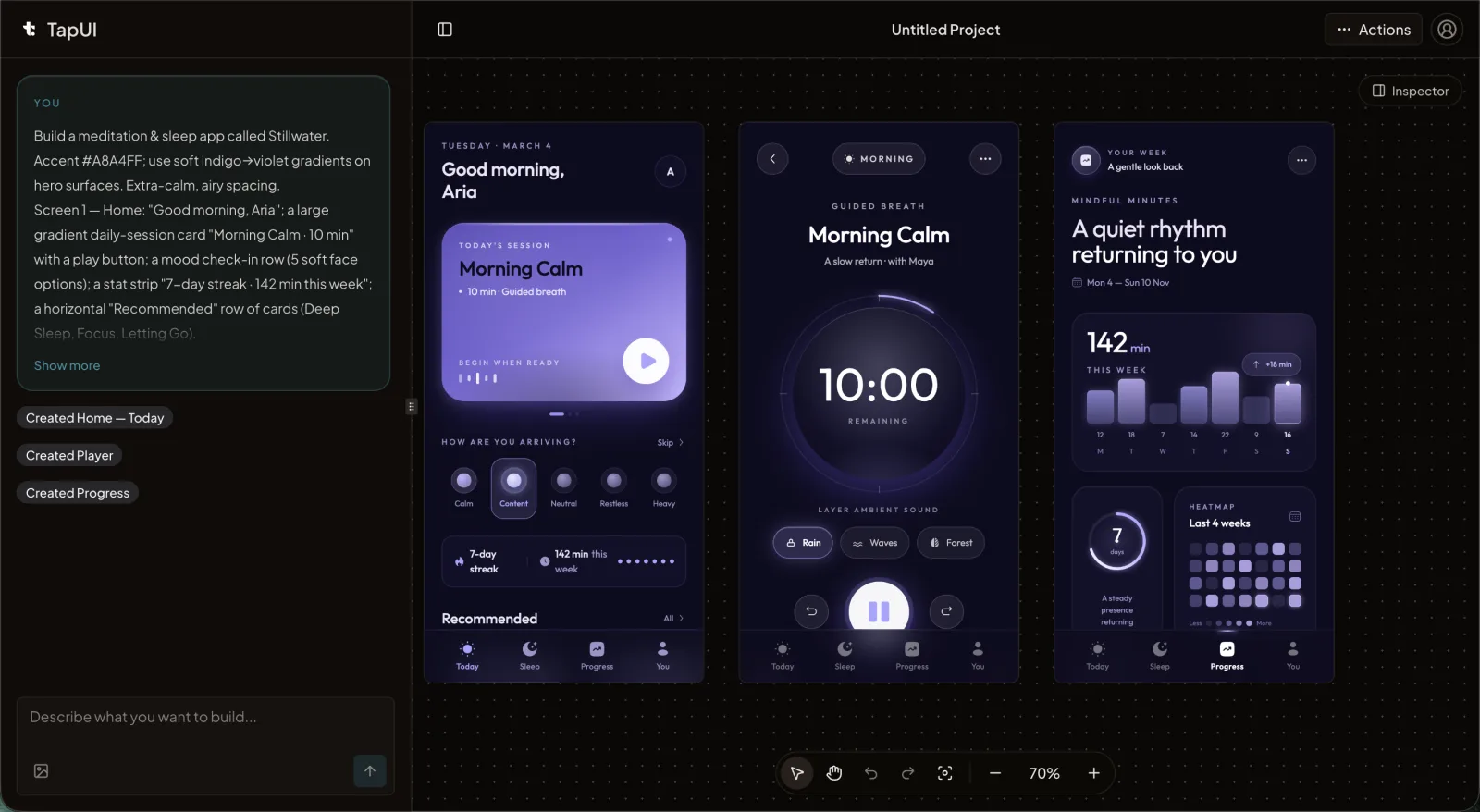 The TapUI editor: describe a mobile app in plain text and get polished mobile UI screens to iterate on.
What that looks like in practice: you write something like "a meditation app with daily sessions, a progress tab, and a paywall," and you get mobile screens you can react to, adjust, and refine. When the direction is right, those designs are something you can hand to your developers to build against.
- Best for: founders and PMs who need polished native mobile UI screens fast, without design skills.
- Pros: plain-text prompts, mobile-first output, quick iteration, designs you can hand to developers.
- Cons: mobile-only (not for web MVPs); a design tool, not a full-stack app generator — your engineers still build the backend and wire up logic.
I'll be straight about the boundaries, because they matter for your decision:
- TapUI is mobile-focused. If you're building a web app, the tools in the section above will serve you better. This isn't false modesty — it's the right call for your stack.
- It's a design tool, not a full-stack app generator. It gets you polished screens fast; your engineers still build the backend and wire up logic.
- Pricing. There's a free tier plus paid plans: Starter at $20/mo ($17/mo billed yearly) with 100 screen generations per month, project history and exports, and email support; and Pro at $40/mo ($27/mo billed yearly) with 650 generations per month, everything in Starter, plus priority support. The free tier is there so you can try real prompts before paying anything.
The reason a mobile-native tool matters: a prototype that feels like a real iOS or Android app reads very differently in a pitch meeting than a web page squeezed into a phone frame. Reviewers who've seen a thousand decks notice. That's the wedge — not that TapUI wins every category, but that it's aimed squarely at the one most AI tools treat as an afterthought.
How to actually choose
Start with web vs. native mobile — this one question eliminates most of the list. Then work through:
- Web or native mobile? Web → Lovable, Bolt, or v0. Native mobile UI → TapUI, or a mockup tool like Uizard/Visily if you only need static screens.
- Do you need a running app or polished screens? A full deployed web app points you to Lovable or Bolt. Screens to validate and hand off point you to a design-first tool.
- How much will you iterate? Early MVPs change constantly. Favor tools that regenerate and adjust in minutes, and watch out for credit systems that punish heavy iteration (a real consideration with Bolt and, increasingly, Figma's AI credits).
- Who's on your team? A designer cofounder makes Figma far more attractive. A solo non-technical founder is better served by a tool that takes plain-language prompts and makes the design decisions for you.
Decision routing
- Need a deployed full-stack web app today? → Lovable (or Bolt for multi-stack flexibility).
- Need polished React components inside an existing Next.js project? → v0.
- Need polished native mobile UI screens to iterate on and hand to developers? → TapUI.
- Need quick, free static mockups? → Google Stitch (web) or Uizard / Visily (mobile + web).
- Have a designer cofounder and live in Figma already? → Figma AI.
FAQ
What's the best AI design tool for a mobile app MVP?
For polished native-feeling mobile screens, TapUI is built specifically for this — it turns a plain-text description into mobile app UI, the gap most tools leave open since they're web-first. For quick static mockups, Uizard and Visily are reasonable alternatives. The answer depends on whether you need finished screens or just rough wireframes.
Is Galileo AI still available?
No — Google acquired Galileo AI in 2025 and relaunched it as Google Stitch, powered by Gemini. Any guide recommending "Galileo AI" as a standalone product is out of date.
Are any of these tools free?
Yes — several have free tiers. Google Stitch is fully free with no credit card (though it's in Google Labs, so long-term availability is uncertain). TapUI, Uizard, Visily, and Figma also offer free tiers with paid plans above them. The free tiers are usually enough to test whether a tool fits before you pay anything.
How much does TapUI cost?
TapUI offers a free tier to try real prompts before committing to paid plans. Starter is $20/mo ($17/mo billed yearly) with 100 screen generations per month, project history, exports, and email support. Pro is $40/mo ($27/mo billed yearly) with 650 generations per month, everything in Starter, plus priority support.
Do investors care that I used AI to design my prototype?
No — investors generally care that you can execute and move fast, not which tool you used. A clean, native-feeling prototype communicates capability more effectively than a static slide. The tool is rarely the conversation — execution is.
Can I hand AI-generated designs to my developers?
Yes — that's the intended workflow for a design tool like TapUI. Generate polished screens, refine them through iteration, then hand them to your engineering team to build against. If you want the tool itself to produce a deployed app, you'd use a full-stack builder like Lovable or Bolt for web instead.
Bottom line
If you're building a native mobile MVP, TapUI is built for exactly this gap: describe the app in plain text, get polished mobile screens, iterate quickly, and hand them to your developers. Start with the free tier and run a couple of real prompts from your own product before deciding. For web MVPs, the AI builder market is in great shape — Lovable, Bolt, and v0 are all worth your time and will beat a mobile-focused tool for that job. Pick by output type first, then by everything else.