The Best AI Mockup Tools for Non-Designers in 2026
A practical, honest comparison of AI mockup tools for founders and PMs who need app screens fast — including where each one wins and falls short.
TL;DR: If you're building a mobile app, start with TapUI — it's purpose-built to turn a plain-text description into polished mobile screens you can refine conversationally and hand straight to developers. For a completely free option with no paid tier, Google Stitch is the most generous (though capped and experimental). For broad web-plus-mobile coverage and deep template libraries, Visily and Uizard are strong non-designer picks. And if you already have a Figma file you want turned into code, that's Locofy's job — not a mockup tool's.
You have an app idea and a meeting in two days. You need screens to show — not a wireframe sketched on a napkin, but something that looks close enough to real that people react to the product instead of the ugliness. The problem: you've never opened Figma, and the thought of learning auto-layout before Thursday is its own special kind of dread.
This is the situation most "AI mockup tools" are built to solve. You type a description, the AI returns a screen, and you skip the part where you're supposed to already know typography and spacing. The category has gotten genuinely good in the last year — but the tools differ a lot in what they're actually for. Some do web. Some do mobile. One is free but capped. One is technically a design-to-code tool wearing a mockup costume.
Here's an honest read on the main options, who each one fits, and where they fall short — including ours.
Quick comparison
| Tool | Best for | Key strength | Free tier | Notes |
|---|---|---|---|---|
| TapUI | Mobile app screens | Mobile-only focus, polished output | ✅ Free tier | ⚠️ Mobile only — wrong pick for web |
| Google Stitch | Free, fast concepts | High-fidelity, zero cost | ✅ Generous, but capped | ⚠️ Regenerate-don't-edit; Google Labs experiment |
| Uizard | Full flows from text | Sketch/screenshot-to-design | ⚠️ Very limited | Acquired by Miro; web + mobile |
| Visily | Best free value | Large template library (1,000+) | ✅ Most generous | ⚠️ Runs on AI credits |
| Locofy | Figma → code | Design-to-code handoff | — | ❌ Needs an existing design file |
No single tool wins every category. The sections below explain the reasoning.
The short version
The right tool depends on your platform, not a feature checklist.
- Building a mobile app and want polished screens fast? TapUI is built specifically for that, which is the whole pitch below.
- Want something completely free and don't mind caps? Google Stitch is the most generous free option, with no paid tier at all.
- Want the best free template library and broad web-plus-mobile coverage? Visily and Uizard both fit non-designers well.
- Already have a Figma file and need code from it? That's Locofy's job, not a mockup tool's.
No single tool wins every category. Below is the reasoning.
TapUI — built narrowly for mobile UI
Best for: non-designers who want polished mobile app screens from a plain-language description.
TapUI is purpose-built for mobile: you describe a screen in plain language, get a polished mobile UI back, and skip the hundred small decisions that normally stall non-designers. Not a web page squeezed into a phone frame — actual mobile screens, with the conventions you'd expect.
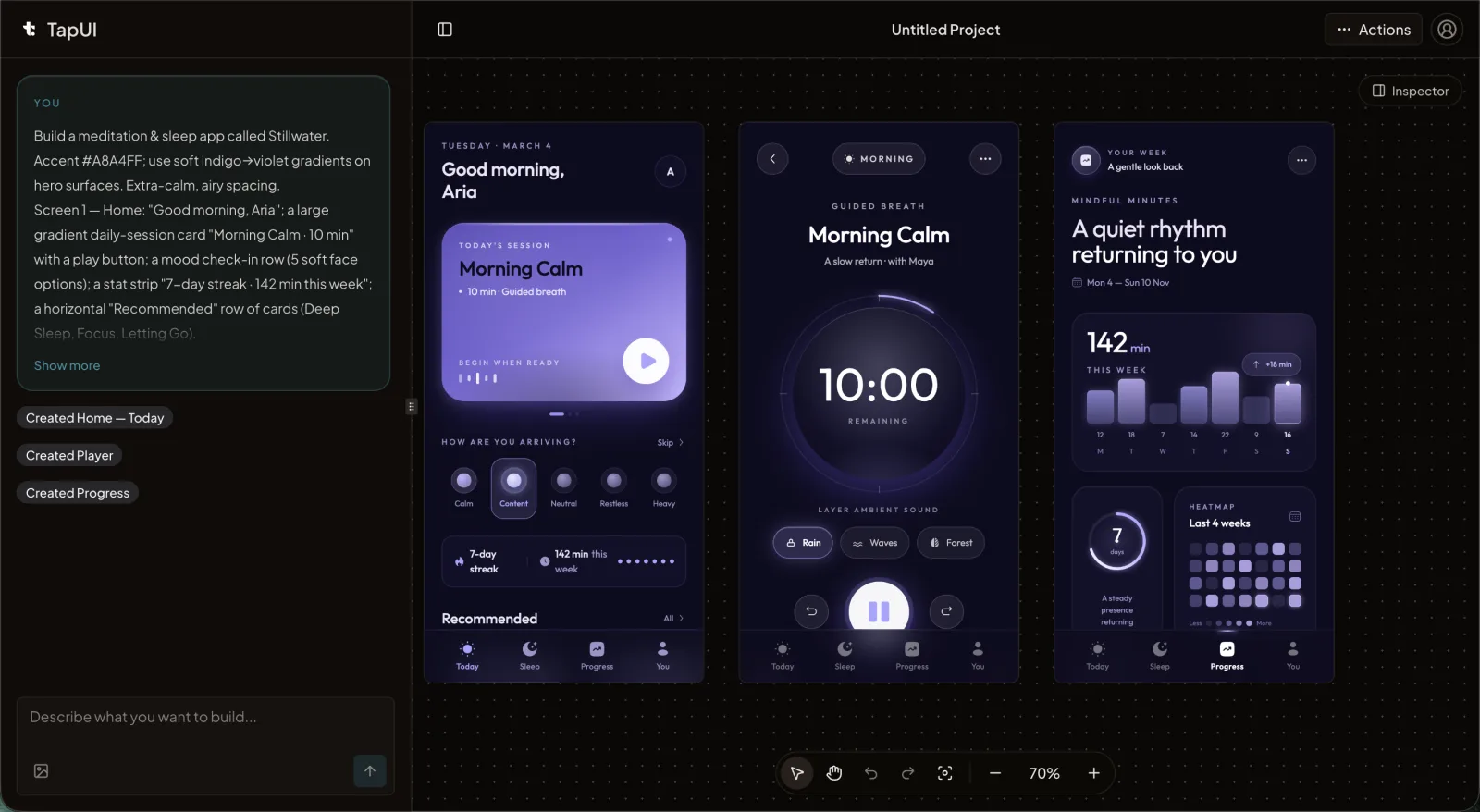 The TapUI editor turns a plain-language prompt into a polished mobile UI screen.
The reason that focus matters: most general AI design tools do both web and mobile, and "both" usually means mobile gets the leftovers. When a tool is built around the desktop canvas, phone output tends to feel like an afterthought — odd proportions, web-ish navigation, spacing that looks fine at 1440px and cramped at 390px. By constraining the problem to mobile, TapUI can lean on the patterns that actually repeat in apps: tab bars, list-detail flows, onboarding sequences, settings screens.
For a non-designer, the practical upside is that you describe the screen — "a fitness home screen with today's workout, a start button, and a weekly progress chart" — and you get something to react to. Reacting is much easier than starting from a blank canvas, and that's most of the value here.
Once you have a screen, you can refine it conversationally and hand the result to your developers as the visual reference for the build.
Pros
- Mobile-specific output that respects phone conventions
- Fast first drafts you can react to, no design skills needed
- Conversational refinement; designs and project history you can export and hand off
Cons
- Mobile only — the wrong tool for marketing sites or desktop web apps
- Trades pixel-level control for speed (the wrong trade for working designers)
Pricing: there's a free tier to try it. Paid plans are Starter at $20/mo ($17/mo billed yearly — 100 screen generations/mo, project history and exports, email support) and Pro at $40/mo ($27/mo billed yearly — 650 generations/mo, everything in Starter plus priority support).
Google Stitch — the strongest free option, with caveats
Best for: fast, free, high-fidelity concepts when you can live with regenerate-don't-edit and the monthly cap.
Google Stitch is the most generous free option in this category — zero cost, fast turnaround, and high-fidelity output — but it comes with real trade-offs you should know upfront. It runs in Google Labs and is powered by Gemini. If you used Galileo AI in the past, note that Galileo is gone — Google acquired it in 2025 and folded it into Stitch. Old Galileo conversations are import-only and read-only; you can't continue them.
The March 2026 update added multi-screen generation — up to five interconnected screens — plus an infinite canvas, voice input, and interactive prototyping. It can export to Figma and to code in several formats, including Tailwind and SwiftUI. For a non-designer who wants to spin up a concept at zero cost, it's the most generous starting point on this list.
Pros
- Free, fast, and high fidelity
- Multi-screen generation, infinite canvas, voice input
- Exports to Figma and to code (Tailwind, SwiftUI)
Cons
- Editing is weak — you often regenerate instead of nudging
- No design-system enforcement, so multi-screen flows can drift
- Monthly generation cap with no paid tier to buy more
- Lives in Google Labs, which has a history of shutting experiments down
For a throwaway concept that's fine; for something you're betting a quarter on, factor in the uncertainty.
Uizard — purpose-built for non-designers
Best for: non-designers who want full flows from text and like the sketch- or screenshot-to-design workflow.
Uizard is one of the few tools explicitly designed for founders and PMs rather than designers, and it shows in what it prioritizes. Acquired by Miro in 2024, its Autodesigner feature turns a single prompt into a full multi-screen flow, and it's strong at exactly that. It also has a neat trick: scan a hand-drawn sketch or a screenshot and it'll turn that into an editable design. There's a Figma plugin and real-time collaboration.
Pros
- Built explicitly for non-designers
- Autodesigner produces full flows from one prompt
- Sketch- and screenshot-to-design; Figma plugin; collaboration
Cons
- Free tier is very limited — a small handful of AI generations per month
- Output fidelity is a notch below Stitch for pixel-perfect polish
- Covers both web and mobile rather than specializing
Paid Pro lands around the low-double-digits per month billed annually.
Visily — best free-tier value and template library
Best for: non-designers who want the most generous free starting point and a deep template head start.
Visily offers the most generous free tier on this list and backs it up with a deep template library — well over a thousand — making it a low-risk place to start. It's built openly for non-designers, with text-to-UI, screenshot-to-design, sketch input, mobile and web component libraries, diagramming, prototyping, and real-time collaboration all included.
Pros
- Most generous free tier on this list
- Deep template library plus mobile and web component sets
- Multiple input modes: text, screenshot, sketch
Cons
- Runs on AI credits that can drain faster than you'd like
- Less well-known than Uizard
- Output polish sits below Stitch's
Paid Pro is roughly comparable to Uizard's, billed annually.
Tools that look similar but solve a different problem
A couple of names come up in this category that aren't really competitors once you look closely:
- Locofy turns an existing Figma or Penpot design into frontend code. That's powerful — it's used by large enterprises — but it requires you to already have a design file. If you're a non-designer without one, it has nothing to start from. It's a handoff tool, not a mockup generator.
- Relume generates sitemaps, wireframes, and design systems, but it's aimed at web and marketing sites (very Webflow-centric) and priced for agencies. Wrong shape for mobile app UI.
- Mockplus is a traditional drag-and-drop prototyping tool. Capable, but it isn't built around the text-to-UI generation that defines this category.
Worth knowing they exist, so you don't burn an afternoon on a tool that was never going to fit.
How to actually choose
Three questions cut through the feature checklists:
- Web or mobile? If you're building a phone app, weight tools that specialize in or genuinely respect mobile conventions. If it's a website, the web-first tools pull ahead and TapUI is the wrong pick.
- How much will you iterate? If you expect to tweak heavily, a regenerate-only tool like Stitch will wear thin — favor something with real editing. If you mostly need a strong first draft to react to, generation speed matters more than editing depth.
- Free forever, or willing to pay? Stitch is the only genuinely free-with-no-tier option, but it's capped and experimental. Everyone else gives you a free taste and expects you to upgrade.
For most non-designers building a mobile app, the honest sequence is: try the free tier of whichever tool fits your platform, generate a real screen from a real description, and see whether the output is something you'd actually put in front of someone. That five-minute test tells you more than any comparison table.
Where each tool wins
- Building a mobile app and need polished screens from a text description? → TapUI — the only tool here built exclusively for mobile UI, with conversational refinement and developer handoff built in.
- Need it free with zero cost, and can live with caps? → Google Stitch.
- Need full multi-screen flows or sketch-to-design? → Uizard.
- Need the most generous free tier and a big template library? → Visily.
- Already have a Figma file and need code? → Locofy (a handoff tool, not a mockup generator).
FAQ
Do I need design experience to use these tools?
No — that's the entire point of the category. The AI makes the layout, typography, and color decisions for you. You describe what the screen is for and react to what comes back. TapUI, Uizard, and Visily are all built with non-designers in mind.
Which tool is completely free?
Google Stitch is free with no paid tier, though it caps your monthly generations. TapUI, Uizard, and Visily all offer a free tier to start, then paid plans for heavier use.
Can I export the generated design for my developers?
Yes, but it depends on the tool. TapUI lets you export your project history and screens for handoff to developers. Some tools offer code export in various formats (Stitch exports to Tailwind and SwiftUI), but the main use case is giving developers a visual reference for the build.
Can I generate multiple connected screens at once?
Yes, several tools support multi-screen flows. Stitch generates up to five interconnected screens, Uizard's Autodesigner produces full flows from one prompt, and TapUI is built around generating individual mobile screens you can chain into a flow.
Which tool is best for a mobile app?
TapUI is purpose-built for mobile app screens and respects phone conventions (tab bars, list-detail flows, settings screens). For web apps or sites, use Stitch, Visily, or Uizard instead — TapUI is mobile-only.
Can I edit designs after they're generated, or do I have to regenerate?
Tools vary here. TapUI supports conversational refinement within a project. Google Stitch typically regenerates rather than edits fine details. Uizard and Visily allow more hands-on editing once generated.
If you're building a mobile app and want to see what a described screen actually looks like, try TapUI for free. And if your project is web-first or you want a zero-cost starting point, one of the alternatives above will serve you better — pick the one that matches what you're building.