The Best AI UI Generators for Mobile App Design in 2026
A practitioner's guide to AI UI generators for mobile apps, comparing TapUI, Google Stitch, Uizard, v0, and more on what each does well.
TL;DR: The best AI UI generator depends on where you start. For generating mobile app screens from a text description, TapUI is the most mobile-native pick with a generous free tier; Google Stitch wins on free, multimodal input; v0 is best if you write React; Uizard suits sketch-thinkers. If you already have Figma designs to turn into code, you want a design-to-code converter like Locofy or Builder.io, which are a different category entirely.
Type "a meditation app with a streak tracker and a calm onboarding flow" into a prompt box, and a few seconds later you have a stack of mobile screens you can actually react to. That is the promise of AI UI generators, and in the last two years the category has gone from a curiosity to something founders and product teams genuinely lean on.
The catch is that "AI UI generator" has quietly become two different product categories wearing the same label. Knowing which one you actually need will save you more time than any feature comparison.
At a glance: AI UI generators compared
| Tool | Category | Best for | Key strength | Mobile-native | Code export |
|---|---|---|---|---|---|
| TapUI | Text-to-UI | Mobile screens from a sentence | Opinionated mobile-only output, generous free tier | ✅ | ❌ |
| Google Stitch | Text-to-UI | Free, multimodal starting point | Image/voice input, Figma export, Google-backed | ⚠️ | ✅ |
| Uizard | Text-to-UI | Sketch-to-mockup, Miro teams | Hand-drawn sketch conversion | ⚠️ | ⚠️ |
| v0 by Vercel | Text-to-UI | React developers building web | Production-ready React/Tailwind code | ❌ | ✅ |
| Locofy | Design-to-code | Enterprise Figma handoff | Multi-framework code from designs | ⚠️ | ✅ |
| Builder.io | Design-to-code | Teams with design systems + CMS | Design-system-aware Figma-to-code | ⚠️ | ✅ |
Mobile-native = how tuned the output is to iOS/Android conventions. ⚠️ = partial or web-first.
Two categories that get lumped together
The first group is text-to-UI generators: you describe an app in words, and the tool designs the screens. Google Stitch, Uizard, v0, and TapUI live here.
The second group is design-to-code converters: you bring an existing Figma file, and the tool turns it into frontend code. Locofy and Builder.io live here. They are excellent at what they do, but they cannot help you if you are staring at a blank canvas with nothing to convert yet.
If you do not have designs but want them, you want the first group. If you already have polished Figma files and want them in code, you want the second. Most of the "best AI UI generator" lists online blur these together and end up comparing tools that do not compete with each other. I'll keep them separate.
I work at TapUI, so treat this as informed but interested. I have tried to be honest about where other tools are genuinely better, because for a lot of readers they will be.
Text-to-UI generators
TapUI
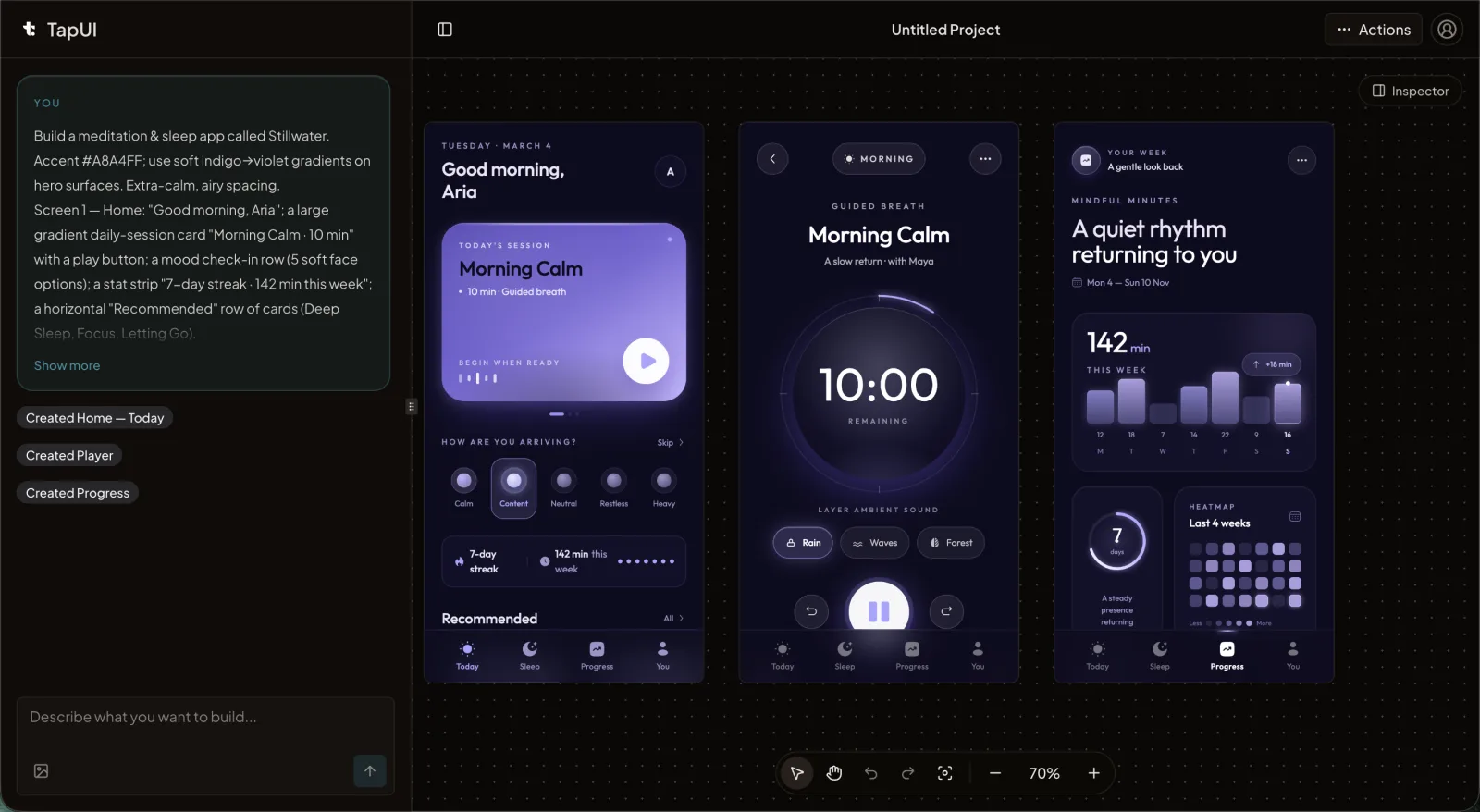 The TapUI editor turning a plain-text app description into polished mobile screens.
TapUI is built narrowly for one job: generating mobile app UI screens from a plain-text description. You write what you want, and it produces polished iOS and Android-style screens that you can iterate on. The audience is founders, product managers, and designers who need working app UI quickly without grinding through manual design work.
The deliberate narrowness is the point. Because it only does mobile, it is opinionated about mobile patterns rather than treating phone screens as a shrunken website. The free tier is also unusually generous for this space, with no watermarks on exports, which matters if you are validating an idea before you are ready to pay for anything.
On pricing, there is a free plan, plus Starter at $20/mo ($17/mo billed yearly, 100 screen generations per month, project history and exports, email support) and Pro at $40/mo ($27/mo billed yearly, 650 generations per month, everything in Starter plus priority support).
Best for: founders and product teams who need mobile app screens fast and do not want to learn a design tool to get them.
Pros
- Mobile-only focus means output follows native iOS/Android patterns
- Generous free tier with no export watermarks
- Designer-friendly; no coding required
Cons
- Mobile-only, so no desktop or web app design
- Does not generate platform code; designs are meant to be handed to your developers to build. (TapUI offers project history and design exports, not native code generation.)
Google Stitch
Stitch is the rebranded successor to Galileo AI, which Google acquired in 2025 and relaunched the same day under Google Labs. It is powered by Gemini and accepts text, image, sketch, or voice prompts, then produces UI designs and frontend code, with Figma-compatible export.
Two things make Stitch hard to argue with. It is free while in beta, and it carries Google's brand and infrastructure. The multimodal input is also a real advantage. If you have a rough sketch or a screenshot of an app you like, Stitch can take that directly rather than making you translate it into words.
Best for: anyone who wants a free, Google-backed starting point and values multimodal input over mobile-native polish.
Pros
- Free while in beta, backed by Google
- Multimodal: text, image, sketch, and voice input
- Exports to Figma and produces frontend code
Cons
- Output skews toward Material Design and a web-first aesthetic, less tuned to native iOS/Android
- Generation consistency can vary
- Free-tier limits during beta are not clearly published
Uizard (now part of Miro)
Uizard, acquired by Miro in 2024, turns text prompts or hand-drawn sketches into multi-screen wireframes and clickable prototypes. Its sketch-to-mockup conversion is its standout feature. Draw something on paper, photograph it, and watch it become an editable mockup. For non-designers, that is a satisfying on-ramp, and the Miro integration helps teams that already live in that ecosystem.
Best for: non-designers who think in sketches and teams already using Miro.
Pros
- Sketch-to-mockup conversion is genuinely useful for non-designers
- Tight integration with Miro
- Produces multi-screen wireframes and clickable prototypes
Cons
- Tight free tier: few AI generations per month on an older engine, watermarked exports
- The newer Autodesigner engine and a workable quota sit behind paid plans
- More focused on mockups than production-ready output, and not mobile-specialized
v0 by Vercel
v0 is the developer's pick, and it is a bit of an outlier on this list. It generates production-ready React, shadcn/ui, and Tailwind CSS code from a prompt, and recent updates pushed it toward full-stack work with database connectivity and GitHub import. Its pricing is token-based rather than a fixed number of generations, with a free tier and paid plans above it.
The code quality is the reason developers like it. v0 produces clean, modern React you can drop into a project. But that is also its boundary: it outputs web UI, not native mobile, and it is built for people comfortable with code.
Best for: React developers building web interfaces.
Pros
- Clean, production-ready React/shadcn/Tailwind output
- Full-stack capable with database connectivity and GitHub import
- In a different league if your output is a React or Next.js web app
Cons
- Outputs web UI, not native mobile
- Built for people comfortable with code, not designers
- Token credits can disappear quickly on complex prompts
Design-to-code converters
These need an existing design as input. They are not competitors to text-to-UI tools, but they often show up in the same searches, so it is worth knowing what they are.
Locofy
Best for: serious design-to-code handoff at enterprise scale.
Locofy converts existing Figma, Penpot, or Adobe XD designs into production frontend code across many frameworks, and counts large enterprises among its customers. The trade-offs are that it requires an existing design to start from, it is priced for teams rather than individuals, and it is not especially beginner-friendly.
Builder.io
Best for: teams with established Figma workflows that also need content infrastructure.
Builder.io does Figma-to-code through its Visual Copilot and Fusion features, with the notable strength of understanding your existing design system and components. It is also a headless CMS with A/B testing, which tells you something about who it is for: teams with established Figma workflows and a need for content infrastructure, not someone trying to generate a first draft from a sentence.
If you already have designs and a developer-heavy team, these are worth a look. If you are starting from a blank page, they cannot help you yet.
A note on Figma's own AI and mobile specialists
Figma has added native AI features such as First Draft, which generate starting points inside files you are already working in. The context awareness is real: it knows your design system. The catch is that it requires a Figma subscription and the AI feels additive to an existing workflow rather than a standalone generator.
There are also smaller mobile-first specialists like Sleek that target iOS and Android output directly. Sleek's public documentation is thinner than the larger players, so I would verify its exact feature set directly before committing rather than trusting any secondhand summary, including this one.
So which one should you pick?
There is no universal winner, and any list that crowns one is selling you something. Route by where you are starting from:
- Starting from nothing and building mobile? → TapUI if you want mobile-native screens and a generous free tier; Google Stitch if free and multimodal input matter more than native polish.
- You think in sketches? → Uizard.
- You write React and ship web apps? → v0.
- You already have Figma designs to convert? → Locofy or Builder.io, depending on whether you want raw code or design-system awareness.
- Your team lives in Figma already? → Try Figma's built-in AI before adding another tool.
The category is moving fast, and the specific limits and prices above will drift. The durable advice is simpler: match the tool to where you are starting from. A generator that designs from text and a converter that turns designs into code are answering different questions, and picking the wrong category is the most common, most expensive mistake people make here.
FAQ
Can an AI UI generator replace a designer?
No, and the better tools do not pretend otherwise. AI is good at producing a fast first draft and keeping things consistent. Human judgment still does the work that matters most: brand interpretation, user empathy, and deciding which of the AI's options is actually right. The most effective teams use these tools to skip the blank-page problem, not to skip designers.
Are AI-generated designs production-ready?
Treat the output as a strong starting point, not a finished product. Whichever tool you use, review accessibility, check that it matches your brand, and test on real devices before anything reaches users.
What is the difference between a text-to-UI tool and a design-to-code tool?
A text-to-UI tool (TapUI, Google Stitch, Uizard, v0) creates designs from a description. A design-to-code tool (Locofy, Builder.io) needs an existing design and turns it into code. If you have nothing to convert yet, you want the first kind.
Which AI generator is best for mobile apps?
For starting from text, TapUI, Google Stitch, and the smaller specialist Sleek are the most directly mobile-focused options. Tools like v0, Locofy, and Builder.io lean toward web and developer workflows, even when they technically support mobile output.
Does TapUI export native code?
No. TapUI generates polished mobile UI designs you hand to your developers to build, and it offers project history and design exports. It does not generate native platform code such as React Native, Swift, or Flutter.
How much does TapUI cost?
TapUI offers a free tier with no export watermarks, plus Starter at $20/mo ($17/mo billed yearly, 100 screen generations per month, project history, and email support) and Pro at $40/mo ($27/mo billed yearly, 650 generations per month, and priority support).
Want to try the text-to-UI approach for mobile? Generate your first app screens with TapUI on the free tier, no credit card required.