The Best AI UI Generators for Mobile Apps in 2026
An honest look at the best AI UI generators for mobile apps in 2026, including TapUI, Google Stitch, Uizard, Visily, and Sleek.
TL;DR: There's no single best AI UI generator for mobile apps — the right pick depends on your starting point. Use Google Stitch for free, fast concepting, Uizard if you work from sketches, Visily for the widest inputs and team collaboration, and TapUI or Sleek when you want screens that genuinely feel like native mobile apps. If you actually want an installable app rather than screens for handoff, look at app builders like a0.dev or Rork instead.
Type "habit tracker with a weekly streak view" into one of these tools and you get back a set of mobile screens in under a minute. That's the pitch, and for early-stage product work it mostly holds up. Where the tools diverge is everything that happens after that first generation: how much you can edit, whether the output actually looks like a native iOS or Android app, and what you can hand to a developer when you're done.
I've spent enough time inside these tools to have opinions, and the honest summary is that there's no single winner. The right pick depends on whether you're a non-designer sketching on a napkin, a PM who needs something presentable by Friday, or a designer who cares about brand differentiation. This piece walks through the tools I'd actually recommend in 2026 and where each one falls down.
A quick framing point first, because it saves a lot of confusion: there's a real split in this category between UI design tools that generate screens for handoff (TapUI, Google Stitch, Uizard, Visily, Sleek) and app builders that spit out an installable app (a0.dev, Rork, FlutterFlow). This article is about the first group. If you want a working app in the store, jump to the app-builder note near the end.
A quick comparison
| Tool | Best for | Key strength | Pricing | Notes |
|---|---|---|---|---|
| TapUI | Polished mobile screens from a text description | Native-feeling iOS/Android output, fast | Free tier; Starter $20/mo, Pro $40/mo | ⚠️ Newer and narrower than the generalists; no platform code export |
| Google Stitch | Free, fast text-to-UI concepting | Generous free generation, Gemini-powered | ✅ Free (no paid tier announced) | ⚠️ Output skews Material/generic; Google Labs experiment |
| Uizard | Non-designers working from sketches | Sketch-to-design, friendly Autodesigner | Free + Pro (~$12/mo annual) | ⚠️ Best AI features gated behind Pro |
| Visily | Teams needing the widest input options | Text/screenshot/sketch input, collaboration | Free + Pro (~$14/editor/mo) | ⚠️ Free tier blocks Figma/code export; not mobile-first |
| Sleek | Mobile-first iOS/Android screens | Specialized mobile output, Figma/code export | Free + paid tiers | ⚠️ Newer tool; verify details before committing |
Prices and limits move around in this category, so treat the table as a starting point and confirm on each vendor's site before you commit budget.
TapUI
Best for: turning a written app idea into polished mobile screens, fast — without opening a design tool.
TapUI is the strongest choice when you want native-feeling mobile screens from a plain-text description, fast. It optimizes for getting non-designers and time-strapped teams — founders, PMs, designers who want a head start — to a presentable set of screens without pushing rectangles around in a design tool.
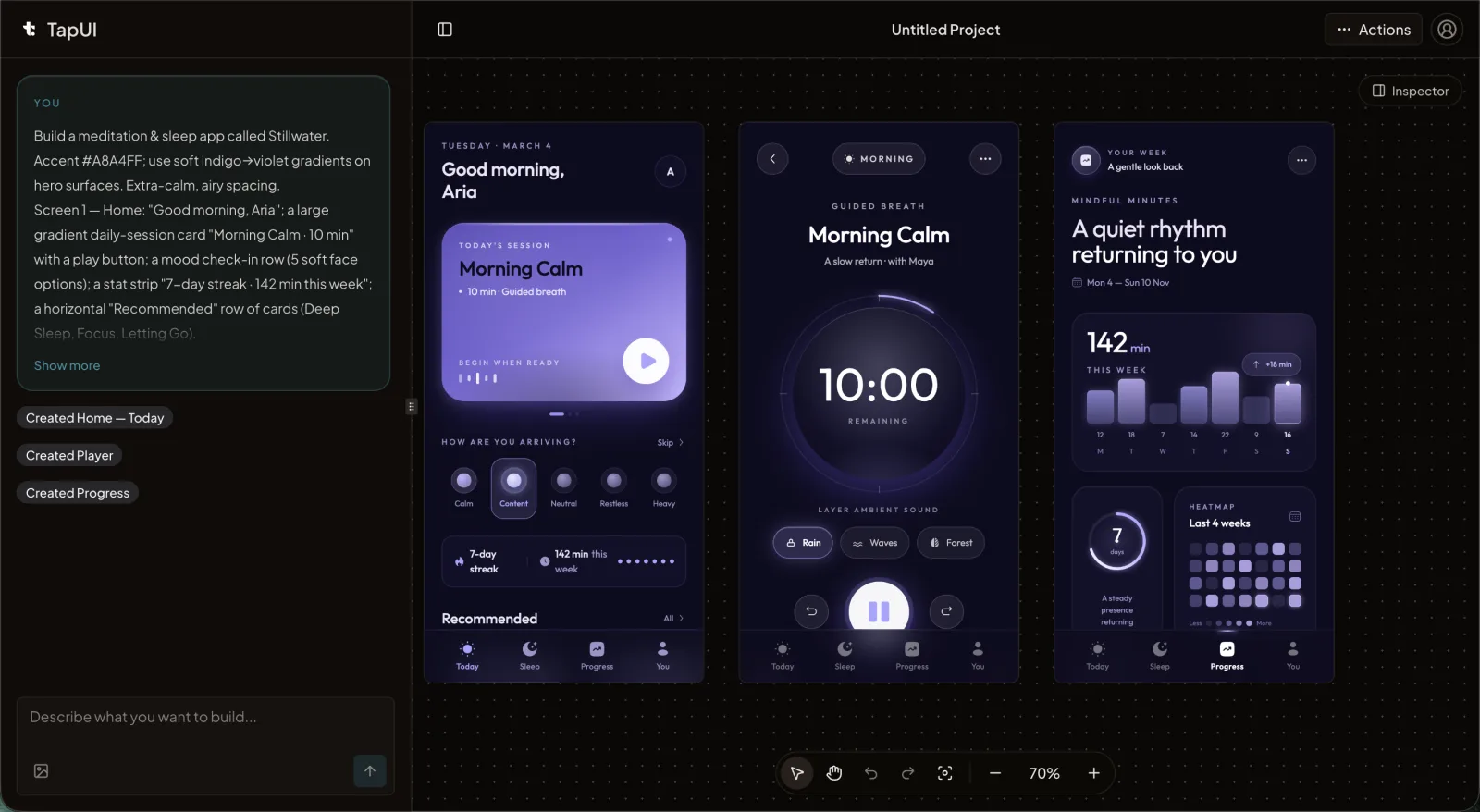 The TapUI editor turns a plain-text app description into polished mobile screens you can iterate on.
In practice that's the appeal: you describe the screen, you get something that looks intentional rather than wireframe-gray, and you iterate from there. The output is meant to be designs you can hand to your developers, not a static mood board you abandon.
Pros:
- Strong, native-feeling mobile output from a simple text prompt
- Built specifically for mobile screens, not web-first layouts
- Project history and exports of your designs, plus a free tier to try it
Cons:
- More focused and newer than the broad platforms
- No platform code export — you hand off designs/screens to developers, not React Native, Swift, or Flutter code
- If your workflow lives in Figma or you need sketch digitization, the generalists may fit better
Pricing. A free tier to try it, then Starter at $20/mo ($17/mo billed yearly: 100 screen generations/mo, project history and exports, email support) and Pro at $40/mo ($27/mo billed yearly: 650 generations/mo, everything in Starter plus priority support). Start on the free tier and upgrade only once you've confirmed the output works for your project.
Google Stitch
Best for: free, fast concepting when you just need an idea on screen.
Google Stitch is the best free option in this category — and for speed-to-concept, it's genuinely good. It came out of Google's acquisition of Galileo AI in 2025, relaunched under Google Labs and powered by Gemini. (If you used Galileo, that's where it went — it no longer exists as a standalone product.) The March 2026 "Stitch 2.0" update added an infinite canvas for multi-screen work, theming, interactive prototyping, and even voice commands.
You can throw text, an image, or an annotated screenshot at it and get screens back fast, and the free generation allowance is generous compared to anything you'd pay for elsewhere.
Pros:
- Free, with a generous generation allowance
- Multiple input types (text, image, annotated screenshot)
- Backed by Gemini, with infinite-canvas and prototyping features
Cons:
- Aesthetic leans Material Design and generic; harder for brand differentiation
- It's a Google Labs experiment with no committed pricing or roadmap
- Nudges you toward the Firebase/Google stack for handoff
For throwaway concepting that's fine. For a workflow your team depends on for months, the uncertainty around a Labs project is a real cost.
Pricing. Free, with a monthly generation cap. No paid tier announced as of early 2026.
Uizard
Best for: non-designers who think in sketches.
Uizard is the friendliest on-ramp for non-designers — its standout trick is sketch-to-design: draw a rough layout on paper, photograph it, and Uizard turns it into an editable wireframe. Now part of Miro (after the 2024 acquisition), its Autodesigner feature takes a text prompt and produces multi-screen flows with navigation already wired up. Drop in a screenshot and it'll convert that into something editable too.
Pros:
- Best-in-class sketch-to-design for non-designers
- Autodesigner builds multi-screen flows with navigation wired up
- Excellent for rapid prototyping and getting ideas out of your head
Cons:
- The current Autodesigner (2.0) sits behind Pro; the free tier only gives you 1.5
- Less mobile-specialized than tools built specifically for app screens
- Not where I'd build a production-grade design system
Pricing. Free plan (limited to the older Autodesigner); Pro around $12/month billed annually, which unlocks the current AI features.
Visily
Best for: cross-functional teams that need the widest range of inputs.
Visily accepts more kinds of input than anything else here — text, screenshot, hand-drawn sketch — which makes it the natural fit for teams of PMs and founders who aren't designers. It also ships with a large library of pre-built UI templates and real-time collaboration.
Pros:
- Widest input options: text, screenshot, and sketch
- Large template library and real-time collaboration
- Strong fit for cross-functional, non-designer teams
Cons:
- Free tier is heavily restricted (no Figma or code export, only a couple of boards)
- A general web-and-mobile tool, not mobile-first
- Output isn't as tuned to native app patterns as a specialized tool's
Pricing. Free forever with limited AI credits and no export; Pro around $14/editor/month unlocks more credits, unlimited boards, and Figma/code export.
Sleek
Best for: mobile-only work where iOS/Android fidelity matters.
Sleek is the most directly comparable to TapUI in intent, and if mobile is your whole focus it belongs on your shortlist. It specializes in mobile, generating iOS and Android screens from text prompts, and offers Figma and code export paths.
Pros:
- Mobile-first, generating iOS and Android screens from text
- Offers Figma and code export paths
- Directly comparable to TapUI in focus
Cons:
- A newer entrant with less third-party coverage
- Verify current pricing and feature set before building a workflow around it
Pricing. Free plan plus paid tiers; confirm current numbers at the source.
A note on the "design-to-code" tools
Locofy and Builder.io don't belong in the same bucket as the tools above. Both are design-to-code handoff tools: you bring an existing Figma file and they generate frontend code from it. They don't generate UI from a text description, and they're web-framework-focused. Useful tools — just for a different job than the one this article is about.
And if you actually want a working app
If "UI screens for handoff" isn't enough and you want something installable, that's the app-builder category: a0.dev (YC-backed, builds full React Native apps from text with one-click publishing) and Rork (cross-platform builder reaching into native iOS and Android) are the names to look at. They blur the line between design and engineering, which is powerful but a different commitment than a design tool. Worth knowing the category exists so you pick the right kind of tool from the start.
How to actually choose
A few things matter more than a feature checklist when you're evaluating any of these for mobile work.
Editability after generation. The first generation is a starting point, never a finished design. If you can't comfortably adjust spacing, swap components, and rework a layout, you'll hit a wall fast. This is where the generous-but-shallow free tools tend to disappoint on real projects.
Native feel. Mobile apps aren't shrunk-down websites. iOS leans on bottom tab bars and swipe gestures; Android uses different navigation conventions and larger touch targets. Tools that treat mobile as a responsive breakpoint produce screens that technically work but feel foreign. The mobile-specialized tools have an edge here.
What you can hand off. Decide up front whether you need exportable design files, exportable code, or just a clean set of screens to share. The tools differ a lot here, and several gate export behind paid plans, so check before you assume.
Total cost at your usage. Free tiers are real, but several of them cap generations or strip out export. Map your actual monthly volume against the limits before deciding anything is "free."
FAQ
What's the best AI UI generator for mobile apps in 2026?
There's no single winner — the right tool depends on your starting point. For polished mobile screens from a written description, TapUI and Sleek are both built for that. For free and fast concepting, Google Stitch is hard to beat — with the caveat that it's a Labs experiment. For non-designers working from sketches, Uizard is the friendliest, and Visily handles the widest range of inputs for teams. Pick based on your starting point and how much editing and handoff you need.
Is Google Stitch better than TapUI?
No — they're good at different things. Stitch wins on price (it's free) and raw speed, but its output skews generic/Material Design and its long-term availability is uncertain as a Google Labs project. TapUI is more focused on producing polished mobile screens from a description. If brand differentiation and a stable tool matter, weigh that against Stitch's price advantage.
Can AI really design good mobile interfaces?
Yes, as a strong starting point — but it still needs human judgment. Modern tools understand common app patterns and accessibility basics well enough to get you most of the way to a presentable screen. You'll still need to match your brand, fix touch-target and layout issues, and make the flow feel right. Treat it as a fast first draft, not a final deliverable.
Do these tools export to code?
It varies, and it's worth checking carefully. Visily and Sleek advertise code export (often on paid plans), and several integrate with Figma for handoff. TapUI does not export platform code — it gives you polished screens and design exports you hand to developers. Don't assume a particular export format — confirm it on the vendor's site for your use case.
What makes mobile design different from web design?
Mobile design is defined by smaller screens, touch instead of a cursor, and platform conventions users already expect. iOS and Android each have their own navigation and interaction norms, and touch targets need to be finger-sized. Generic AI tools that treat mobile as a narrow browser window tend to miss these, which is why mobile-specialized tools exist.
Do I still need design skills to use these tools?
These tools lower the barrier significantly — you can get a presentable screen without knowing a design tool. But understanding basic UX, accessibility, and platform conventions helps you write better prompts and judge the output. The tools make design accessible; they don't replace taste.
Bottom line: which one should you pick?
Route by your situation rather than chasing a single winner:
- Need free and fast concepting? → Google Stitch (just don't build a long-term workflow on a Labs experiment).
- Think in sketches? → Uizard.
- Need the widest input options and team collaboration? → Visily.
- Want screens that feel like native mobile apps? → TapUI or Sleek.
- Wanted a working, installable app all along? → app builders like a0.dev or Rork.
The category moves fast and pricing shifts, so start on a free tier wherever you can and confirm the details before you commit.
Want to try it? Generate your first mobile screens with TapUI for free.