The Best Figma AI Alternatives for Designing App UI Fast
Figma AI is powerful but pricey and not mobile-first. Here are the alternatives worth trying, with honest notes on where each one wins and falls short.
TL;DR: Figma AI is excellent for design teams already living in Figma, but it's a pricey generalist if all you need is mobile app screens fast. For non-designers who want quick multi-screen mobile flows, look at Uizard, Visily, Banani, or TapUI. For the most polished free output, try Google Stitch. For React components instead of design files, use v0 by Vercel.
Figma's AI features are good. They're also bolted onto a tool that got noticeably more expensive in 2025, when the Professional plan jumped by roughly a third and started bundling FigJam and Slides whether you wanted them or not. If your job is mostly designing mobile app screens, you're paying for a lot of surface area you don't use, on a tool that treats mobile UI as one of many things it can do rather than the thing it's built for.
That gap is exactly why the alternatives below exist. None of them is "Figma but cheaper" — they make different trade-offs, and the right pick depends on whether you're a designer who wants control, a founder who wants screens fast, or a developer who wants code out the other end.
A quick orientation before the list. First, TapUI — where I work, so take my framing with the appropriate grain of salt — is built around one job: you describe an app in plain language and it generates polished mobile UI screens. Second, Galileo AI, which used to show up on every list like this, no longer exists as a standalone product. Google acquired it in mid-2025 and folded it entirely into Google Stitch. If someone points you to Galileo, they're pointing you to history.
Related: If you're specifically designing for native, see our guides on the best AI UI generators for mobile apps and how to design app UI with AI.
The alternatives at a glance
Here's how the main options compare before we get into the detail:
| Tool | Best for | Key strength | Mobile-first | Pricing |
|---|---|---|---|---|
| Figma AI | Design teams with a real design system | On-brand output from your own component library | ❌ Generalist | Paid seats + AI credits (rose in 2025) |
| Google Stitch | Most polished free output (with risk) | Refined visual output, generous free beta | ⚠️ Web-leaning | Free beta |
| Uizard | Non-designers needing multi-screen flows | Autodesigner generates flows from a prompt | ✅ Yes | Tight free tier; best engine is paid |
| Visily | PMs on a budget aligning on structure | Generous free tier, 1,500+ templates | ⚠️ Not tuned for mobile | Generous free tier |
| Banani | Seeing a full flow from one prompt | Multi-screen from one prompt, Figma export | ✅ Yes | Free tier available |
| v0 by Vercel | React web developers | Near production-ready React components | ❌ Web only | Free tier + paid plans |
| TapUI | Founders/PMs/designers wanting screens fast | Mobile-first text-to-UI, polished first drafts | ✅ Yes | Free; Starter $20/mo; Pro $40/mo |
First, what's actually wrong with Figma AI?
Nothing, if you're a design team already living in Figma. Its biggest strength is that First Draft and Figma Make pull from your existing component library, so generated screens come out on-brand instead of generic. For an established team with a real design system, that's hard to beat, and no standalone AI tool matches it.
The friction shows up at the edges:
- It's a generalist. Figma designs web, desktop, and mobile. That breadth means mobile UI starts from a blank canvas rather than a mobile-first starting point. Specialists tend to produce more usable first drafts for app screens.
- The output needs work. AI-generated layouts are a starting point, not a finished screen. First Draft in particular leans on your component library and gets shaky with novel or uncommon patterns.
- Code handoff is broad but generic. Dev Mode exports HTML, CSS, Tailwind, SwiftUI, UIKit, Compose, and XML — impressive coverage — but the generated code tends to be light on accessibility and semantic structure, so it's reference material, not something you ship as-is.
- Cost and learning curve. The 2025 price increase stung budget-conscious teams, and AI credits sit on top of the base subscription. For non-designers, the whole environment is a lot to learn just to get a few screens.
So the question isn't "is Figma bad" — it's "am I paying for an industry-standard design platform when I really just need app screens fast?" If yes, keep reading.
Best for: design teams with an established design system who want on-brand output.
Pros: unmatched component-library integration; broad code handoff coverage; deep ecosystem and design-ops tooling.
Cons: generalist rather than mobile-first; output needs cleanup; price rose in 2025 with AI credits on top; steep learning curve for non-designers.
Google Stitch
Best for: the most polished free AI output, if you can tolerate beta uncertainty.
Among free tools, Google Stitch's visual output is the most refined available right now — and the free beta is genuinely generous. Stitch is Google's text/image/sketch/voice-to-UI generator, the home Galileo AI got absorbed into. It runs on Gemini, works on an infinite canvas, and a March 2026 update added multi-screen generation and voice commands.
The catch is structural. Stitch is a Google Labs experiment, and Google has a long, well-documented history of killing experiments. Building a real workflow on something that could vanish is a real risk, and some users have reported design quality slipping after version updates. It also leans web-first; mobile works but isn't the focus.
Pros: most polished free visual output; generous free beta; multi-screen generation and voice commands.
Cons: Google Labs experiment that could be discontinued; quality reportedly varies between versions; web-leaning rather than mobile-first.
Verdict: Try it today, especially at zero cost. Just don't make it load-bearing until Google signals it's here to stay.
Uizard
Best for: non-designers who need multi-screen mobile flows from a prompt.
Uizard is the strongest pick for non-designers who want to go from a text prompt to a full multi-screen mobile app flow. From an independent Copenhagen team, its Autodesigner generates multi-screen mobile app UI from a text prompt, it handles sketch-to-design, and it ships a large template library across mobile, web, and tablet. For early-stage ideation and wireframing, it's quick and approachable.
Two honest caveats. The free tier is tight — a small number of AI generations per month — and the better engine, Autodesigner 2.0, sits behind a paid plan; the free tier only gets the older 1.5 model. Output is wireframe-grade rather than pixel-perfect, so it's better for shaping ideas than for production handoff.
Pros: built for non-designers; multi-screen mobile flows from a prompt; sketch-to-design and a large template library.
Cons: tight free tier; best engine (Autodesigner 2.0) is paid-only; wireframe-grade fidelity, not production-ready.
Verdict: A strong fit for founders and PMs sketching out an app's flow, as long as you expect to refine the fidelity elsewhere.
Visily
Best for: product managers who want a generous free tier and low fidelity that gets ideas across.
Visily is the most budget-friendly option here — unlimited projects on the free tier, plus 1,500+ templates and real-time collaboration. It targets the same non-designer audience as Uizard but is more forgiving on the free side. It turns text, screenshots, or sketches into wireframes and prototypes across mobile, web, and desktop dimensions.
Where it gives ground: output is low-to-mid fidelity, it's less generative than Stitch, and it isn't specifically tuned for mobile-first design. It's a fast way to align a team on structure, not a way to produce finished screens.
Pros: generous free tier with unlimited projects; 1,500+ templates; real-time collaboration; multiple input types.
Cons: low-to-mid fidelity; less generative than Stitch; not tuned for mobile-first design.
Verdict: The better starting point if budget matters and you mainly need to communicate intent, not ship polish.
Banani
Best for: seeing a full app flow — several connected screens — from one prompt.
Banani's core strength is generating multiple connected screens from a single prompt, so you see the whole flow at once rather than building it screen by screen. It's a newer entrant focused on text-to-UI prototypes, with fast iteration and Figma export when you want to move work into a more established tool.
Being new cuts both ways. It's less proven, has limited brand recognition, and a smaller template ecosystem than the incumbents. If that's acceptable, the multi-screen-from-one-prompt approach is genuinely useful for early app concepting.
Pros: full flow from a single prompt; fast iteration; Figma export as an escape hatch.
Cons: newer and less proven; limited brand recognition; smaller template ecosystem.
Verdict: Worth a look for rapid flow exploration, with Figma export as a sensible escape hatch.
v0 by Vercel
Best for: developers who'd rather get React components than design files.
v0 generates near-production-ready React components styled with shadcn/ui from text prompts — the output is closer to shippable code than anything else on this list. If you're building a web app and live in a React codebase, it drops in cleanly with a clean default aesthetic.
But be clear about what it isn't: a visual design tool. There's no native mobile output, and you need React knowledge to use it well. For pure mobile-app design — the actual screens, before code — it's the wrong instrument.
Pros: near production-ready React + shadcn/ui output; drops cleanly into a React codebase; clean default aesthetic.
Cons: not a visual design tool; no native mobile output; requires React knowledge.
Verdict: Excellent for React web developers, off-target for mobile UI design.
Where TapUI fits
I'll keep this honest, because the rest of the piece earns nothing if this part reads like an ad.
TapUI does one thing: you describe an app in plain text and it generates polished mobile app UI screens. It's built for founders, product managers, and designers who want working app UI quickly without doing the manual design work themselves. When the screens are ready, you get designs you can hand to your developers.
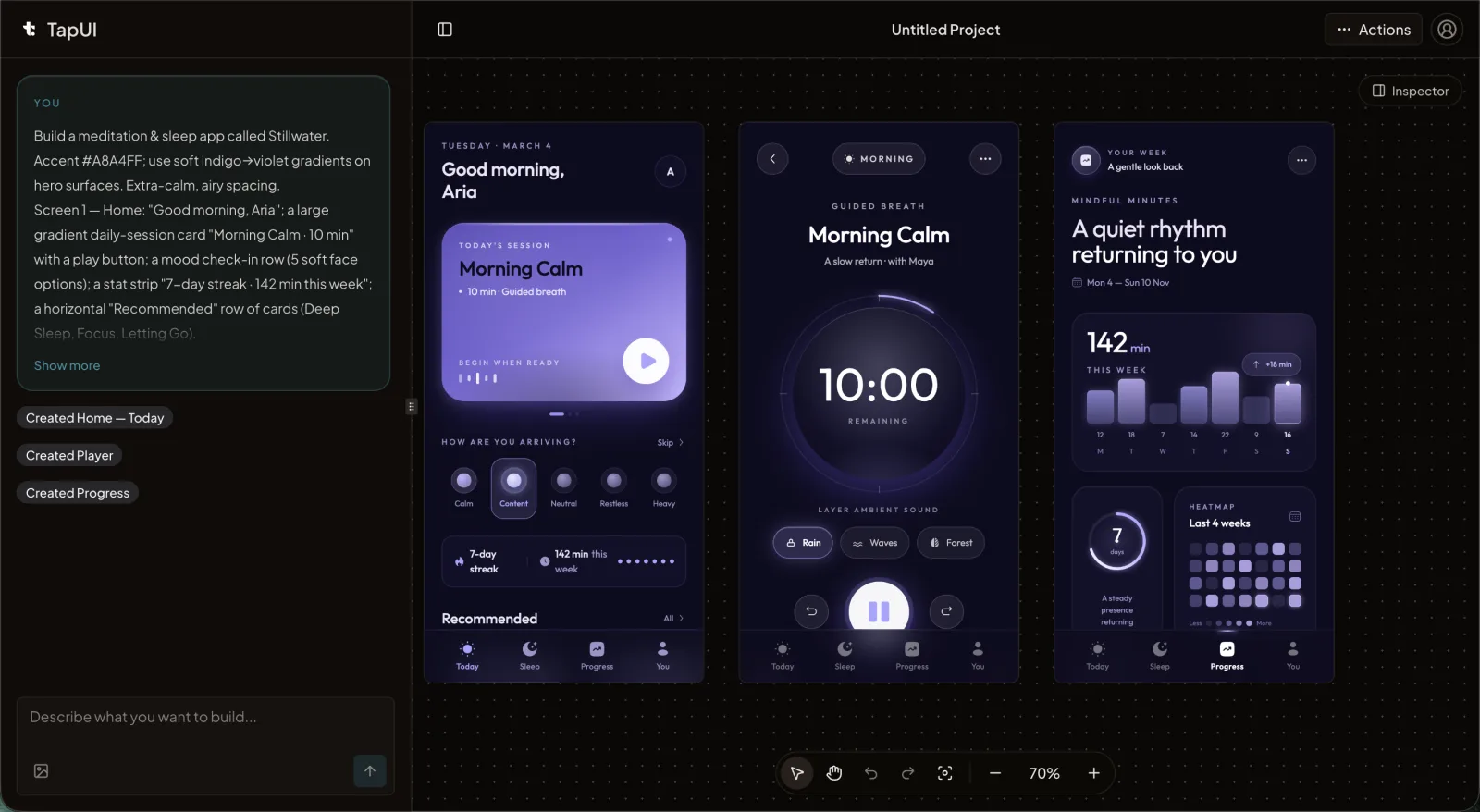 The TapUI editor turns a plain-text app description into polished mobile UI screens.
On pricing, there's a free tier plus two paid plans: Starter at $20/mo ($17/mo billed yearly) with 100 screen generations a month, project history and exports, and email support; and Pro at $40/mo ($27/mo billed yearly) with 650 generations a month, everything in Starter, plus priority support.
Where it doesn't win: it's a focused mobile-UI tool, not a full design platform. It won't replace Figma's deep component-library integration for an established design team, and it won't generate React code the way v0 does. If your work is web-first, or you need a sprawling plugin ecosystem and design-ops tooling, the generalists serve you better.
The case for it is narrow and specific: if "I need good mobile app screens, fast, from a description" is your actual problem, a mobile-first tool will usually get you a more usable first draft than a generalist's blank canvas. That's the whole pitch.
Best for: founders, PMs, and designers who need polished mobile app screens fast from a description.
Pros: mobile-first by design; polished first drafts from plain text; designs you can hand straight to developers; free tier to start.
Cons: focused mobile-UI tool, not a full design platform; no deep component-library integration like Figma; does not generate React or native code.
A quick way to choose
The decision mostly comes down to who you are and what comes out the other end:
| If you are… | And you want… | Look at |
|---|---|---|
| A founder / PM, non-designer | Fast multi-screen mobile flows | Uizard, TapUI, Banani |
| A team on a tight budget | A generous free tier to align on structure | Visily, Google Stitch |
| A designer with a real design system | On-brand output from your components | Figma AI |
| A React web developer | Working components, not design files | v0 by Vercel |
| Anyone | The most polished free output (with risk) | Google Stitch |
So, routing it simply: Need polished mobile screens fast from a description? → TapUI or Uizard. Need the most refined free output and can stomach beta risk? → Google Stitch. Need to align a team on structure cheaply? → Visily. Need to see a whole flow from one prompt? → Banani. Need React components, not design files? → v0. Already deep in a Figma design system? → stick with Figma AI.
Two practical notes. Most of these offer free tiers or trials, so run a real screen from your actual project through two or three before committing — generated output varies enormously by how well a tool's training matches your use case. And nobody says you have to pick one: it's common to ideate flows in one tool and refine in another.
FAQ
Is Galileo AI still available?
No — Galileo AI no longer exists as a standalone product. Google acquired it in mid-2025 and fully absorbed it into Google Stitch. Former Galileo users can import their conversation history into Stitch, but only in a view-only capacity.
Are Figma AI alternatives actually cheaper?
Often, but compare on more than the headline price. Figma's 2025 increase and forced FigJam/Slides bundling pushed costs up for a lot of teams, and AI credits sit on top of the base seat price. Several alternatives here have free tiers — Google Stitch's beta is notably generous, as is Visily's — though the strongest engines (Uizard's Autodesigner 2.0, for instance) tend to be paid.
Which alternative is most mobile-focused?
For mobile-first design, the specialists are Uizard, Banani, and TapUI — Figma AI is deliberately broad and isn't mobile-specific. Google Stitch can produce mobile UI but leans web-first, and v0 outputs React for the web rather than app screens.
Can I use more than one of these tools together?
Yes, and many teams do. A common pattern is generating and exploring flows in one tool, then exporting into a more established environment for refinement. Use each tool for the phase it's best at rather than forcing one to do everything.
Does TapUI export to React Native, Swift, or Flutter?
No. TapUI generates mobile UI designs you can hand to developers, not native platform code. You get polished design screens for any platform, but developers handle the native implementation themselves.
Will AI design tools replace Figma?
Not soon. Figma's ecosystem, enterprise footprint, and design-system integration are deep, and that's not easily displaced. Specialized tools are instead taking specific niches — mobile-first generation, code output, non-designer accessibility — where a generalist platform is overkill.