The Best Free AI UI Generators for Mobile App Screens
A practitioner's look at free AI UI generators for mobile apps, where each one earns its "free" label and where the limits bite.
TL;DR: For maximum free capability with no card required, Google Stitch is the current leader — generous daily credits and broad framework code export, at the cost of generic visuals. Uizard is the best non-developer pick if you value sketch/screenshot input and will pay past its thin free tier. If your output is specifically mobile app screens generated from a text description, that focus is where TapUI fits. Web-app builders should look at v0; Figma-to-code users at Locofy or Anima.
"Free" is the most overloaded word in design software. A tool advertises a free plan, you sign up, and three prompts later you hit a wall, a watermark, or a checkout page. So before recommending anything, I keep one test in mind: can you actually finish a small piece of real work — a handful of mobile screens you'd show a teammate — without paying? Surprisingly few tools pass.
This is a working rundown of the free AI UI generators worth your time if you're trying to get mobile app screens out of a text prompt. I'll be specific about where each one shines and where it falls down, including the tool I work on.
A quick disclosure: I'm on the team at TapUI. I've tried to be honest about where other tools beat us, because a comparison that crowns its own product every time isn't worth reading.
At a glance: free AI UI generators compared
| Tool | Best for | Key strength | Free tier | Mobile screens? |
|---|---|---|---|---|
| Google Stitch | Most free capability | Broad framework code export, large daily credits | ✅ Generous (beta, free) | ✅ |
| Uizard | Non-developers | Sketch- and screenshot-to-design | ⚠️ Trial-grade, branded exports | ✅ |
| Visily | Quick wireframes | Fast text/screenshot to wireframe | ✅ Reportedly generous | ⚠️ Wireframe-grade |
| v0 by Vercel | Web apps | React + Tailwind + shadcn, deploy to Vercel | ⚠️ Credits deplete fast | ❌ |
| Locofy / Anima | Figma-to-code | Convert existing Figma to frontend code | ❌ Limited / needs a design | ❌ Web-oriented |
| Builder.io | Figma-to-code | Design-system-aware Visual Copilot | ⚠️ Needs existing design | ❌ Web-focused |
| TapUI | Mobile screens from a prompt | Mobile-only focus; designs to hand to developers | ✅ Free tier to start | ✅ |
What "free" should actually mean
A free tier earns the label when it lets you reach a finished artifact — generation credits you can spend, an export or handoff that isn't crippled, and output you're allowed to use. Where free plans usually pinch:
- Generation caps. Some are generous enough to forget about; others give you a literal handful of prompts per month.
- Watermarks and branding stamped on anything you export.
- Locked export or handoff — you can look at the design but not get it out in a usable form.
- Older models reserved for the free tier while the good model sits behind the paywall.
None of these are dealbreakers on their own. The question is whether the combination still lets you ship something.
The genuinely free option: Google Stitch
Best for: maximum free capability when you don't mind generic visuals or an experimental product.
Google Stitch is the strongest free option right now — no credit card required, and a daily credit allowance large enough that most people won't touch the ceiling. It came out of Google Labs (it absorbed the team and tech behind Galileo AI, which was shut down as a standalone product) and during its beta it's been completely free.
You describe a screen, or feed it an image, and it generates multi-screen UI plus frontend code. The framework coverage is broad: HTML/CSS, Tailwind, Vue, Angular, Flutter, SwiftUI, with Figma export on top. A more recent update added an infinite canvas, generating several connected screens at once, voice input, and MCP integration so it can plug into tools like Claude Code and Cursor. For a free product, that's a lot.
Pros: broad framework coverage, generous free daily credits, multi-screen generation, image and voice input. Cons: generic visual output, inconsistency across multi-screen flows, no way to buy more credits when capped, and uncertain long-term availability as a Labs experiment.
Use it when: you want free, fast, multi-screen output and you're comfortable refining the visuals yourself, or handing them to a designer to give them personality.
Uizard: closest non-developer alternative, hamstrung free tier
Best for: non-developers who value sketch- and screenshot-to-design input.
Uizard's best feature is its sketch-to-design and screenshot-to-design inputs — photograph a whiteboard or paste an app screenshot and get an editable mockup back. It's an independent company out of Copenhagen, squarely aimed at founders and PMs who want mobile mockups without learning a design tool; its Autodesigner feature turns a prompt into full app UI.
The catch is the free tier, which is hard to recommend for real work. You get a small number of projects and only a few AI generations per month — enough to evaluate the tool, not to build with it. The current Autodesigner model and SVG export sit on the paid plans, and free exports carry Uizard branding. If you like it, you'll be paying fairly quickly.
Pros: approachable for non-designers, strong sketch- and screenshot-to-design inputs, prompt-to-full-app UI. Cons: thin free tier (few projects and generations), best model and SVG export are paid, free exports are branded.
Use it when: you're a non-developer who values the sketch- and screenshot-to-design inputs, and you're willing to upgrade past the trial-grade free plan.
v0, Locofy, Anima, Builder.io: web tools, not mobile UI generators
These come up in "AI UI generator" searches, so they're worth addressing — but for mobile app screens specifically, they're the wrong category.
- v0 by Vercel — Best for: web apps. Skips mockups entirely and goes straight to React + Tailwind + shadcn/ui, deployed to Vercel. Excellent for the web; does not generate native mobile UI, and its free monthly credits deplete fast.
- Locofy and Anima — Best for: turning an existing Figma file into code. These are design-to-code: you need a design first, and the output is web-oriented. Locofy has no meaningful free tier.
- Builder.io — Best for: design-system-aware Figma-to-code. Its Visual Copilot turns Figma designs into production frontend code. Again: web-focused, and it needs an existing design to work from.
If you're building a website or web app, several of these are strong picks. For someone who types "design me a mobile onboarding flow" and wants screens back, they're a detour.
Visily: fast, free, but wireframe-grade
Best for: quick wireframes and early structure.
Visily is the right tool for the napkin-sketch stage of a mobile app — it turns text or screenshots into wireframes and mockups quickly, with Figma export and a reportedly generous free tier. The ceiling is fidelity: it's better at early structure than high-fidelity, ready-to-ship UI or code, so it's less useful when you need polished, developer-ready screens.
Where TapUI fits
Best for: turning a plain-text description into polished mobile app screens you can hand to developers.
TapUI does one thing: it turns a plain-text description of an app into polished mobile UI screens. That focus is the whole pitch — most tools on this list treat mobile as one output among many (web, wireframes, code), and the mobile result reflects that. We only do mobile screens, so the defaults, components, and layouts are tuned for how phone apps actually look and behave.
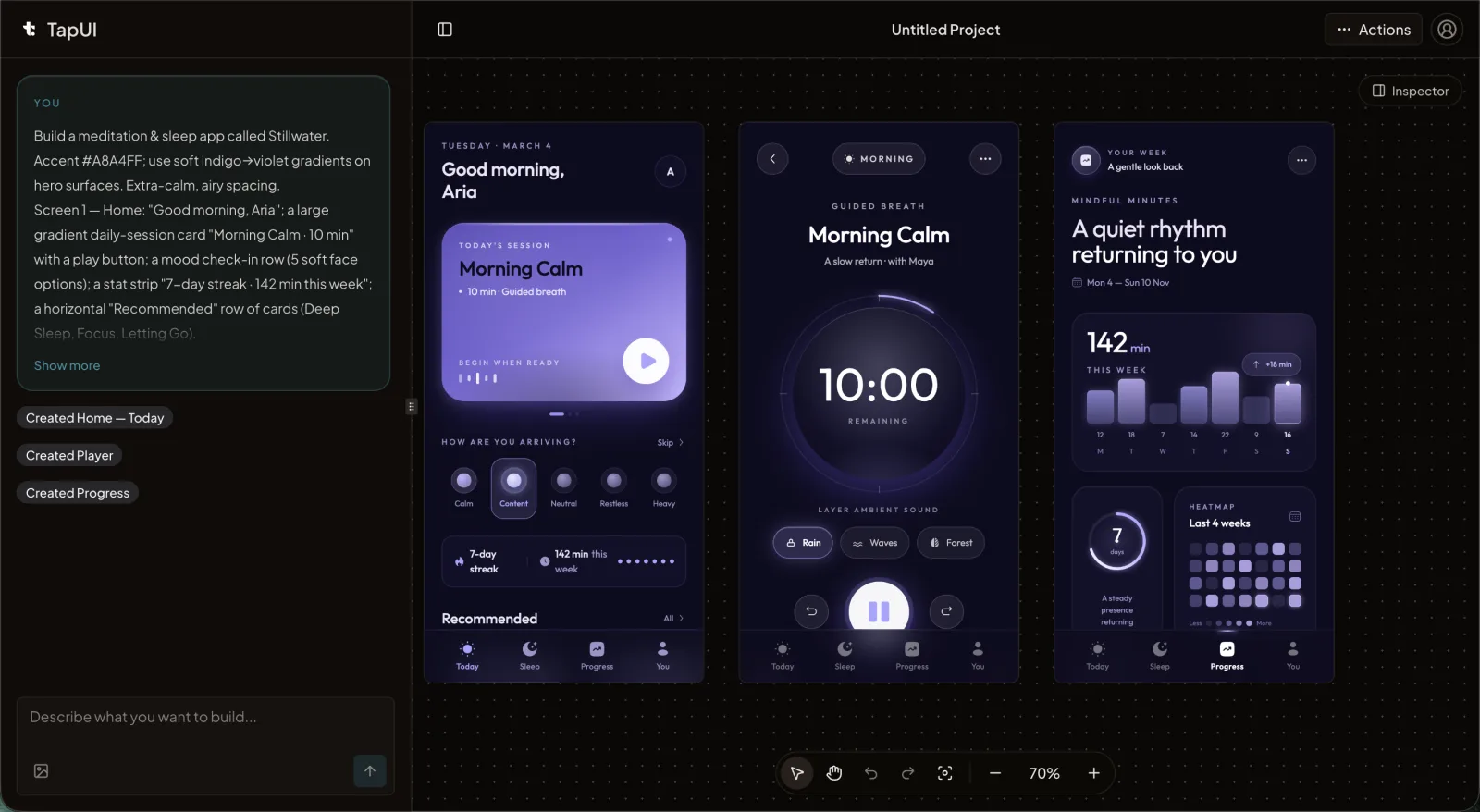 The TapUI editor: describe an app in plain text and get polished mobile screens back.
It's aimed at founders, PMs, and designers who want working app UI fast without doing the manual design labor, and the designs are ones you can hand to your developers to build from. There's a free tier to start with, plus Starter ($20/mo, or $17/mo billed yearly) and Pro ($40/mo, or $27/mo billed yearly) when you outgrow it — Starter covers 100 screen generations a month with project history and exports, and Pro raises that to 650 with priority support.
Pros: mobile-only focus tuned for how phone apps look and behave, fast prompt-to-screen workflow, designs you can hand to developers, real free tier. Cons: no broad framework code export — TapUI produces designs, not platform code; not for web apps; doesn't convert existing Figma files into code.
Honest about the limits: if you need broad framework code export today, Stitch covers more ground. If your project is a web app, v0 is the better tool. And if you want to convert an existing Figma file rather than start from a prompt, that's Locofy or Anima territory, not ours. TapUI is the right call specifically when your output is mobile app screens and you'd rather describe them than draw them.
A quick way to choose
- Want the most free capability and don't mind generic visuals or an experimental product? -> Google Stitch.
- Non-developer who loves sketch/screenshot input and will pay after the trial? -> Uizard.
- Building for the web, not mobile? -> v0 by Vercel.
- Converting existing Figma designs to code? -> Locofy, Anima, or Builder.io.
- Just need quick wireframes? -> Visily.
- Output is mobile app screens, generated from a description? -> TapUI.
Getting more out of any free tier
Whichever tool you land on, a few habits stretch a free plan further:
Batch your prompts. Design a whole flow in one focused session instead of burning credits on one screen at a time across the month. You'll waste fewer generations on near-duplicate variations.
Edit instead of regenerating. AI is great at the first draft. Once you have a screen you like, nudge it by hand rather than rolling the dice on a fresh generation that may drift.
Export or save early. Get your work out of the tool as soon as it's good. Free products change, and a local copy protects you if a plan or a Labs experiment gets reshuffled.
Mix tools by phase. There's no rule that one product has to do everything. Rough the structure in one place, refine in another, generate marketing assets in a third.
So which free AI UI generator is best?
For raw free capability with no card required, Google Stitch is the current high-water mark — as long as you accept generic visuals, daily credit caps, and an experiment that could change. If you're a non-developer who values sketch and screenshot input, Uizard is worth trying despite a thin free tier. And if the thing you're making is specifically a mobile app, with screens you describe and then hand off to build, that narrower focus is where TapUI is meant to earn its place.
Start free, see how far the limits take you, and only pay when a real constraint is genuinely slowing you down.
FAQ
Which free AI UI generator is best for mobile app screens?
For maximum free capability with no credit card required, Google Stitch leads today — though its visuals trend generic. If you want a tool built specifically for mobile screens generated from a text description, TapUI focuses on that and has a free tier to start.
Can these tools export code for mobile platforms like React Native or Swift?
Google Stitch offers broad framework code coverage on its free beta, including Flutter and SwiftUI. TapUI does not export React Native, Swift, Flutter, or any native platform code — it produces polished mobile UI designs you hand to developers to build from.
What does TapUI's free tier include?
TapUI has a free tier with limited generations. Paid plans are Starter at $20/mo (or $17/mo billed yearly) with 100 screen generations per month, project history, and exports; and Pro at $40/mo (or $27/mo billed yearly) with 650 generations per month and priority support.
Why are v0, Locofy, and Anima not suitable for mobile-first design?
These tools are web-oriented. v0 generates React/Tailwind web code, while Locofy and Anima convert existing Figma designs into frontend code. None are built around "describe a mobile app and get phone screens back," so they're a detour if mobile design is your primary goal.
Can I ship a real app using free AI UI generators?
Yes, but fidelity matters. Wireframe tools like Visily are great for early structure but not polished, production-ready UI. For higher-fidelity mobile screens you'll want a tool specifically tuned for app design, and you may still refine the output by hand before handing off to developers.
Do free AI UI generators require a credit card to start?
Most free tiers don't require a card upfront, including Google Stitch and TapUI. However, free tier limits — generation caps, export restrictions, and branded watermarks — are common, so check each tool's specific constraints before committing design work to it.