Google Stitch Alternatives for AI App Design (2026)
Google Stitch is free and capable, but Material Design-heavy. Here are the AI UI tools worth trying when it doesn't fit your workflow.
TL;DR: Google Stitch is a strong, free, Material-Design-heavy AI UI tool — for a lot of Android-flavored work it's genuinely enough. Look elsewhere when its Material bias, browser-only workflow, or Google Labs status gets in your way. The best fits: TapUI for fast, polished mobile screens from plain text, Figma AI if your team already lives in Figma, and v0 by Vercel if you're a React developer who wants code first.
Google Stitch is good. That's the honest starting point most "alternatives" posts skip. It's free, it's backed by Gemini, and it ships a multi-screen canvas, voice control, and code export across several frameworks. If you're designing Android-flavored screens and you don't mind living in a browser tab, you may not need an alternative at all.
But "good for most people" and "good for you" aren't the same thing. Stitch leans hard on Material Design 3 — a strength if you're shipping for Android, a constraint if you want a custom look or a genuinely iOS-native feel. It's a Google Labs experiment, which means it's free today but carries the usual question mark over any Labs product's lifespan. And it's browser-only, with no mobile-first workflow and no path to installable app assets like icons or store screenshots.
So the real question isn't "what beats Stitch." It's "where does Stitch stop fitting, and what picks up from there." This guide walks through the tools worth considering when that happens, including our own, TapUI, with an honest read on where each one wins and loses.
At a glance: Stitch vs. the alternatives
| Tool | Best for | Key strength | Native mobile output | Code export | Pricing |
|---|---|---|---|---|---|
| Google Stitch | Android/Material screens in the browser | Broad framework code export | ⚠️ Material-leaning frames | ✅ Multi-framework (incl. Flutter, SwiftUI) | Free (Labs) |
| TapUI | Polished mobile UI from plain text | Fastest text-to-screens flow | ✅ Mobile-first by design | ❌ No platform code export | Free tier; Starter $20/mo; Pro $40/mo |
| Figma AI | Teams already in Figma | Zero switching cost, mature handoff | ⚠️ Web-design-centric | ⚠️ CSS/React snippets | Part of Figma plans |
| v0 by Vercel | React developers who want code first | Production-ready React/Tailwind | ❌ Web only | ✅ React components | Free tier; paid plans |
Honest placement: no single tool wins every column — match the tool to the constraint that matters most to you.
Related reading: Best Figma AI alternatives, best Sleek.design alternatives, and the best AI UI generators for mobile apps.
First, an honest look at what Stitch does well
Stitch is a strong product, and switching away means giving up real capabilities. Here's what you'd be leaving behind:
- It's free, with generous limits. As a Labs experiment it costs nothing beyond a Google account, and the monthly generation allowance is roomy for most individual designers.
- The code export is real. Stitch outputs to multiple frameworks including HTML/CSS, Tailwind, Vue, Angular, Flutter, and SwiftUI, plus a Figma handoff. Flutter and SwiftUI mean you can get actual mobile code out of it, which most AI UI tools can't claim.
- Material Design 3 is built in. For Android-style screens, that's a head start, not a limitation.
- It's improving fast. Voice control, an AI agent that reasons across your whole project, real-time multiplayer, a portable design format. The feature velocity has been high.
If those line up with your work, stay where you are. The tools below matter when they don't.
When it makes sense to look elsewhere
A few specific situations push people off Stitch:
You want a non-Material look. Stitch's Material Design bias is bone-deep. You can nudge it, but if you're chasing a custom design language or a polished iOS feel, you'll spend energy fighting the defaults.
You need mobile-first output, not just web frames. Stitch is a browser tool that happens to design screens. It doesn't have a mobile-first workflow, and it doesn't generate the installable assets a real app launch needs.
You're nervous about Labs. Google has a track record of retiring experiments. Paid plans are rumored for when Stitch exits Labs, but nothing is confirmed. If you're building a workflow you need to count on for years, that uncertainty is a legitimate factor.
You hit the free ceiling. The free limits are generous until they aren't. High-volume teams can run into them.
None of these are dealbreakers for everyone. They're the seams where another tool starts to make sense.
The alternatives worth your time
TapUI — describe an app, get polished mobile screens
Best for: founders, PMs, and designers who want polished mobile app UI fast from a plain-text description.
Full disclosure: this is our tool, so weigh the rest of the list accordingly.
TapUI is the fastest path from a plain-text app description to polished mobile screens. You describe an app, and it generates the UI — no canvas wrangling, no component-by-component assembly. It's aimed at people who want working app UI quickly without doing the manual design labor first.
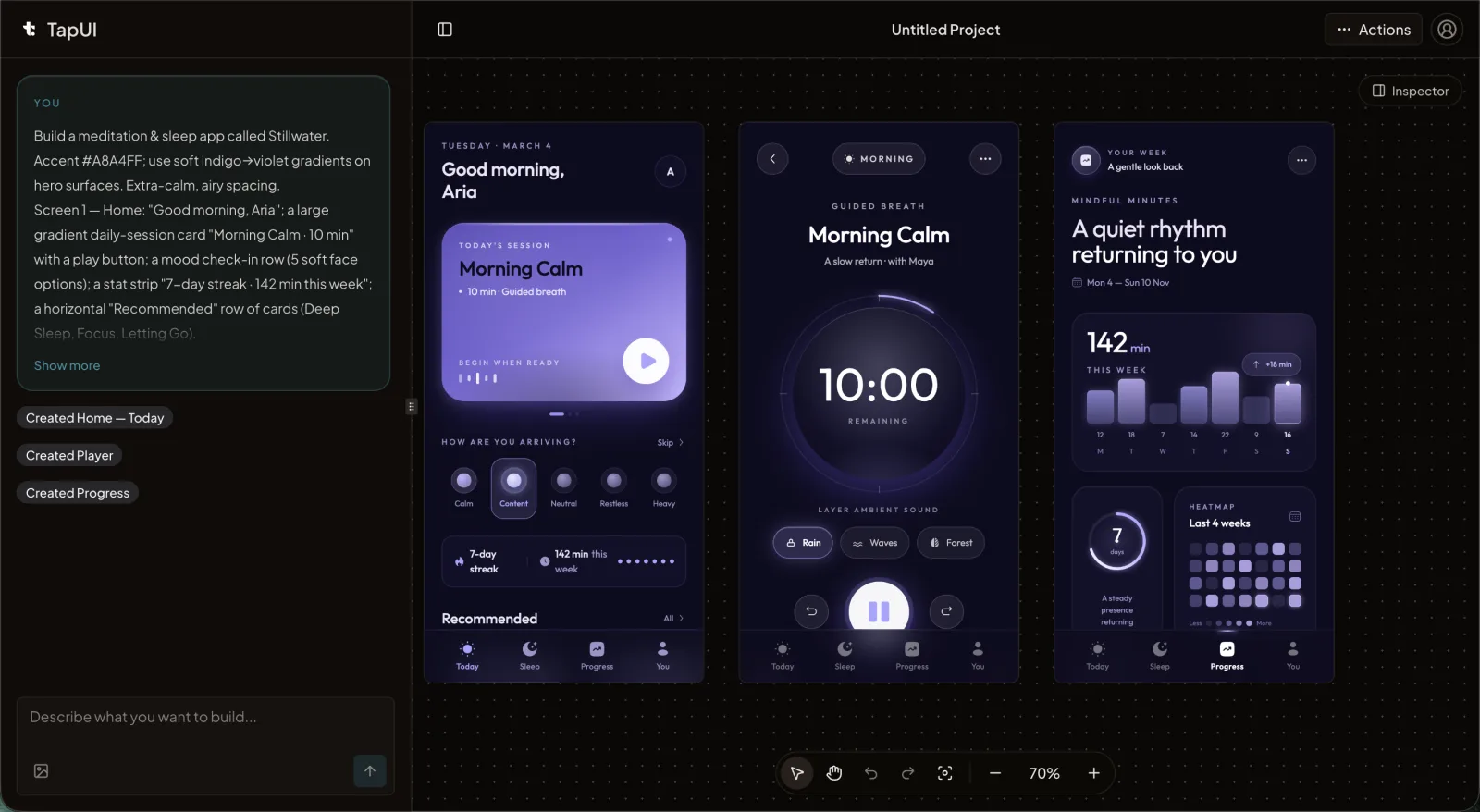 The TapUI editor turns a plain-text app description into polished mobile screens you can hand to developers.
Where it differs from Stitch comes down to focus. Stitch is a browser-based, Material-leaning, do-everything UI tool with broad code export. TapUI is narrower and mobile-first by design, which is the point if mobile screens are all you actually need. You can hand the results to your developers to build from.
Pros:
- Fastest path from idea to polished mobile screens
- Mobile-first by design, no Material defaults to fight
- Plain-text-to-screens flow with project history and exports
Cons:
- Does not export React Native, Swift, or Flutter code — you hand designs to developers, you don't ship framework code from it
- Narrower scope than a full do-everything UI tool
Pricing: Free tier; Starter $20/mo ($17/mo billed yearly) for 100 screen generations a month, project history and exports, and email support; Pro $40/mo ($27/mo billed yearly) for 650 generations a month plus everything in Starter and priority support. Start free and upgrade if it earns a place in your workflow.
Figma AI — if your team already lives in Figma
Best for: teams already in Figma that want AI assistance rather than an AI-first generator.
Figma AI is the lowest-switching-cost option for teams already using Figma daily. It bakes generation and assistance into the design tool many teams already know, creating component variations, suggesting layouts, and turning screenshots into editable Figma layers — all inside a canvas your team doesn't have to learn.
Pros:
- Zero switching cost for existing Figma teams
- Mature collaboration, plugins, and developer handoff (CSS and React snippets)
Cons:
- AI features feel more like assistance than generation; a purpose-built tool usually beats it for pure text-to-UI speed
- Web-design-centric — mobile-specific output isn't its strength
v0 by Vercel — for React developers who want code first
Best for: React developers building web apps who want AI starting points to refine in their editor.
v0 generates production-ready React components from prompts, built on shadcn/ui and Tailwind, ready to drop into a Next.js project. It's developer-first by design: the output is code you edit in code, not a visual layer you nudge.
Pros:
- Production-ready React/Tailwind output you can drop into a project
- Strong fit if you already write React
Cons:
- Web-only, with no native mobile path
- Thin visual editing; non-coders will struggle to get value from it
How to actually choose
Match the tool to the constraint that matters most to you:
- Need to escape Material Design? → a tool with more stylistic range (TapUI). Building Android-native screens? → Stitch's Material foundation is an asset.
- Need mobile-first output? → a mobile-first tool (TapUI). Need React web code? → v0. Already in Figma? → Figma AI.
- Need framework-specific code out the door? → Stitch's export breadth is hard to match. Need polished screens to hand to developers? → a design-first tool is the cleaner path.
- Worried about cost and longevity? → Stitch is free now but a Labs experiment; paid tools with defined plans trade money for more certainty.
- Want the fastest first draft? → plain-text-to-screens tools get you to something real fastest. That's TapUI's core bet.
The fastest way to decide is to throw the same real prompt — an actual screen from something you're building — at two or three of these and compare what comes back. Marketing copy won't tell you which one matches your taste. The output will.
FAQ
Is Google Stitch discontinued?
No. As of mid-2026, Stitch is live and actively developed. It remains a Google Labs experiment, which is a different thing from being sunset.
Is Google Stitch free?
Yes, currently. It runs as a Google Labs experiment and needs only a Google account, with a generous monthly generation allowance. There's no paid tier yet. Paid plans are widely expected when it leaves Labs, but Google hasn't confirmed timing or pricing.
Does Google Stitch export code?
Yes — and this is one of its real strengths. Stitch exports to several frameworks including HTML/CSS, Tailwind, Vue, Angular, Flutter, and SwiftUI, and it can hand off to Figma. The Flutter and SwiftUI options mean you can get actual mobile code, not just images.
What's the best Google Stitch alternative?
The best alternative depends on the constraint pushing you off Stitch. For polished mobile UI from a plain-text description, TapUI is built for exactly that. For teams already in Figma, Figma AI has the lowest switching cost. For React web work, v0 by Vercel keeps you in code. There's no single winner.
Does TapUI export React Native code?
No. TapUI generates polished mobile app UI screens you can hand to your developers, but it does not export React Native, Swift, or Flutter code. If framework-specific code export is your hard requirement, Stitch's broader export support is the better fit.
The short version
Stitch is a strong, free, fast-moving tool, and for a lot of mobile UI work it's genuinely enough. Look elsewhere when its Material Design bias, browser-only workflow, or Labs status gets in your way.
Need polished mobile screens fast from plain text? → TapUI. Need to stay where your team already works? → Figma AI. Need React code first? → v0 by Vercel. Need broad framework code export? → stick with Stitch.
If the mobile-first, describe-it-and-get-screens approach sounds like your workflow, TapUI has a free tier — try it and run one of your own prompts through it.