TapUI vs Figma for Mobile App Design
TapUI generates mobile app screens from a prompt; Figma is a full design platform. Here's an honest take on which fits your mobile workflow.
TL;DR: They barely overlap, so "better" depends on the job. TapUI turns a written description into polished mobile app screens — best for founders, PMs, and designers who want screens fast without learning a design tool. Figma is the full design platform for live collaboration, mature design systems, vector work, and structured developer handoff. Many teams use both: generate a starting point, then bring it into a platform when the work demands depth.
At a glance
| Tool | Best for | Key strength | Pricing | Notes |
|---|---|---|---|---|
| TapUI | Non-designers who want mobile screens fast | Prompt-to-mobile-UI, no canvas to learn | Free; Starter $20/mo ($17 yearly); Pro $40/mo ($27 yearly) | ✅ Mobile-focused ⚠️ Hands off designs to devs, but ❌ no native code export |
| Figma | Teams collaborating on a full design system | Live collaboration, deep systems, dev handoff | Free Starter; paid per-seat tiers + metered AI | ✅ Vector + prototyping ✅ Dev Mode/Code Connect ⚠️ AI output often needs cleanup |
| Google Stitch | Trying prompt-first mobile design free | Natural language + voice to high-fidelity UI | Free tier; paid pricing unannounced | ⚠️ Google Labs experiment, long-term availability uncertain |
Ask "is TapUI better than Figma?" and the honest answer is: it depends what you're trying to do, and the two tools barely overlap. Figma is a general-purpose design platform that happens to do mobile screens. TapUI is a prompt-first tool that does one thing — turn a written description of an app into polished mobile UI screens. Comparing them straight-up is a little like comparing a kitchen to a meal-kit. One gives you every appliance and total control; the other hands you something nearly finished and asks you to season it.
So the better question isn't which tool "wins." It's: where are you in the process, who's on your team, and how much manual design work do you actually want to do?
The fundamental split
The core difference is where each tool starts. Figma starts with a blank canvas. You place frames, draw components, wire up auto-layout, build a system of variants and tokens, then link screens into a prototype. Its AI features — First Draft for generating a layout from a prompt, Figma Make for interactive prototypes, Dev Mode's design-to-code — sit on top of that workflow. They're additive. The core experience is still hands-on design, and that's by design.
TapUI starts with a sentence. You describe the app or the screen you have in mind, and it generates the mobile UI for you. The output is meant to look finished, not like a wireframe you'll spend an afternoon cleaning up. There's no canvas to master first, which is the whole point for the people it's built for: founders, product managers, and designers who want working app screens fast without doing the manual layout themselves.
That difference cascades into everything else.
Where TapUI fits better
Best for: non-designers, founders, PMs, and designers who want polished mobile screens fast — straight from a written description.
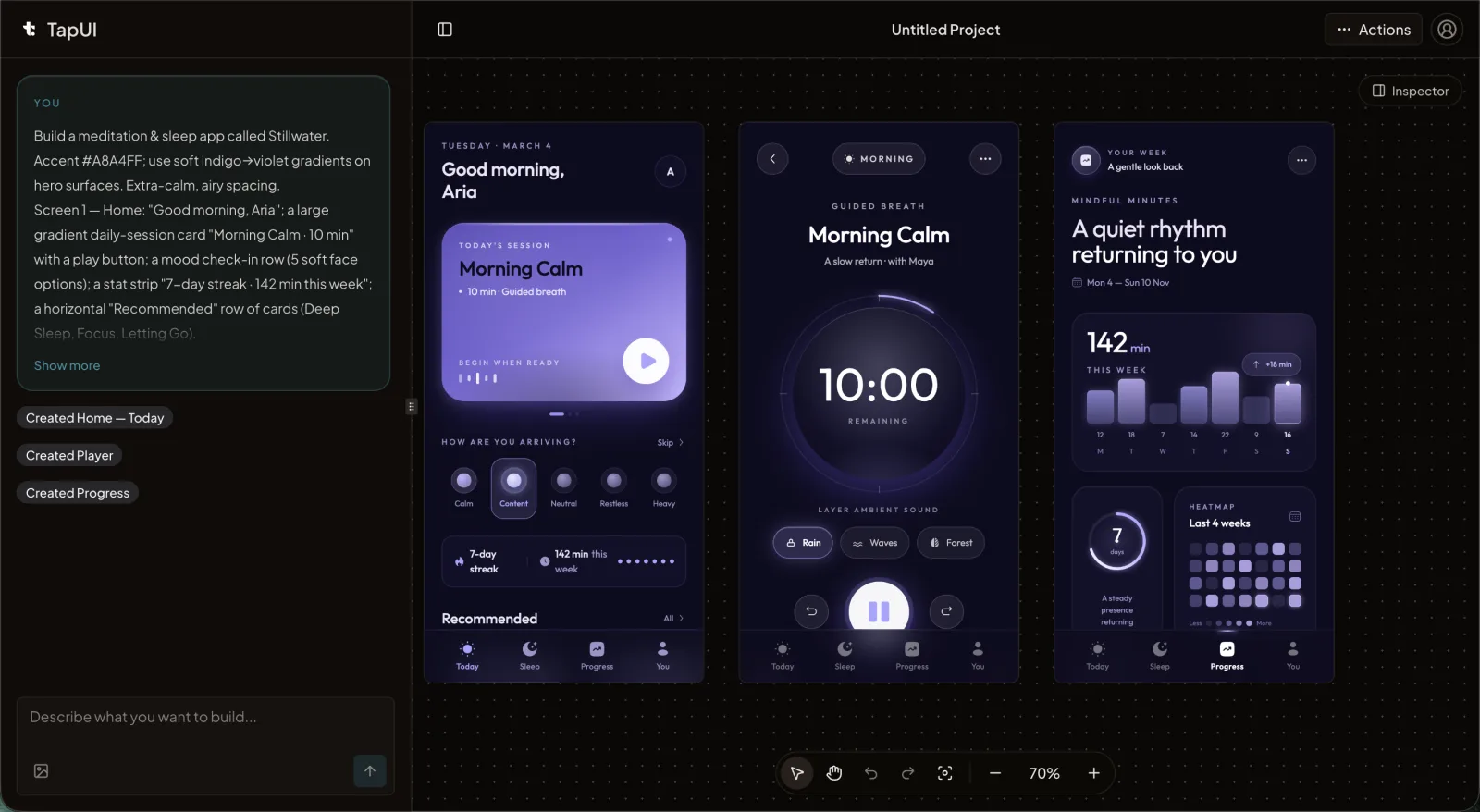 The TapUI editor: describe the app in plain text and it generates a finished-looking mobile UI screen.
You don't already know how to use a design tool. Figma has a real learning curve. Auto-layout, constraints, component properties, variant logic — none of it is obvious to a non-designer, and the gap shows up fast when a founder tries to mock up an idea themselves. TapUI's prompt-first approach skips that. If you can describe the screen, you can get the screen.
You want to go from idea to something tangible quickly. When the input is plain text and the output is a polished screen, the distance between "I have an idea" and "I can show someone" collapses. For early-stage product work — testing a concept, aligning a team, putting something in front of a stakeholder before committing engineering time — that speed is the entire value.
Mobile is the whole job, not one of five surfaces. TapUI is built specifically for mobile app UI. It isn't trying to also do websites, marketing assets, slide decks, and whiteboards. That focus means the defaults it generates are aimed at mobile from the start, rather than a general layout you then have to coax into a phone-shaped frame.
You need designs you can hand to your developers. TapUI produces screens you can pass along to the people building the app, plus project history and exports of your work.
A note worth stating plainly, because an earlier version of this article got it wrong: TapUI does not export React Native, Swift, or Flutter code. If you came here looking for native code generation specifically, it isn't a feature — TapUI generates the designs, not the implementation.
Pros: No design-tool learning curve; mobile-first by default; fast idea-to-screen; project history and exports. Cons: Mobile only; no real-time multi-user collaboration or design-system tooling; no native code export.
Where Figma is genuinely better
Best for: design teams building and maintaining a product's full visual system, collaborating live, and running a structured developer handoff.
For a lot of teams and a lot of work, Figma is the stronger tool, and pretending otherwise would be dishonest. This is where the honest comparison earns its keep.
Real-time, cross-functional collaboration. Figma's defining strength is having designers, developers, and stakeholders in the same file at the same time, commenting and editing live. For teams that work this way — especially agencies juggling many external reviewers — there isn't a close substitute. It's the reason Figma became an industry standard.
Mature design systems. Components, variants, design tokens, shared libraries across files — Figma's system tooling is deep and battle-tested. If you're maintaining a multi-brand design system or an enterprise component library, that maturity matters more than generation speed.
Developer handoff. Dev Mode and Code Connect give developers a structured way to inspect designs and pull values, with design-to-code output spanning formats like HTML/CSS, Tailwind, Swift, and Kotlin. It's a more complete handoff pipeline than a generation-first tool offers.
Vector and illustration work. Figma is a real vector editor. Custom icons, detailed illustration, fine graphics — that's its turf, not something a prompt-to-screen tool is built for.
Prototyping and user-flow simulation. Linking screens into navigable flows is built in, and third-party tools can turn those prototypes into testable native apps. If your work depends on simulating a full flow, that's well-supported ground.
It's also worth being clear-eyed about Figma's rough edges. Its AI generation — First Draft in particular — tends to produce generic, low-variability layouts that often need real cleanup, and it doesn't draw on your custom design system. Third-party reviewers have noted the output frequently still "looks AI-generated" and needs human refinement. Performance has reportedly suffered as AI features piled on. And cost scales steeply: seat pricing climbs as you move from Professional to Organization to Enterprise tiers, and AI usage is now metered as a separate credit cost on top of the subscription. None of that makes Figma a bad tool — it's the price of being the do-everything platform.
Pros: Live cross-functional collaboration; mature design systems; deep vector/illustration; structured dev handoff via Dev Mode and Code Connect. Cons: Real learning curve; AI generation often needs cleanup; steep per-seat cost and metered AI; overkill if mobile screens are all you need.
TapUI isn't the only prompt-first option
Best for: evaluating prompt-first mobile design for free, including voice input — if you're comfortable with a Labs product's uncertain future.
Google Stitch occupies similar territory and belongs on the list. It's a Google Labs experiment that turns natural language — and voice — into high-fidelity UI designs and prototypes, with a free tier and exports to developer tools. Its 2.0 update added an infinite canvas and multi-screen generation.
The honest caveat: Stitch is a Labs product, and Google has a long history of retiring Labs experiments without much warning. Long-term availability isn't guaranteed, and paid pricing is still unannounced. But if you're evaluating prompt-first mobile design tools, it belongs on the list alongside TapUI — the real comparison for both is each other, not Figma.
How to actually decide
| If you... | Lean toward |
|---|---|
| Are a non-designer who wants screens fast from a description | TapUI |
| Work only on mobile app UI | TapUI |
| Want to test or pitch a concept before building | TapUI |
| Run a team that collaborates live in one file | Figma |
| Maintain a serious design system or component library | Figma |
| Need deep vector/illustration control | Figma |
| Design across web, mobile, print, and presentations | Figma |
| Want a structured developer handoff with design-to-code | Figma |
The split isn't really TapUI or Figma for many teams. A common pattern is to use a generation-first tool to get to a strong starting point quickly, then bring it into a full design platform when the work demands real systems, collaboration, or handoff depth. Each tool is good at the thing the other treats as a side feature.
Pricing, briefly
TapUI's pricing is straightforward: a free tier, Starter at $20/mo ($17/mo billed yearly) with 100 screen generations a month, project history and exports, and email support, and Pro at $40/mo ($27/mo billed yearly) with 650 generations a month, everything in Starter, plus priority support. Figma has a free Starter tier and paid Professional, Organization, and Enterprise plans, with per-seat pricing that rises across tiers and AI usage now metered separately. For an early-stage team, the relevant question usually isn't the headline number — it's whether you're paying for a platform's full capability you won't use, or for a focused tool that does exactly the one thing you need.
So, is TapUI better than Figma?
For the specific job of getting polished mobile app screens out of a written description, without learning a design tool or doing the layout by hand, TapUI is the better choice — it's built for that and Figma isn't. For everything a mature design platform does — live collaboration, design systems, vector work, structured handoff — Figma leads, and it's not close.
If you're a founder or PM who needs to see your app idea as real screens this week, start with TapUI. If you're a design team building and maintaining a product's full visual system, Figma is the backbone. Plenty of people end up using both, and that's a reasonable answer too.
Quick routing:
- Need mobile screens fast from a description, no design skills? → TapUI.
- Want to try prompt-first design for free and don't mind a Labs product? → Google Stitch.
- Running live collaboration, a real design system, or vector/handoff work? → Figma.
- Doing both — fast start, then real depth? → Generate in TapUI, refine in Figma.
You can try TapUI on its free tier and see whether the prompt-to-screen approach fits how you actually work.
FAQ
Does TapUI export React Native, Swift, or Flutter code?
No. TapUI generates polished mobile UI screens and supports project history and exports of your designs, but it does not export native platform code. You hand the designs to your developers to build.
Is TapUI a replacement for Figma?
No — for most teams, they solve different problems. TapUI gets you from a text description to mobile screens fast. Figma is a full design platform for collaboration, design systems, vector work, and structured handoff. Many people use both.
How much does TapUI cost?
TapUI has a free tier, Starter at $20/mo ($17/mo billed yearly) for 100 screen generations per month with project history, exports, and email support, and Pro at $40/mo ($27/mo billed yearly) for 650 generations per month plus priority support.
Which tool is better for a non-designer founder?
TapUI is the better fit. There's no canvas or auto-layout to learn — if you can describe the screen, you can generate it. Figma's learning curve tends to slow non-designers down significantly.
What's the best free way to try prompt-to-UI design?
TapUI's free tier is the most direct path for mobile app UI. Google Stitch is another free option with voice input support, though it's a Google Labs experiment with uncertain long-term availability.