v0 or TapUI? How to Pick the Right AI Design Tool
v0 builds web UI in React. TapUI designs mobile app screens. Here's how to tell which one actually fits what you're building.
TL;DR: v0 generates web UI as React code and is the natural pick for a web app on Next.js. TapUI generates polished mobile app screens from a plain-text description — built for founders, PMs, and designers. They aren't really competitors: pick by the surface you're shipping (web vs. native mobile), and if you ship both, use each tool for the surface it owns.
Most "v0 vs TapUI" debates end the moment you say what you're building. They aren't really competitors. v0 generates web UI as React code. TapUI generates mobile app screens from a text description. If you put them side by side and ask which is better, the honest answer is: better at what?
So this guide skips the scoreboard. Instead, it walks through the few questions that actually decide it for your project — what platform you're shipping, who's on your team, and what you need to hand off at the end.
The short version
v0 is the natural pick for web apps; TapUI is the natural pick for mobile app screens. If you're building a dashboard, a SaaS product, or a marketing site and your team writes React, v0 was made for that. It was made by Vercel, it outputs the stack Vercel teams already use, and as of early 2026 it can scaffold full Next.js apps, not just components.
If you're designing a mobile app and you want polished screens fast without doing the design work by hand, that's TapUI's whole reason to exist. You describe the app, it produces the UI.
Plenty of teams end up using both, one per surface. That's not a cop-out — it's usually the right call, and I'll get to why.
At a glance
| Tool | Best for | Key strength | Web | Mobile | Outputs code? | Pricing |
|---|---|---|---|---|---|---|
| v0 | React/Next.js web apps | Production-grade web code, deep Vercel integration | ✅ | ❌ | ✅ React/Next.js | Free tier + credit-based paid plans |
| TapUI | Mobile app screens, fast | Plain text → polished mobile UI, no design work by hand | ❌ | ✅ | ❌ designs only | Free; Starter $20/mo, Pro $40/mo |
| Google Stitch | Free sketching, either surface | Free, multi-screen prototypes, web + mobile | ✅ | ⚠️ HTML/CSS | ⚠️ HTML/CSS | Free (Labs experiment) |
What v0 actually is
Best for: React teams shipping web apps, dashboards, or marketing sites on Next.js and deploying to Vercel.
v0 is Vercel's text-to-UI tool — describe a component or screen, and it returns production-ready React code. Specifically: shadcn/ui components styled with Tailwind, targeting Next.js, editable in a browser-based editor that feels like a stripped-down VS Code with a visual Design Mode for nudging things around without touching code.
After its February 2026 platform overhaul, v0 went further than components. It now generates full-stack Next.js apps: API routes, Server Actions, and Supabase database wiring. It also syncs with GitHub, imports from Figma on paid tiers, and deploys to Vercel in one click.
Where v0 is genuinely strong:
- Production-grade web output. The code isn't throwaway. It's the same stack a lot of React teams ship today, so it drops into a real codebase with little friction.
- Deep Vercel/Next.js integration. If you already live in that ecosystem, the generate-to-deploy loop is about as smooth as it gets.
- Full-stack, not just mockups. Database and server logic in the same flow is a real differentiator versus pure UI tools.
Where it stops short:
- It's web-only. v0 produces React for the browser. It does not generate native iOS or Android app screens, and as of mid-2026 mobile isn't on the public roadmap. Vercel has hinted at it, but nothing's confirmed.
- You're locked to one stack. shadcn/ui, Tailwind, Next.js. No Vue, Svelte, or Angular. If your project lives elsewhere, you're fighting the tool.
- You need to read code to get value. The output is code. For a designer or PM who just wants to see screens, that's a barrier, not a feature.
- Token-based pricing can drift. Since February 2026, v0 runs on credits. The free tier comes with a small monthly credit allowance; paid tiers add more. Heavy users find the cost harder to predict, and unused credits expire after a couple of months.
What TapUI actually is
Best for: founders, PMs, and designers who want polished mobile app screens fast from a text description — no manual design work, no code required.
TapUI is built for mobile and nothing else — you describe an app in plain language and it generates polished mobile app UI you can iterate on. The target user isn't only an engineer. It's the founder sketching a product, the PM who needs something real to react to, the designer who'd rather start from a strong draft than a blank artboard.
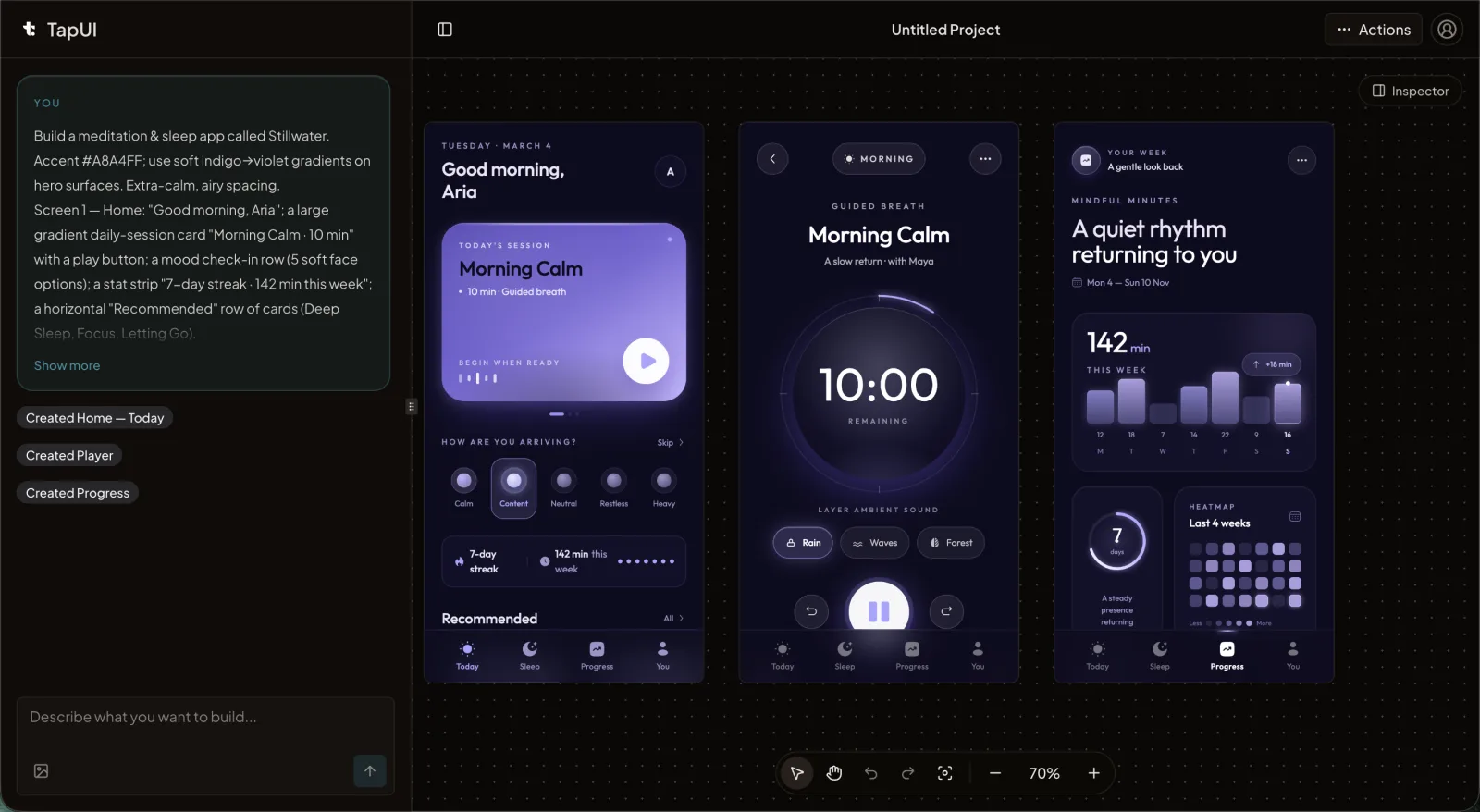 The TapUI editor turns a plain-text app description into designed mobile screens you can iterate on.
Where TapUI fits well:
- Mobile UI is the entire focus. The output is built around how phone screens actually work, not a desktop layout shrunk down.
- Speed from idea to screen. Plain text in, designed screens out. For early product exploration, that compresses a lot of manual work.
- Designs you can hand to your developers. You walk away with screens to build from, not a vague brief.
Where to be clear-eyed:
- It's not a web app builder. If you need a browser dashboard or a marketing site, TapUI isn't the tool. That's v0's lane.
- It's a design tool, not a code generator. TapUI generates app UI. It does not export React Native code — that capability was removed. Don't pick it expecting a finished native codebase to drop into Xcode.
On pricing, TapUI has a free tier plus paid plans: Starter at $20/mo ($17/mo billed yearly, 100 screen generations per month, project history and exports, email support) and Pro at $40/mo ($27/mo billed yearly, 650 generations per month, everything in Starter plus priority support). Try the free tier before you commit to anything.
The one question that usually settles it
Are you building for the web or for a phone? That's the deciding question — and the answer closes the debate.
Web and native mobile diverge at nearly every layer — the components, the navigation patterns, the layout constraints, what users expect when they tap versus click. A responsive website viewed on a phone is not a native app, and people can feel the difference. Web output can't be poured into an App Store submission without a real rebuild.
So:
- Native mobile app → TapUI is built for this; v0 doesn't generate mobile screens.
- Web app or site → v0 is built for this; TapUI doesn't do web.
- Both surfaces → use each tool for the surface it owns.
That last case is worth sitting with, because people resist it.
When you genuinely need both
Use v0 for the web side and TapUI for the mobile screens — that's the workable approach, and it beats forcing one tool to do both. Say you run an e-commerce business with a web store and you want to add iOS and Android apps. The instinct is to find one tool that does everything. There isn't a good one, because doing both well means making opposite tradeoffs.
The boring-but-effective execution: v0 for web, TapUI for mobile screens, and a shared set of brand decisions — color, type, tone — to keep them feeling like one product. Two tools, one design language. That beats living with mediocre results on both ends because you forced a single tool to do a job it wasn't built for.
A third option worth knowing: Google Stitch
Best for: free, low-stakes sketching across web and mobile when you're still exploring and don't need a tool you'll build a real workflow on.
Google Stitch is worth knowing as a free alternative for early exploration — it generates UI for both mobile and web from text or image prompts. It's a Google Labs experiment, launched at I/O 2025 and still active as of mid-2026, powered by Gemini. It supports multi-screen interactive prototypes and, notably, it's free.
That makes it tempting. A few honest caveats:
- It outputs HTML and CSS, not native iOS/Android code. So it's a visual design layer, not a path to a shipped native app.
- It's a Labs experiment. Google has a long track record of shutting down experiments. Building a workflow on something with no longevity guarantee is a real risk for anything beyond exploration.
- Brand and customization control is limited, and some users have reported quality dipping after certain updates.
If you want a free way to sketch both web and mobile and you're comfortable with the experimental status, Stitch is a reasonable starting point. For mobile work you intend to actually ship and design seriously, a dedicated mobile tool gives you more control.
A few honest mismatches to avoid
Picking by brand recognition. v0 has Vercel's reach behind it, so it's the name people know. That's irrelevant if you're building a phone app — name recognition doesn't generate mobile screens.
Assuming responsive web equals a mobile app. It doesn't. A site in a mobile browser and a native app are different products with different performance and different store eligibility. If you need an app, design for an app.
Fighting a tool's home turf. v0 outside the React/Next.js world, or a mobile tool pressed into building a web dashboard — both produce work you'll redo. Match the tool to the surface and to what your team already knows.
Quick reference
| If you're… | Lean toward |
|---|---|
| Shipping a web app on React/Next.js | v0 |
| Deploying to Vercel | v0 |
| Designing native mobile app screens fast | TapUI |
| A founder/PM/designer who wants UI without manual design work | TapUI |
| Building both web and mobile | v0 for web, TapUI for mobile |
| Sketching either surface for free, exploration only | Google Stitch (mind the Labs caveat) |
FAQ
Can I use v0 to design a mobile app?
No — v0 generates web layouts, not native mobile app screens. You can build a web layout that resembles a phone screen, but it's a web page: no native interactions, and no path to an app store without rebuilding. For native mobile app design, use a tool built for it.
Does TapUI generate web UIs?
No. TapUI is focused on mobile app UI design only. If you're building a web app or marketing site, v0 is the better fit.
Does TapUI export React Native, Swift, or Flutter code?
No. TapUI generates mobile app UI designs you can iterate on. It does not export to React Native, Swift, Flutter, or any native platform codebase.
Which tool should I pick for my team?
Pick based on your platform: if your team writes React and you're shipping a web app on Next.js, v0 outputs the exact stack you already use — immediate value. If you want polished mobile app screens from a text description without writing code, TapUI is faster for non-engineers and designers.
What's the cost difference?
v0 offers a free tier plus credit-based paid plans. TapUI has a free tier, Starter ($20/mo or $17/mo billed yearly with 100 generations/month), and Pro ($40/mo or $27/mo billed yearly with 650 generations/month). Both free tiers let you try before committing.
Can I use both tools in one project?
Yes. If you're shipping both a web app and mobile app, use v0 for the web side and TapUI for mobile screens. Share brand decisions (color, type, tone) to keep them feeling like one product.
How to decide
There's no single winner here — only the right tool for the surface:
- Need a web app, dashboard, or site on React/Next.js? → v0.
- Need polished mobile app screens fast, without doing the design by hand? → TapUI.
- Shipping both web and mobile? → v0 for web, TapUI for mobile, with shared brand decisions to keep them feeling like one product.
- Just sketching either surface for free, exploration only? → Google Stitch (mind the Labs caveat).
Pick the tool that matches the surface you're shipping and the people doing the work. For a web product on React, that's v0. For mobile app screens designed fast, try TapUI free and see how far a plain-text description gets you.