TapUI vs Adalo: AI UI Screens or a Full No-Code App?
TapUI generates polished mobile UI from a prompt; Adalo builds working no-code apps with a backend. Here's which one fits your stage.
TL;DR: TapUI generates polished mobile UI screens from a written prompt — ideal when you're still shaping a concept and need credible-looking screens fast. Adalo is a full no-code builder that ships working native iOS, Android, and web apps with a built-in database. Choose TapUI to design and pitch, Adalo to build and publish. Many teams use TapUI first, then build the real app in Adalo or with a developer.
People usually land on this comparison after hitting the same wall: they have an app idea, they want to see it, and they can't tell whether they need a design tool or an app-building platform. TapUI and Adalo both promise to get you from "I have an idea" to "I can show someone," but they solve genuinely different problems. Picking the wrong one wastes a week.
Here's the short version. TapUI generates polished mobile UI screens from a written description — you tell it what the app is, and it produces the screens. Adalo builds a working, publishable no-code app — screens, a database, buttons that actually do things, and a path to the App Store and Google Play. One is a design tool. The other is a build-and-ship platform.
TapUI vs Adalo at a glance
| Tool | Best for | Key strength | Publishing | Pricing |
|---|---|---|---|---|
| TapUI | Founders, PMs, designers shaping a concept | Polished mobile UI screens from a prompt, fast | ❌ Designs to hand off — no native publishing | Free tier; Starter $20/mo ($17/mo yearly); Pro $40/mo ($27/mo yearly) |
| Adalo | Non-technical founders shipping a real app | Working app + built-in database, no developer | ✅ Native iOS, Android, and responsive web | Free tier (no publishing) + paid plans |
They overlap at the edges, which is exactly why the comparison feels confusing until you name what you're actually trying to do.
The real question isn't "which is better"
The real question is which stage you're in. These aren't competing answers to the same question — they're answers to two different questions that happen to sit next to each other on the timeline.
If you're still figuring out what the app should look like — exploring layouts, pitching a concept, putting something in front of users to react to — you want screens fast, and you want them to look credible. That's design and ideation. TapUI is built for that loop.
If you've already settled on what you're building and you want a real app that stores data and goes live without hiring a developer, you want a full no-code builder. That's Adalo's whole reason to exist.
What Adalo actually is
Best for: non-technical founders who want a working, publishable app without writing code.
Adalo is a no-code app builder that ships native iOS, Android, and web apps with a built-in backend — no separate database service required. You work on a drag-and-drop canvas, drop in components like lists, forms, and buttons, wire them to a built-in database, and publish. No code required, and the backend comes included.
It's been around since 2018, and it's an active, maturing product. A late-2025 infrastructure overhaul (Adalo 3.0) brought a performance jump and removed usage-based charges on paid plans, so you're not metered on data requests. Adalo has also added AI features: "Magic Start" spins up an app from a description, "Magic Add" adds features through natural language, and an assistant called Ada is in beta.
Pros:
- It ships real apps. Native iOS and Android publishing is built in — you can get to the App Store and Google Play from inside the tool.
- The backend is included. Screens, data, and logic live in one place, so a non-technical founder doesn't have to stitch together a separate backend.
- It's beginner-friendly. Strong templates, a large community, and a gentle learning curve for simple apps.
Cons:
- UI fidelity is generic. Adalo's strength is function, not visual polish. If design quality is the thing you're judged on, this is a real limit.
- Complex logic strains it. Heavy custom workflows or data-intensive, production-scale apps are a poor fit. I'd build a stress test before betting a serious app on it.
- The free tier is tight. It doesn't allow app store publishing, so it's really a trial, not a place to ship from.
- It's not built for designers. There's no design-to-developer handoff, and it's slow for pure visual ideation. Adalo wants you building, not sketching.
What TapUI is
Best for: founders, PMs, and designers who need finished-looking mobile UI fast — to pitch, review, or test.
TapUI is an AI design tool that generates polished mobile UI screens from a plain-language description. It's aimed at people who need working app UI fast, without doing the manual design work themselves — the kind of screens you'd put in a pitch, a concept review, or in front of test users.
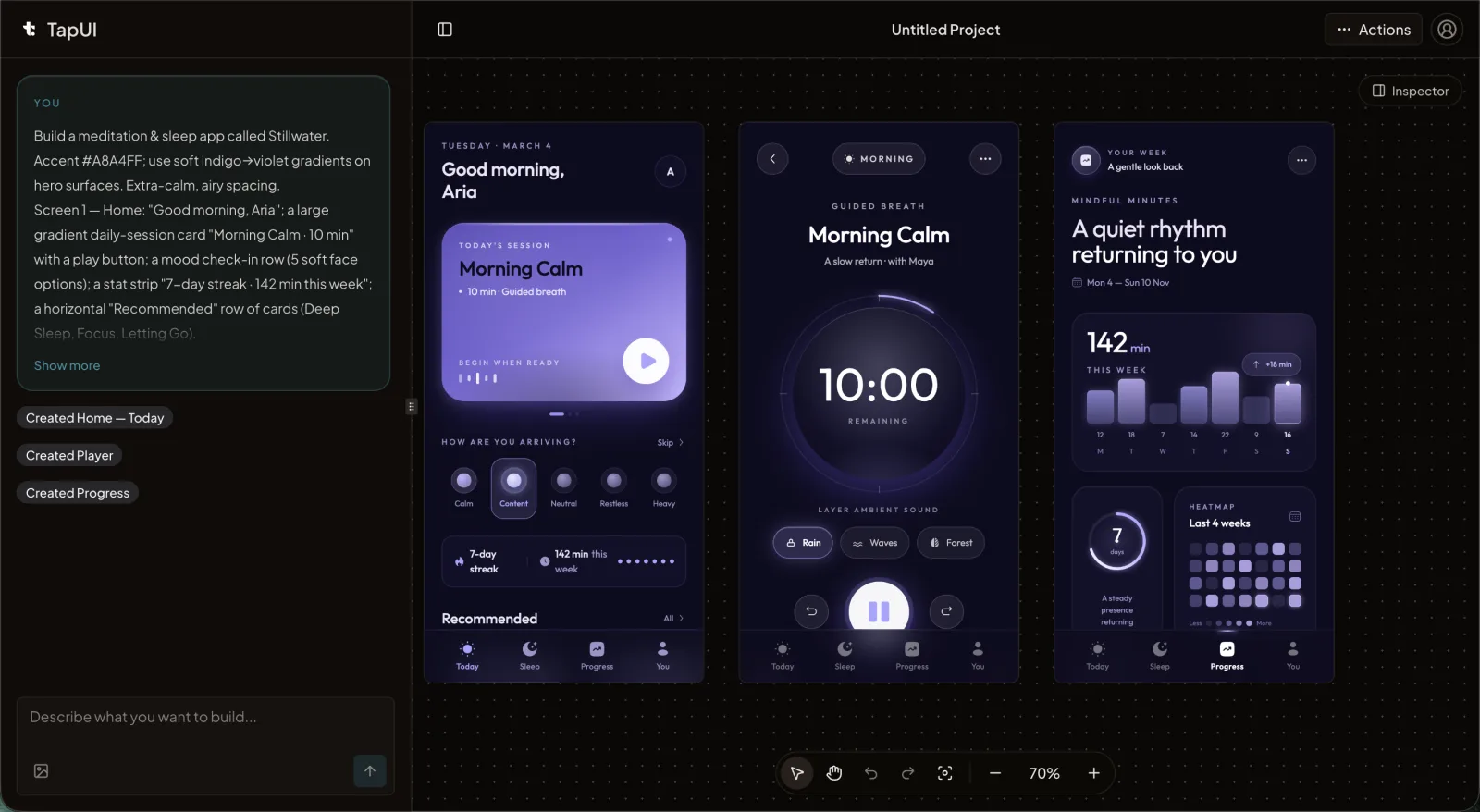 The TapUI editor turns a plain-language description into ready-to-share mobile UI screens.
The thing it's good at is the part Adalo is weakest at: producing screens that look finished, quickly. When you're iterating on a concept and want three versions of an onboarding flow to compare before lunch, that's the loop TapUI is built around. You get designs you can hand to your developers to build from.
Pros:
- High visual fidelity. Screens look finished and credible — good enough to pitch or test.
- Fast iteration. Spin up multiple UI variations from prompts instead of hand-placing components.
- Clean handoff. Project history and exports let you share designs with developers (or a builder) to implement.
Cons:
- It's not an app builder. It doesn't ship to the App Store, host a database, or wire up working buttons and data.
- No backend. If you need a running app users can sign into and save data in, TapUI gets you the screens — not the system behind them.
To be clear about one common misconception: TapUI does not generate platform code (React Native, Swift, or Flutter). It produces designs you hand to developers to build from. If you read otherwise somewhere, it's out of date.
Side by side
| TapUI | Adalo | |
|---|---|---|
| What it produces | Polished mobile UI screens from a prompt | Working, publishable native + web apps |
| Core job | Design and ideation | Build and ship |
| AI | Generates screens from plain-text descriptions | Magic Start / Magic Add; Ada assistant (beta) |
| Backend / database | ❌ None — UI only | ✅ Built-in relational database |
| Publishing | ❌ Designs to hand off | ✅ Native iOS, Android, and responsive web |
| Code export | ❌ No platform code (designs only) | ❌ Closed no-code platform |
| Best for | Founders/PMs/designers needing fast UI | Non-technical founders shipping a real app |
On pricing: TapUI offers a free tier, plus Starter at $20/month ($17/month billed yearly; 100 screen generations/month, project history and exports, email support) and Pro at $40/month ($27/month billed yearly; 650 generations/month, everything in Starter plus priority support). Adalo has a free tier (no publishing) and paid plans. Notice you're comparing the cost of generating designs against the cost of hosting and running a live app — those aren't the same line item.
When Adalo is the better call
Adalo wins outright when you need a working app in users' hands and you're not hiring a developer. Be honest with yourself here. Specifically:
- Your app is mostly screens, records, and straightforward actions — a directory, a booking tool, a simple marketplace, an internal team app.
- You need a backend and don't want to manage one separately.
- Native app store publishing is a hard requirement.
For a non-technical founder who wants to ship, Adalo does something TapUI simply doesn't. Don't reach for a design tool when what you need is a deployed app.
When TapUI fits better
TapUI is the better starting point when you're still shaping the product and need to see it before you commit to building. Specifically:
- Design quality matters — you're pitching investors, comparing directions, or testing with users who'll judge the look.
- You want to move fast through many UI variations instead of hand-placing components.
- You'll hand the designs to a developer (or a builder) to implement.
A common, sane workflow: use TapUI to nail the screens and the visual direction, then build the actual app — in Adalo, with a developer, or wherever fits — from a design you already trust.
Which one should you pick?
- Need finished-looking screens to pitch, review, or test fast? → TapUI.
- Need a working app with data and logic, shipped without a developer? → Adalo.
- Still deciding what the app should be? → Start with TapUI, then build in Adalo (or with a developer) once the direction is set.
Most teams end up wanting both at different moments: design the thing first, then build it. Knowing which moment you're in is the whole decision.
FAQ
Is TapUI a full Adalo alternative?
No. TapUI generates polished mobile UI screens for design and ideation; Adalo is a full no-code app builder with backend, database, and app store publishing. They're for different stages: use TapUI to design and pitch, use Adalo to build and ship a working app.
Can TapUI export React Native, Swift, or Flutter code?
No. TapUI produces design files you hand to developers or other builders to implement. It does not generate any platform-specific code.
Can I publish a live app to the App Store using TapUI?
No. TapUI is a design tool for creating mobile UI screens. Only Adalo (among these two) handles native iOS and Android publishing and running live apps.
What does TapUI pricing look like?
TapUI has a free tier, plus Starter ($20/mo or $17/mo billed yearly, 100 screen generations/month), and Pro ($40/mo or $27/mo billed yearly, 650 generations/month). Adalo has separate pricing for running a live app, so compare based on what you actually need — design iterations versus hosting a running backend.
When should I use TapUI instead of Adalo?
Use TapUI when you're still exploring what the app should look like, need to pitch or test a concept quickly, or want finished-looking screens to hand to developers. Use Adalo when you've settled on your product and need a working, data-backed app running without hiring a developer.
Does Adalo have AI features?
Yes. Adalo offers Magic Start (generates an app from a description), Magic Add (adds features via natural language), and an AI assistant called Ada in beta. However, Adalo's AI focus is on building functional apps, not producing high-fidelity visual design.
The bottom line
If you need to see and shape a mobile app — fast, polished, and good enough to put in front of people — start with TapUI. If you need to build and ship a working app with data and logic, without a developer, Adalo is the stronger choice and it's genuinely better at that job than any UI generator.
Most teams end up wanting both at different moments: design the thing first, then build it. Knowing which moment you're in is the whole decision.
Try TapUI to generate your first screens, or read How to Design App UI with AI for the design-first workflow.