TapUI vs Appy Pie: Which One Fits Your App Project?
TapUI designs polished mobile UI from a prompt; Appy Pie builds and publishes full apps. Here's which tool fits your project, and where each falls short.
TL;DR: TapUI turns a plain-text prompt into polished, custom mobile UI screens you can refine and hand straight to developers — fast iteration, no template ceiling, no lock-in. It's the right pick when the quality of the interface matters and you have someone (or a team) to build it. Appy Pie answers a different question: if you need a live, published app this month with no developer involved at all, it handles the build, backend, and store submission that TapUI deliberately doesn't do.
At a glance
| Tool | Best for | Key strength | Pricing | Publishes apps? |
|---|---|---|---|---|
| TapUI | Founders, PMs, designers who want strong UI fast | Custom, high-fidelity screens from a prompt — no template ceiling | Free tier; Starter $20/mo ($17/mo yearly); Pro $40/mo ($27/mo yearly) | ❌ Designs only |
| Appy Pie | Non-technical owners who need a live app now | End-to-end build, backend, and store publishing | Per-app monthly tiers + trial | ✅ Google Play & App Store |
| Google Stitch | Anyone weighing the closest TapUI alternative | AI-native UI design from prompts/images | Free with a monthly cap | ❌ Designs only |
People compare these two tools all the time, and most of the comparisons miss the point. TapUI and Appy Pie aren't really competing for the same job. One designs mobile app screens. The other builds and ships a working app to the stores. Picking between them on price or feature count, the way most listicles do, leads people to the wrong tool for what they actually need.
So before anything else, the honest framing: if your goal is a live, published app that your customers can download this month, Appy Pie does something TapUI does not. If your goal is sharp, custom-looking UI screens you can iterate on and hand to whoever builds the product, that's where TapUI lives. Read the next section, decide which sentence describes you, and you've basically made the decision.
The one distinction that decides it
Appy Pie is an app builder and publisher. You describe an app, its AI generates screens, navigation, and a backend, and a drag-and-drop editor lets you refine from there. Then it handles the parts most people dread: hosting, content management, push notifications, and submission to Google Play and the Apple App Store. At the end you have an app people can install.
TapUI is an AI design tool. You describe an app in plain text and it generates polished mobile UI screens. That's the deliverable: clean, high-fidelity designs you can refine and then hand to your developers to build. TapUI doesn't host, publish, or run a backend, and it doesn't ship code as a finished app.
Put plainly: Appy Pie's output is a functional, live app constrained by its templates. TapUI's output is design-quality screens with no template ceiling on how they look. Neither replaces the other.
When Appy Pie is the better call
Appy Pie is the better call when you need a real, downloadable app without involving a developer. It aims squarely at non-technical owners who need something real, fast — and has been doing so since 2011. If you run a local business and need an app that lists your services, sends a push notification when there's a promo, and shows up in the store under your name, this is a legitimate path that skips hiring a developer entirely.
Pros:
- It finishes the job. Hosting, a backend CMS, push notifications, store submission — Appy Pie owns the whole pipeline. TapUI stops at the design. For a non-technical founder, that end-to-end coverage is the entire value proposition.
- No skills required. Describe the app, let the AI rough it in, then nudge things around with drag-and-drop. There's a large library of templates for common categories like retail, restaurants, and services, plus modules for eCommerce, payments, chatbots, and workflow automation that connects to tools like Shopify, Mailchimp, and Google Sheets.
- Fast to a live app. When "good enough and published" beats "beautiful and waiting," Appy Pie wins on time-to-store.
Cons:
- iOS sits behind the pricier tier. The lower plans publish to Android only; you need to move up to the higher standard tier (Platinum) to get the Apple App Store. If you want both stores from day one, budget for that — plus Apple's separate annual developer fee and Google's one-time registration fee, which exist no matter which builder you use.
- Pricing is per app, per month. That's fine for one app. Run three or four and the monthly cost climbs to where hiring a developer starts looking reasonable again.
- Design is template-deep. You can recolor and rearrange, but you can't invent a custom layout or a bespoke interaction. Apps built this way tend to look like apps built this way.
- Reviews are mixed on billing and support. Across Capterra, G2, and Gartner Peer Insights, you'll find recurring complaints about billing and customer service. Worth reading before you commit.
Appy Pie's own headline numbers — "10 million+ builders," "150+ countries" — are self-reported, so weigh them as marketing rather than independent fact.
When TapUI is the better call
TapUI is the better call when you care what the screens look like and aren't ready to lock into a publishing platform's template system. Founders refining a concept, product managers who need something concrete to align a team around, designers who'd rather start from a strong draft than a blank artboard — this is where TapUI lives.
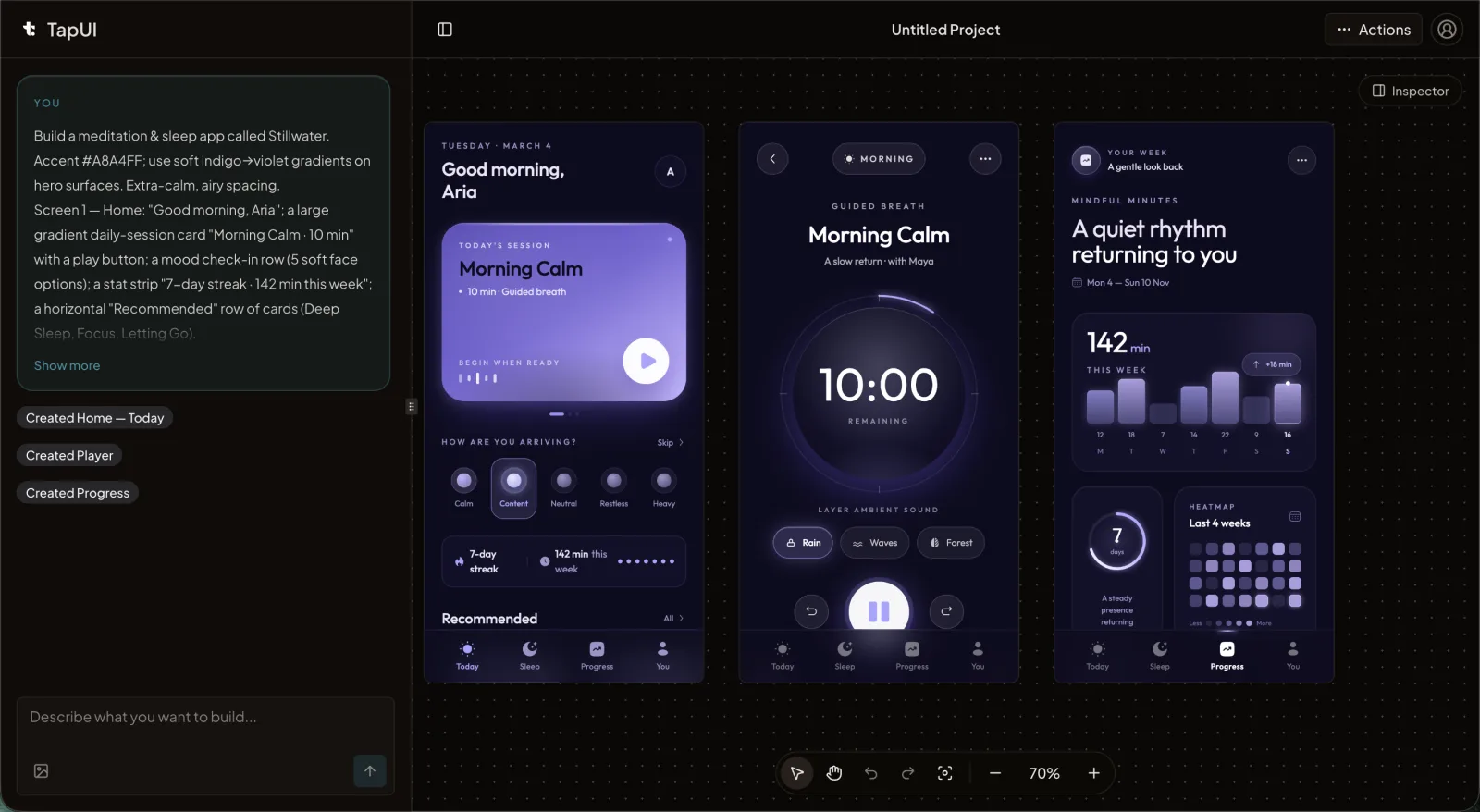 The TapUI editor: describe an app in plain text and refine the generated mobile screens.
You type a description, you get polished mobile screens, and you iterate from there. Because nothing is template-bound, two different prompts produce two genuinely different interfaces. That's the core trade: TapUI gives you design range and fidelity, and in exchange it hands the building and shipping back to you.
Pricing: a free tier to try it, then Starter at $20/mo ($17/mo billed yearly — 100 screen generations a month, project history and exports, email support) and Pro at $40/mo ($27/mo billed yearly — 650 generations a month, everything in Starter plus priority support).
Pros:
- No template ceiling. Two prompts produce two genuinely different interfaces, so the look isn't capped by a builder's library.
- Fast from idea to concrete screens. You start from a strong draft instead of a blank artboard.
- Clean handoff. The output is a high-fidelity target your developers can build against.
Cons:
- It produces designs, not a deployed app. No hosting, backend, or store publishing — that's the same limitation that makes its design range possible.
- You still need a way to build. TapUI hands the building and shipping back to you.
When you're done designing, you take those screens — along with TapUI's project history and exports — to whoever builds the product. TapUI's job ends at giving them a clear, high-fidelity target to build against, which removes a lot of the back-and-forth that usually eats the start of a project.
A side-by-side, with the caveats intact
| TapUI | Appy Pie | |
|---|---|---|
| What it actually produces | High-fidelity mobile UI screens | A live, publishable app |
| How you start | Describe the app in plain text | Describe the app, then drag-and-drop refine |
| Design ceiling | Custom, not template-bound | Template-constrained |
| Publishing to the stores | No — designs only | Yes — Google Play and App Store |
| Backend / hosting / push | Not included | Included |
| iOS access | Design any platform's screens | Higher (Platinum) tier and up |
| Pricing shape | Free tier; Starter $20/mo, Pro $40/mo (cheaper billed yearly) | Per-app monthly tiers + trial |
| Best fit | Founders, PMs, designers who want strong UI fast | Non-technical owners who need a live app now |
The row that matters most is the second-to-last one about publishing. If you need a downloadable app and don't want to involve a developer, that single row points you to Appy Pie regardless of everything else on the table.
The competitor worth knowing about
If you're evaluating TapUI, the closer comparison probably isn't Appy Pie at all — it's Google Stitch. Stitch is an AI-native UI design tool from Google Labs that generates high-fidelity mobile and web screens from prompts, images, or annotated screenshots, and it competes with design tools like Figma rather than with app publishers. It's currently free with a monthly generation cap.
The catch: Stitch lives in Google Labs, which is explicitly experimental. Labs products carry no guarantee they'll stick around or stay free. That's a real consideration if you're choosing a tool to build a workflow on. Still, if your question is "what's the best way to generate mobile UI designs from a prompt," Stitch belongs in that conversation more than Appy Pie does — Appy Pie answers a different question entirely.
So which should you pick?
The decision comes down to one thing: do you need a published app, or do you need designs? Route yourself by three questions and you'll have your answer.
- Do you need a published app, or do you need designs? Published app, no developer in the picture → Appy Pie. Designs you'll build from → TapUI.
- How much does the look matter? If a template-shaped app is fine, Appy Pie gets you there fastest. If the interface is part of the product's appeal, the template ceiling will frustrate you, and TapUI's range is the point.
- How many apps, and on which stores? One Android app on a budget leans Appy Pie. Both stores or several apps changes the math — re-check the per-app, per-month cost against your alternatives.
There's no universal winner here, and anyone telling you otherwise is selling something. Route yourself by what you actually need:
- Need custom, high-fidelity mobile UI generated from a prompt, fast to refine and ready to hand to developers? → TapUI.
- Need a published app this month, with no developer? → Appy Pie.
- Just comparing the best way to generate mobile UI from a prompt? → put Google Stitch next to TapUI; Appy Pie answers a different question.
Match the tool to the sentence that describes your project, and you'll pick right.
FAQ
Is TapUI an alternative to Appy Pie?
Only partially — they overlap on the "describe your app and get screens" step, but diverge completely after that. Appy Pie then publishes a working app while TapUI produces UI designs you take elsewhere to build. If you specifically need a published app without a developer, TapUI won't replace Appy Pie.
Does TapUI publish apps to the App Store or Google Play?
No. TapUI generates mobile UI designs only. Publishing, hosting, and backend are outside what it does — that's where a builder like Appy Pie or a development team comes in.
Can Appy Pie publish to both iOS and Android?
Yes, but iOS requires the higher Platinum tier. Lower plans publish to Android only. Both stores also carry separate developer fees from Apple and Google regardless of which platform you use.
Does TapUI export React Native, Swift, Flutter, or native code?
No. TapUI generates high-fidelity mobile UI designs as visual files that you hand to developers. It does not export production-ready code in any framework or platform-specific language.
Which is cheaper, TapUI or Appy Pie?
TapUI has a free tier, Starter at $20/mo ($17/mo yearly), and Pro at $40/mo ($27/mo yearly). Appy Pie charges per app per month, which compounds if you build multiple apps. For a single app, pricing is comparable; for multiple apps, Appy Pie's model adds up quickly.
What's the closest direct competitor to TapUI?
Google Stitch is the nearer comparison — it's an AI UI design tool that generates screens from prompts, rather than an app publisher like Appy Pie. Note that Stitch is a Google Labs experiment with no guaranteed long-term availability.
Related: Ship mobile UI faster with AI • Validate your app idea before coding • Accessible app design with AI