TapUI vs Bravo Studio: Which Mobile App Tool Fits Your Workflow?
TapUI generates app UI from a text prompt. Bravo Studio turns Figma designs into native apps. Here's which one fits how you actually work.
TL;DR: TapUI turns a plain-text description into polished mobile UI screens you refine and hand to developers — best when you have an idea but no design yet. Bravo Studio turns a finished Figma design into a published, data-connected native app — best when you already live in Figma and need a shippable app. They sit at opposite ends of the same workflow, so the right pick depends on where you're starting and what you need at the end.
These two tools get compared a lot, but they start from opposite ends of the same problem. Bravo Studio assumes you already have a finished Figma design and want to turn it into a real, installable app. TapUI assumes you have an idea and a sentence, and want screens to look at by the end of the afternoon.
That difference in starting point matters more than any feature checklist. If you're a designer who lives in Figma, the "best" tool here is probably not the same one a non-designer founder would pick. So instead of crowning a winner, this piece walks through where each tool's entry point pays off and where it starts to hurt.
TapUI vs Bravo Studio at a glance
| Tool | Best for | Key strength | Starting point | Publishes to stores? | Pricing |
|---|---|---|---|---|---|
| TapUI | Founders, PMs, designers starting from an idea | Text prompt → polished UI screens, fast | A sentence (no design needed) | ❌ Hands off designs to developers | Free tier; Starter $20/mo, Pro $40/mo |
| Bravo Studio | Teams who already work in Figma | Pixel-faithful Figma → native app with live data | A finished Figma design | ✅ App Store + Google Play | Free tier; paid plans (check current page) |
The short version:
- Bravo Studio takes a Figma design you've already built, lets you tag elements for interactivity, wires it to a backend through APIs, and publishes a native iOS or Android app to the stores. It is design-first: the design is the input.
- TapUI takes a plain-text description and generates polished mobile UI screens for you, which you can refine and hand to your developers. It is AI-first: there is no design to bring, because TapUI produces the design.
If you don't have a design yet and don't want to build one by hand, TapUI removes the slowest step. If you already have a polished Figma file and your real goal is a shippable app with live data, that's Bravo's home turf.
What Bravo Studio actually does
Best for: teams who already design in Figma and need a working, data-connected app published to the stores.
Bravo Studio is a no-code, design-first app builder that turns a finished Figma file into a functioning native app. The workflow is built around Figma: you design your screens there, then apply Bravo's tagging system (tags like #BUTTON and #LIST) directly inside Figma to mark which elements should be tappable, scrollable, or data-bound. Bravo reads those tags and turns the static design into a functioning native app.
A few things make it more than a prototype tool:
- Real backend connections. Bravo binds your UI to REST APIs and services like Firebase, Airtable, Xano, and Backendless, so lists and profiles show real data instead of placeholder text.
- Native device features. Push notifications, in-app purchases, OAuth, Stripe, and Firebase auth are supported, plus native maps and charts on paid plans.
- Actual store publishing. You can publish to the App Store and Google Play, not just share a preview link. A companion app, Bravo Vision, gives you a real-time preview on a device while you build.
- AI-assisted building. Bravo MCP plugs into Claude, Cursor, and ChatGPT, so you can drive parts of the build with AI assistance inside tools you may already use.
It's an established, actively maintained product with live docs, a community forum, and a current pricing page — an independent company, not a Google or Meta side project.
Where Bravo is genuinely the better choice
Pros:
- Bravo is the natural choice when your team already works in Figma — it extends that workflow rather than replacing it with a new tool.
- The design fidelity is the headline strength: what you draw in Figma is what ships, pixel for pixel, into the native app. There's no "the AI almost got my brand right" gap to close.
- It's the better pick when your endpoint is a working, data-driven app rather than a set of screens. Bravo's API binding lets a designer demo a functioning app — real content, real auth, real Stripe checkout — without writing code. For client demos where "it actually works" is the whole point, that's hard to beat.
Where Bravo gets in your way
Cons:
- The Figma dependency cuts both ways. If you don't already know Figma, that's a real wall to climb before you produce a single screen — you have to design the entire app by hand first. For a non-designer, that's often the slowest, most intimidating part of the process.
- No built-in database. Bravo connects to backends but doesn't provide one. You'll wire up Xano, Airtable, or Firebase yourself, which adds cost and moving parts.
- Per-app screen limits and a no-code ceiling. Plans cap screens per app, and because it's fully no-code, genuinely complex logic eventually hits a wall you can't customize past. Historically it's mobile-only, so don't expect a web app out of the same design.
Bravo pricing, briefly
Bravo offers a free tier ("Learn") with unlimited projects but a low screen cap and no publishing — fine for exploring. The entry paid plan ("Solo") raises the screen limit, unlocks store publishing, Stripe/OAuth/Firebase, and Bravo MCP, with a short free trial. Team and enterprise tiers exist above that — check the current Bravo pricing page for exact figures.
One honest caveat on cost: because Bravo doesn't include a backend, the real bill often includes whatever external service you connect for data.
What TapUI does differently
Best for: founders, PMs, and designers who have an idea but no design yet, and want polished screens fast.
TapUI skips the blank canvas entirely — you describe the app you want in plain language, and it generates polished mobile UI screens you can refine and hand off. There's no blank Figma canvas to fill first, which is the entire point: the design work that Bravo assumes you've already done is the thing TapUI does for you.
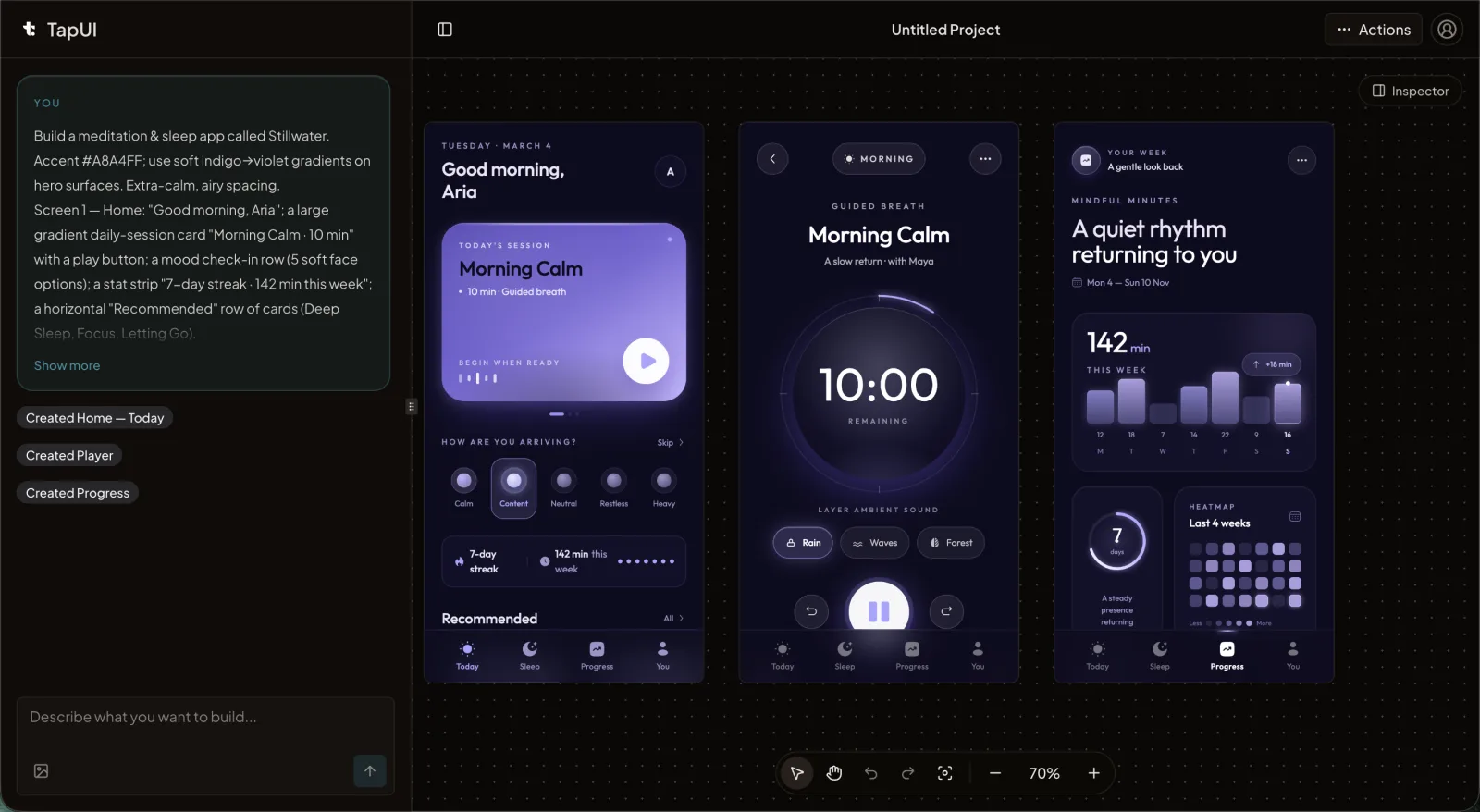 Describe an app in plain text and TapUI generates polished mobile UI screens you can refine and hand off.
That makes the starting line different. A founder, PM, or designer can go from a sentence to a set of real-looking screens without manually placing a single rectangle. From there you refine the output and hand the designs off to your developers to build.
A prompt to TapUI looks like this:
A travel booking app: destination search, hotel listings with photos
and ratings, a booking flow, and a user profile. Clean, modern,
with blue and orange accents.
You get screens back to react to, rather than a blank file to fill. For people who don't think in Figma — or who do, but don't want to spend a day on first-draft layouts — that's the whole appeal.
Where TapUI is the better choice
Pros:
- TapUI wins on the very thing Bravo assumes away: getting to a design at all. Starting from scratch, describing an app and getting screens back is dramatically faster than learning a design tool and building each screen by hand.
- For founders and PMs who need something concrete to show or to brief a developer with, that speed-to-first-draft is the point.
- It's the lower-friction option for non-designers. There's no separate design tool to buy and learn before you start; generation and refinement happen in one place.
Where TapUI is not the right tool
Cons:
- TapUI is a UI design tool, not a full app builder — it does not wire your screens to a live backend the way Bravo's API binding does, and it does not publish to the App Store for you.
- If your goal today is a functioning app with real data and store distribution — not screens to hand off — Bravo's model is built for that and TapUI's isn't.
So the gap is real: TapUI gets you to a strong design fast; turning that into a shipping app still runs through your development team, who take the refined screens and build from them.
TapUI pricing, briefly
TapUI has a free tier so you can try generating screens before paying. Beyond that:
- Starter — $20/mo ($17/mo billed yearly): 100 screen generations/mo, project history and exports, email support.
- Pro — $40/mo ($27/mo billed yearly): 650 generations/mo, everything in Starter plus priority support.
Pick the tier that matches how much you generate.
How to actually choose
The decision comes down to two questions — skip the feature-count scorecard.
1. Do you already have a design? If yes, and it's in Figma, Bravo lets you turn it into a native app without redrawing anything. If no, TapUI gets you a design from a description and saves you the build-it-by-hand step entirely.
2. What do you need at the end — screens or a shipping app? If you need an installable, data-connected app published to the stores, Bravo is built for that endpoint. If you need polished UI screens to refine and hand to your developers, that's where TapUI fits.
A few concrete situations:
- A non-designer founder with an idea and no Figma skills. TapUI removes the biggest blocker — producing a design at all. Starting in Bravo would mean learning Figma first.
- A design team already deep in Figma that wants a working app with live data. Bravo extends what you've built into a native, publishable app. That's its strongest case.
- An agency that needs to show a client something that genuinely works. Bravo's API binding and store publishing make a functioning demo possible without code.
- A PM who needs screens to brief engineering by Friday. TapUI's text-to-UI generation gets you there fastest.
Which tool should you pick?
- Need a design from nothing but an idea? → TapUI. Describe the app, get polished screens, refine, and hand them to your developers.
- Need a shippable, data-connected app and you already have Figma designs? → Bravo Studio. Tag your screens, bind them to a backend, and publish to the stores.
- Not a designer and unsure where to start? → TapUI. It sidesteps the steepest part of Bravo's workflow.
- Need a live, "it actually works" client demo? → Bravo Studio. API binding plus store publishing make that possible without code.
FAQ
Does Bravo Studio require Figma?
Yes. Bravo's entire workflow is built around Figma — you design your screens there, tag elements with Bravo's system, and Bravo converts them into a native app. If you don't already use Figma, you'd need to learn it first before you could use Bravo.
Does TapUI generate designs with AI?
Yes. TapUI takes a plain-text description of your app and generates polished mobile UI screens for you, which you can then refine and hand to your developers. There's no design work needed upfront.
Can I export code from TapUI designs?
No. TapUI generates UI designs, not code or platform-specific libraries like React Native, Swift, or Flutter. You hand the refined designs to developers who build the actual app from them.
Can Bravo Studio publish an app to the App Store and Google Play?
Yes. Bravo publishes native iOS and Android apps directly to the App Store and Google Play, and can wire them to live backends via APIs so they display real data.
What's the pricing difference between TapUI and Bravo?
Both offer free tiers to explore. TapUI's paid plans start at Starter ($20/mo for 100 generations/month) and Pro ($40/mo for 650 generations/month). Bravo's paid plans unlock store publishing and advanced features, but don't include a backend — you'll add the cost of an external data service separately.
Which tool should I pick if I'm starting from scratch?
If you have an idea but no design yet, TapUI is faster — describe your app and get screens in hours, not days. If you already have a polished Figma design and want a shipping, data-connected app, Bravo is your endpoint.
The bottom line
Bravo Studio and TapUI aren't really competing for the same moment in your process. Bravo starts where a finished design ends and carries it to a shipping app. TapUI starts where you have nothing but an idea and gets you to a design.
Pick Bravo Studio if you live in Figma, already have designs, and need a working, data-connected app in the stores. Pick TapUI if you're starting from a description and want polished UI screens fast, without building them by hand first.
If that second case sounds like you, try TapUI and see how far a single prompt gets you.
Related: TapUI vs AppyPie • 8 best v0 alternatives for mobile • Ship mobile UI faster with AI