TapUI vs BuilderX: Which Mobile UI Tool Fits Your Workflow?
TapUI turns text prompts into mobile app screens; BuilderX was a design-to-code tool now effectively abandoned. Here is how they compare.
TL;DR: BuilderX was a design-to-code tool that turned a visual canvas into React and React Native code, but it has been effectively dormant since 2023. TapUI is an actively maintained, prompt-first tool that turns a text description into polished mobile UI screens you can hand to developers — though it does not export code. Need code generation from a visual canvas? Look at BuilderX (knowing it's unmaintained). Need fast, good-looking screens from a prompt? Choose TapUI.
At a glance
| Tool | Best for | Key strength | Pricing | Maintained? |
|---|---|---|---|---|
| TapUI | Founders, PMs, designers who want UI fast | Prompt-to-UI: describe a screen, get a polished design | Free tier; Starter $20/mo, Pro $40/mo | ✅ Actively developed |
| BuilderX | Developers wanting design-to-code in React/React Native | Visual canvas → readable React Native code (flexbox conversion) | Was ~$15/seat/mo + trial | ❌ Dormant since ~2023 |
BuilderX has barely moved in years — that changes the comparison. Its last app release went out in April 2023, the core GitHub repos haven't seen meaningful activity since 2019, and the builderx.io domain now redirects to a completely different product the founder is building. This isn't "old reliable tool versus shiny new one" — it's a maintained, AI-first tool versus one that has effectively been sunset.
So rather than pretend these two tools are competing head to head today, this piece does something more useful: it explains what BuilderX did well, what TapUI does differently, and which one actually makes sense depending on what you're trying to ship.
The short version
BuilderX was a browser-based, design-to-code tool. You laid out screens visually on a canvas, and it generated clean React and React Native code — including a genuinely clever feature that converted absolute-positioned designs into developer-friendly flexbox. Built by Sanket Sahu and the team at GeekyAnts, it found a real audience among developers who wanted to skip the handoff step and get usable code straight out of a design surface.
TapUI starts from text. You describe the app you have in mind, and it generates polished mobile UI screens you can refine and hand to your team. There's no manual canvas-first step required, and no React Native knowledge needed to get something on screen.
The honest framing: if you want production code generated from a visual design and you're willing to work with an unmaintained tool, BuilderX's approach is still interesting. If you want fast, good-looking mobile screens without doing the design work by hand — and you want a tool that's actually being worked on — TapUI is the more practical pick.
What BuilderX actually did
Best for: developers in the React / React Native ecosystem who want to design on a canvas and pull real code out — if they can accept an unmaintained tool.
BuilderX was a thoughtful product, and it helps to be specific about what it did well.
You designed screens on a canvas in the browser — no desktop install. As you worked, BuilderX generated readable React Native (iOS and Android) and React (web) code. A few things genuinely set it apart in its prime:
- Sketch import. You could bring a Sketch file in and convert it toward React Native components, which was a real shortcut for teams already living in Sketch.
- Flexbox conversion. Most visual tools spit out brittle, absolutely-positioned layouts. BuilderX translated designs into flex layouts that developers could actually maintain. That was the standout feature.
- Whole-project or component export, with navigation included, plus a built-in component library and open-source icon sets.
- Shareable links for basic team collaboration.
Pricing, back when it was active, was modest — on the order of $15 per seat per month for an individual plan and a bit more for teams, with a 30-day trial. (You may see a much higher figure quoted on some comparison sites; that number appears to be inaccurate.)
The catch is the present tense. BuilderX requires you to design every screen yourself first — there's no generation step, no prompt-to-UI. And critically, the project looks dormant. The founder, Sanket Sahu, has publicly moved on to a separate AI-native app builder under a different company. BuilderX was never formally shut down, but the domain redirect and the years of silence tell the story. If you adopt it today, you're betting on a tool nobody is fixing.
Pros: real React / React Native code from a visual design, standout flexbox conversion, Sketch import, whole-project export. Cons: no prompt-to-UI (you design every screen by hand), effectively unmaintained, React-ecosystem only.
What TapUI does
Best for: founders, product managers, and designers who want a polished mobile screen fast, without doing the visual design by hand.
TapUI inverts the starting point. Instead of "open a blank canvas and place components," you write a sentence or two describing the screen or flow you want, and it generates a polished mobile app UI for you to refine.
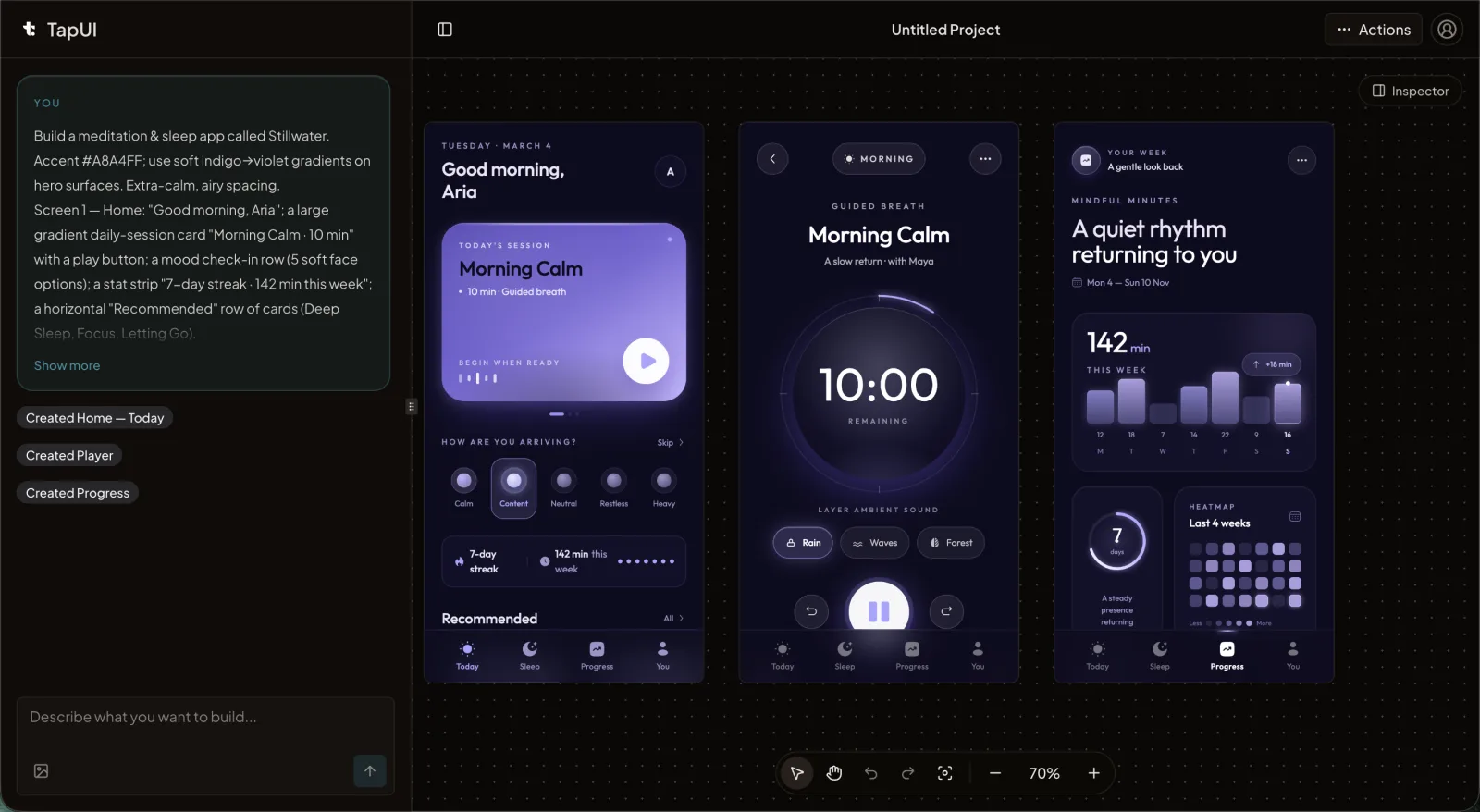 The TapUI editor turns a plain-text description into a polished mobile UI screen you can refine and hand off.
That's the core difference, and it's a big one in practice. A founder validating an idea, a PM sketching a feature for engineering, or a designer who wants a strong first draft can all get to a real-looking screen in the time it would take to set up a BuilderX project file. From there you iterate — adjust the layout, swap content, refine the look — and end up with designs you can hand to your developers.
TapUI is aimed squarely at people who want working app UI fast without manual design labor: founders, product managers, and designers. It runs on a free tier plus paid Starter ($20/mo, or $17/mo billed yearly) and Pro ($40/mo, or $27/mo billed yearly) plans, so you can try the generation flow before committing.
One thing worth stating plainly, because the older version of this comparison got it wrong: TapUI does not export React Native, Swift, or Flutter code. What you get is the design — polished screens, plus project history and exports — that you hand to your developers to build from. If your single hard requirement is "I draw a screen and get native source out the other end," that is exactly the thing BuilderX was built to do and TapUI is not. Be clear-eyed about that before you choose.
Pros: prompt-first, no design skills needed, fast first draft, actively maintained, free tier to start. Cons: no platform code export (designs only), not a visual canvas if you prefer to lay screens out by hand.
Where they genuinely differ
How you start a screen
The real fork in the road is how each tool begins: BuilderX is design-first (you build the layout, it produces code), while TapUI is prompt-first (you describe the layout, it produces the design). Neither is universally "better" — they suit different people. A developer who already thinks in components and wants code may prefer the BuilderX model. Someone who wants to avoid doing the visual design work will move much faster with TapUI.
Code and developer handoff
BuilderX has the clearer historical claim here. Generating actual React and React Native code — readable, flex-based, exportable as a whole project — was its entire reason for existing, and it did it well. TapUI's strength is the design itself: polished screens you can hand to your developers to build from. If automatic code generation from a visual canvas is non-negotiable for you, that points toward BuilderX's approach, with the caveat that the product is no longer maintained.
Whether anyone is maintaining it
This is where the comparison stops being close. TapUI is an actively developed product with a current pricing model and an evolving feature set. BuilderX, by every public signal — release history, repo activity, the founder's own redirect to a new product — is not. For anything you intend to rely on for more than a weekend, that gap matters more than any single feature.
Scope of platforms
BuilderX was explicitly a React / React Native tool. That focus was a strength for teams in that ecosystem and a hard limit for everyone else. TapUI is about generating mobile app UI from a description rather than targeting a specific code framework, so the question isn't "which frameworks does it emit" — it's "how good are the screens and how easily can my team build from them."
A quick side-by-side
| TapUI | BuilderX | |
|---|---|---|
| How you start | Describe the app in plain text | Design screens on a visual canvas |
| Generates designs from a prompt | Yes | No — manual design first |
| Generates code from a visual design | No | Yes — React / React Native (its core feature) |
| Sketch import | No | Yes |
| Who it's for | Founders, PMs, designers who want UI fast | Developers wanting design-to-code in the React ecosystem |
| Maintenance status | Actively developed | Effectively dormant since ~2023 |
| Pricing | Free tier; Starter $20/mo, Pro $40/mo | Was ~$15/seat/mo + trial — but unmaintained |
So which should you use?
Pick BuilderX if — and this is a narrow "if" — you specifically need a visual canvas that emits React or React Native code, you're comfortable designing every screen by hand, and you can live with a tool that has no active support, no updates, and an uncertain future. For some quick code-generation experiments, the old product at v1.builderx.io may still serve. Just go in knowing it's frozen in time.
Pick TapUI if you want to get from an idea to a polished mobile screen quickly, you'd rather describe what you want than build it pixel by pixel, and you value working with a tool that's still being developed. It fits founders shipping fast, PMs spec'ing features, and designers who want a strong starting draft instead of a blank artboard.
And if you're weighing BuilderX mainly because you remember it fondly, it's worth knowing the founder himself has moved on to newer AI-driven work — a fair signal of where this category is heading.
FAQ
Is BuilderX still being maintained?
No — by all public signals, BuilderX is effectively dormant. The last app version shipped in April 2023, the core repositories have been quiet since 2019, and the builderx.io domain now redirects to a separate product from the same founder. It was never formally announced as shut down, but it has stopped moving.
Does TapUI export React Native, Swift, or Flutter code?
No. TapUI generates polished mobile UI designs from your text description that you hand to developers to build from. If exporting production-ready platform code from a design is non-negotiable, that was BuilderX's specialty, not TapUI's.
What was BuilderX best at?
BuilderX's standout feature was turning a visual design into readable, production-ready React and React Native code — especially its conversion of absolute-positioned layouts into maintainable flexbox. Its Sketch import was also a standout feature when the product was active.
Do I need to know how to design to use TapUI?
No. TapUI is built around describing what you want in plain text rather than building the layout manually, so you can generate polished screens without any design experience.
Can I migrate a BuilderX project into TapUI?
There's no automatic import. The two tools work in fundamentally different ways: BuilderX requires you to design first and generates code, while TapUI starts from a text description and generates designs. You'd recreate the screens by describing them.
What are TapUI's pricing plans?
TapUI offers a free tier, plus Starter ($20/mo or $17/mo billed yearly with 100 screen generations per month) and Pro ($40/mo or $27/mo billed yearly with 650 generations per month). Starter and Pro both include project history, exports, and support — Pro adds priority support.
The takeaway isn't that one tool crushes the other — it's matching the tool to the job:
- Need code generated from a visual design, and React Native is non-negotiable? -> BuilderX is the closer fit on paper, with the caveat that it's unmaintained.
- Want fast, polished mobile screens from a text prompt, on a tool that's actively developed? -> TapUI.
- Not sure? -> Start on TapUI's free tier; it's the lowest-cost way to see the prompt-to-UI workflow before committing.
BuilderX was a well-built design-to-code tool, but it's a product that has stopped moving. TapUI bets on a different workflow — describe it, generate it, refine it — and it's a bet that's actively maintained. Match the tool to the job, and to whether you can afford to depend on something nobody is updating.
Want to see the prompt-to-UI workflow for yourself? Try TapUI.