TapUI vs Draftbit: Which Fits How You Actually Work?
TapUI generates mobile UI from a text prompt; Draftbit is a visual builder that ships real apps. Here's which one fits your workflow.
TL;DR: Draftbit is a visual, drag-and-drop builder that exports real React Native code and ships data-connected apps end to end. TapUI is AI-first: you describe an app in plain text and it generates polished mobile UI screens to react to — fast to start, but it designs screens rather than exporting code. Choose TapUI to explore and create UI quickly; choose Draftbit when the destination is a publishable native app you own.
These two tools get compared a lot, which is a little misleading, because they start from opposite ends of the same problem. Draftbit is a visual builder that you assemble screen by screen until you have a real, publishable app. TapUI is the other direction entirely: you describe the app in plain language and it hands you finished mobile UI screens to react to.
So the honest version of this comparison isn't "which one wins." It's "which starting point matches how you think." If you already know exactly where every button goes and you want to place it yourself, those tools feel very different than they do when you're staring at a blank file with a rough idea and no time.
TapUI vs Draftbit at a glance
| Tool | Best for | Key strength | Pricing | Code export |
|---|---|---|---|---|
| TapUI | Founders, PMs, designers who want fast UI | Describe an app, get polished mobile screens back instantly | Free; Starter $20/mo ($17/mo yearly); Pro $40/mo ($27/mo yearly) | ❌ No native code export (designs/screens to hand to developers) |
| Draftbit | Builders shipping real, data-connected native apps | Drag-and-drop control plus real React Native (Expo) output | Free tier + paid plans (credit-based AI) | ✅ React Native source on paid plans |
Let me walk through where each one earns its keep.
The core difference in one paragraph
TapUI was built AI-first — the prompt is the workflow — while Draftbit is a canvas-based visual builder that layered AI on top. Draftbit grew up as a drag-and-drop editor for building React Native apps, and it later added AI assistance. That distinction colors almost everything downstream — speed, control, who it's for, what you walk away with.
What Draftbit is good at
Best for: teams whose end goal is a shippable, data-connected native app and who are comfortable with mobile-development concepts.
Draftbit is a mature platform, and it shows. A few things it genuinely does better than a text-to-UI tool:
- You own the code. Draftbit exports clean React Native (Expo) source. On its paid plans you can take that code with you, push to GitHub, and keep building in a real codebase. For teams who plan to graduate off the builder eventually, that's a real safety net.
- Granular visual control. Because you're placing elements on a canvas, you decide exactly where everything sits. If you have a specific layout in your head and you want pixel-level say over it, manual placement gets you there in a way a prompt can't always match on the first try.
- It builds whole apps, not just screens. Draftbit handles navigation, data binding, and API connections (REST, Airtable, Supabase, and similar). You can wire a screen to live data and preview it on a real device over a QR code. That's a full-stack story, not a mockup story.
- Established ecosystem. Docs, templates, a sizable builder community, team workspaces with roles. If you like learning a tool deeply and having resources to lean on, that maturity counts.
Pros: real code ownership, pixel-level control, full app building, mature ecosystem. Cons: slower manual workflow, a learning curve, AI is an add-on and credit-gated, and export is one-way.
Where Draftbit asks more of you
The trade-off for that level of control is real effort and a bit of expertise:
- Manual building is slower. Placing and configuring every element by hand is, by design, more work than describing a screen and getting it back assembled. That's the trade you're making for precision.
- There's a learning curve. Understanding Flexbox and basic React Native layout helps a lot. It's more technical than a pure text-to-UI tool, which matters if you're a founder or PM who just wants screens, not a build environment to learn.
- AI is the add-on, not the engine. Draftbit's AI agents (it integrates models like Claude, GPT, and Gemini) can turn instructions into UI changes, and there's a bring-your-own-API-key option. But it's a layer on top of a visual builder, so the AI assists the manual workflow rather than replacing it.
- AI usage is credit-gated. Even on paid plans, AI actions consume credits. Worth knowing if you plan to lean on the AI heavily.
- Export is one-way. Once you export the code, you can't round-trip your edits back into the builder. Crossing that bridge is a commitment.
What TapUI is good at
Best for: founders, PMs, and designers who want polished mobile UI fast, without learning a build environment.
TapUI's whole pitch is the starting point — describe your app, get polished mobile UI screens back instantly. You type a description of the app you have in mind, and it generates finished screens you can look at, judge, and iterate on.
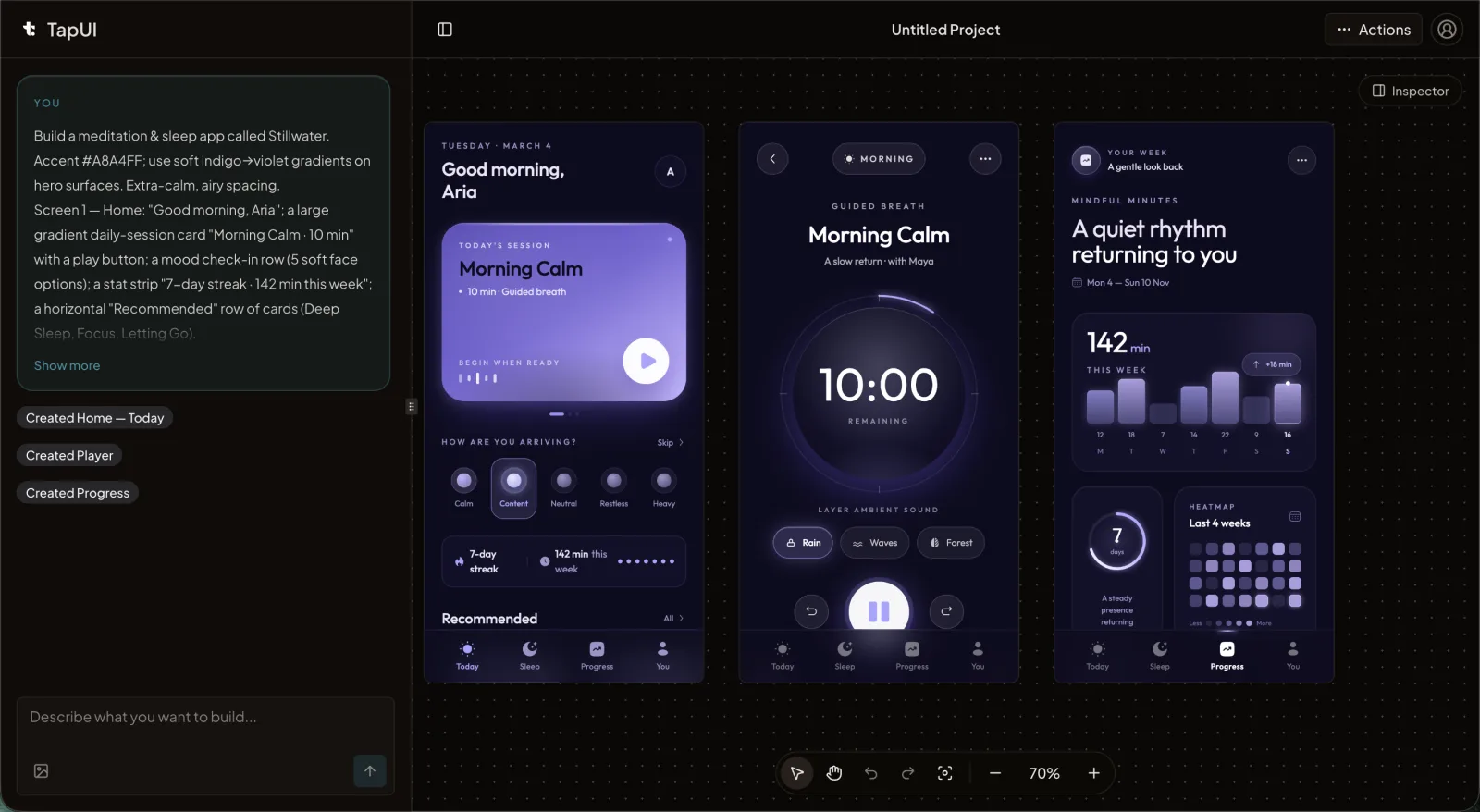 The TapUI editor: describe an app in plain language and get finished mobile screens back to refine.
The wins are mostly about momentum:
- Speed from nothing. When you don't have a layout in your head yet, generating a first pass is dramatically faster than building one element at a time. You get something concrete to react to, which is often the hardest part of starting.
- No design or dev background needed. This is aimed squarely at founders, PMs, and designers who want working app UI without the manual labor. The prompt is the only skill required.
- It's built for exploration. Don't like the direction? Re-describe it and try again. Treating the first output as a draft rather than a deliverable is the natural way to use it.
- Handoff-friendly. The screens you land on are designs you can take to your developers to build from.
Pros: fastest path to a first screen, no technical background required, great for exploring directions, designs that hand off cleanly to developers. Cons: less pixel-level control on the first pass, designs screens rather than a full publishable app, and no native code export.
Where TapUI gives up ground
TapUI trades precision and code ownership for speed — the same trade-off in reverse:
- Less pixel-level control on the first pass. Generation gets you most of the way fast, but if you have an exact, opinionated layout in mind, a manual canvas lets you place every element deliberately. TapUI is a faster start, not necessarily a more precise one.
- It generates UI screens, not a full publishable app. TapUI is focused on the design layer. If your immediate need is a data-connected, store-ready build with navigation and API wiring done in the same tool, that's Draftbit's territory, not TapUI's.
- No native code export. TapUI does not export React Native (or other platform) source. If "own the codebase, push to GitHub, keep building in React Native" is non-negotiable for you, Draftbit is built for that and TapUI isn't trying to be.
A quick side-by-side
| TapUI | Draftbit | |
|---|---|---|
| Core workflow | Describe it, AI generates screens | Drag-and-drop visual building, AI-assisted |
| Starting point | Plain-text prompt | Blank canvas |
| Speed to first screen | Fast | Slower, more deliberate |
| Pixel-level control | Good within mobile patterns | Very high (manual placement) |
| Native code export | ❌ No | ✅ Yes (paid plans) |
| Builds full data-connected apps | Focused on UI screens | Yes, end to end |
| Best for | Founders, PMs, designers who want fast UI | Builders shipping real native apps |
| Learning curve | Minimal | Moderate, some RN/Flexbox helps |
Pricing, roughly
Both tools have a free tier, so you can try either before committing.
TapUI offers a free tier plus two paid plans: Starter at $20/mo ($17/mo billed yearly) with 100 screen generations per month, project history and exports, and email support; and Pro at $40/mo ($27/mo billed yearly) with 650 generations per month, everything in Starter, plus priority support. The thing to weigh isn't the sticker price anyway — it's whether the workflow saves you the hours it's meant to.
Draftbit publishes its plans openly: a free tier, then paid tiers that unlock things like code export, more AI credits, GitHub export, simulators, and team collaboration as you move up. AI actions draw down a monthly credit pool on every plan, which is the main thing to model if you'll be prompting a lot.
So which one? A quick decision guide
The choice comes down to where you are in the work: TapUI if you need to figure out what to build, Draftbit if you're ready to build and ship it.
- Need polished screens in front of someone today, with no tool to learn? → TapUI. You're at the front of a project — validating an idea or exploring directions — and the value is the head start.
- Need a real, publishable native app you own the code for? → Draftbit. You want React Native source, data wiring, and you're comfortable with the more technical, hands-on building that control requires.
- Need both — fast exploration and a shippable build? → Use them together. Generate screens in TapUI to figure out what to build, then rebuild the version you like in Draftbit to ship it.
The two approaches can hand off to each other — one for figuring out what to build, the other for building it. The wrong move is picking based on a feature checklist. Pick based on where you are in the work and how you like to think when you start.
FAQ
Does TapUI export React Native code?
No. TapUI generates mobile UI screens and designs that you hand to developers to build from. If owning and extending a React Native codebase is non-negotiable, Draftbit is built for that workflow. TapUI focuses on the design-to-handoff phase, not code ownership.
Which tool is faster to a first screen?
TapUI wins by a large margin. Describing a screen in plain language and getting polished UI back instantly beats placing elements one by one on a canvas. That speed-from-nothing advantage is the core value of the AI-first approach.
Which one gives you more pixel-level layout control?
Draftbit, if you have a precise vision. Manual canvas placement lets you position every element exactly where you want it, whereas TapUI generation gets you a strong starting point that you then refine. For exploratory work, TapUI's speed usually outweighs the control trade-off.
Can I use both tools together?
Yes, and it's a common pattern. Use TapUI to explore directions and generate candidate designs quickly, then rebuild the version you like in Draftbit to get code export and full app-building features. They hand off cleanly to each other.
What's the real difference in pricing?
TapUI's free tier lets you try it; Starter is $20/mo ($17/mo yearly) with 100 screen generations and project history, and Pro is $40/mo ($27/mo yearly) with 650 generations and priority support. Draftbit uses credit-based pricing where AI actions consume credits on every plan. Which is cheaper depends on how often you generate and whether you need native code export.
Reviewed June 23, 2026.