TapUI vs Figma AI for Mobile App Design: An Honest Comparison
TapUI generates mobile app screens from a prompt; Figma AI lives inside a full design suite. Here's how they actually differ and which fits your work.
TL;DR: TapUI is a focused AI tool that turns a text description into polished mobile app screens, built for founders, PMs, and designers who want UI fast. Figma AI is a set of AI features inside Figma's full design suite, best for teams already living in Figma with a real design system. Neither hands you production-ready code. Pick TapUI for speed and approachability on mobile; pick Figma for breadth, collaboration, and ecosystem.
Type "habit tracker with a weekly streak view" into TapUI and you get a set of finished mobile screens back. Type something similar into Figma's First Draft and you get a starting layout dropped onto an infinite canvas inside a tool that does a hundred other things. That difference, a focused generator versus AI features bolted onto a mature design platform, is really the whole comparison. Which one is "better" depends entirely on what you're trying to do and who's doing it.
I'll lay out where each one is genuinely strong, where each falls short, and how to decide.
TapUI vs Figma AI vs Google Stitch at a glance
| Tool | Best for | Key strength | Pricing | Production code? |
|---|---|---|---|---|
| TapUI | Founders/PMs who want mobile screens fast | Mobile-first generation from a prompt | Free tier; Starter $20/mo ($17/mo yearly); Pro $40/mo ($27/mo yearly) | ❌ designs to hand to developers |
| Figma AI | Teams already on Figma with a design system | Full suite: collaboration, design systems, handoff | Full-seat plans + metered AI credits | ⚠️ Dev Mode code as a reference only |
| Google Stitch | Free, throwaway mobile concepts | Free multi-screen generation | Free (Google Labs) | ⚠️ generates code, experimental |
The two tools aren't the same category
It's worth being precise, because "Figma AI" gets thrown around loosely.
TapUI is a dedicated AI design tool for mobile app UI. You describe an app in plain language and it generates polished mobile screens. It's aimed at founders, product managers, and designers who want working app UI fast, without sitting down to lay out every screen by hand. There's a free tier plus paid Starter and Pro plans.
Figma AI isn't a separate app you download. It's an umbrella of AI features built into Figma, the design platform most professional teams already use. The relevant pieces include First Draft (generates wireframes and screens from a text prompt), Figma Make (turns prompts into interactive prototypes), AI tools that fill layouts with content and auto-connect frames into flows, and Dev Mode features that convert layers into code like HTML/CSS, Tailwind, and SwiftUI. It runs in the browser and in desktop apps for Mac and Windows. The mobile Figma app is view-only, so there's no AI generation on a phone.
So one is a single-purpose generator; the other is a general design suite that happens to have AI woven through it. Keep that framing as you read the rest.
Where Figma AI is genuinely the stronger choice
I'd be doing you a disservice to pretend TapUI wins everywhere. For a lot of teams, Figma is the right answer, and not just out of habit.
Best for: established design teams with a mature design system and developer-handoff workflow.
You're probably already in it. A large majority of working designers already use Figma daily. If your team lives there, the AI features sit right next to your components, your tokens, your version history, and your teammates' comments. There's no new tool to adopt, no second source of truth.
The ecosystem is the moat. Design, prototyping, and developer handoff happen in one place. Code Connect can map Figma components to the real components in your codebase, which is something a standalone generator simply can't offer. For an established product with a mature design system, that integration is hard to give up.
It exports code that developers can use as a reference. Dev Mode can output SwiftUI, Tailwind, and HTML/CSS. Worth a caveat: that generated code is a starting point, not production-ready output. It tends to lack semantic structure and accessibility, so treat it as scaffolding your engineers will rework.
Collaboration is first-class. Comments, shared libraries, branching, version history. If multiple people touch the same files, this matters more than raw generation speed.
Pros: deep design-system tooling, real-time collaboration, code-to-component mapping, one source of truth. Cons: AI output can look generic and need reshaping; mobile design isn't one-click; AI metered in credits that can run out; full-seat pricing sits well above focused generators; real learning curve for non-designers.
Where Figma AI gets weaker, honestly: the AI is layered onto a canvas tool that predates it, and it shows. First Draft and Figma Make output can look visibly AI-generated and generic, and you'll often spend real time reshaping it. Mobile-specific design isn't one-click; you set up responsive behavior yourself. And for a non-designer, Figma has a real learning curve. It's built for design teams, not for a founder who just wants screens.
Where TapUI fits better
TapUI's advantage is narrowness. It does one thing, and the whole product is shaped around it.
Best for: founders and PMs who need mobile screens fast and don't want to learn a design tool.
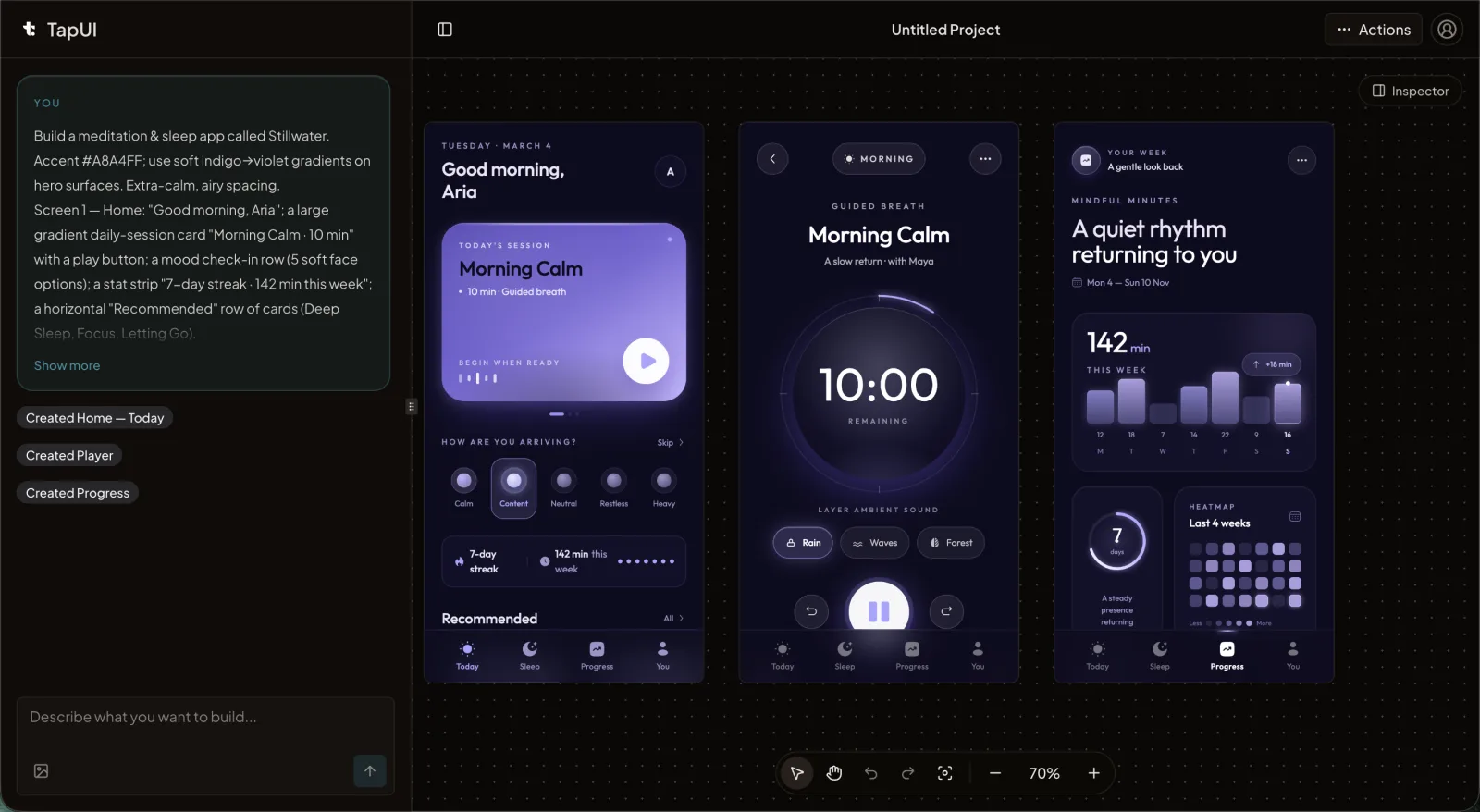 The TapUI editor turns a plain-language app description into polished mobile screens.
It's built mobile-first, not adapted to mobile. You're not configuring frames and breakpoints to coax a general tool into producing a phone screen. You describe the app and get mobile UI back. For someone whose product lives entirely on phones, that removes a lot of fiddly setup.
It's approachable for non-designers. This is the real wedge. A founder or PM who would stall out on Figma's canvas can describe what they want in a sentence and get something usable to react to. Reacting to a real screen beats staring at a blank artboard.
Speed of exploration. Because generation is the core loop rather than one feature among many, trying several directions for a screen is quick. You refine from a draft instead of building from nothing.
On handoff: TapUI gives you designs you can hand to your developers to build from, and paid plans include project history and exports. It does not generate React Native, Swift, or Flutter code, so plan for engineers to build the implementation from the screens.
Pros: mobile-first by default, approachable for non-designers, fast exploration, free tier to start. Cons: not a full design suite; no real-time multiplayer editing, branching, deep design-system tooling, or code-to-component mapping; mobile-only.
And the honest limits: TapUI is not a full design suite. If your work spans web and desktop alongside mobile, or you need tight integration with an existing component library, a focused mobile generator is the wrong tool. TapUI is for getting mobile screens fast, not for running a large design org.
A third option worth knowing: Google Stitch
Best for: generating free mobile concepts when long-term stability doesn't matter.
If you're comparing AI UI generators, Stitch belongs in the conversation. It's a free Google Labs tool that generates UI screens from text prompts or uploaded images, with multi-screen generation, an infinite canvas, theming, and code export across several frameworks.
The catch is right there in "Labs." Stitch is an experiment, with no enterprise roadmap and no guarantee it sticks around. Google has sunset Labs projects before. It's a great way to generate screens for free today, but I wouldn't build a team's workflow on it. It also generates from base AI models rather than your own component library, so design-system enforcement is limited.
Pros: free, multi-screen generation, code export across frameworks. Cons: experimental Labs status with no stability guarantee; limited design-system enforcement.
How to actually decide
A few honest rules of thumb, routed by what you need:
- Already run on Figma with a design system? → Figma. The integration and collaboration outweigh any single tool's generation speed.
- A founder or PM who needs mobile screens and doesn't want to learn a design tool? → TapUI. It's the lower-friction path. Start on the free tier.
- Designing across web, desktop, and mobile? → Figma. Its general-purpose approach handles the spread better than a mobile-only generator.
- Want to spin up mobile concepts for free and don't need long-term stability? → Google Stitch. Go in with eyes open about its experimental status.
- Need production code? → none of them alone. None hand you finished, accessible, production-ready code. Budget engineering time regardless of which you pick.
There's no universal winner here, and anyone telling you otherwise is selling something. Figma AI is the safer institutional choice with more under the hood. TapUI trades breadth for speed and approachability on one job: turning a description into mobile app screens. Match the tool to the work in front of you.
FAQ
Is TapUI a replacement for Figma?
No. Figma is a full design platform with collaboration, design systems, and developer handoff. TapUI is a focused tool for generating mobile app UI from a prompt. Many people use a generator to get a fast starting point and a full design tool to refine.
How much does TapUI cost?
TapUI has a free tier. Starter is $20/mo ($17/mo billed yearly) with 100 screen generations per month, project history and exports, and email support. Pro is $40/mo ($27/mo billed yearly) with 650 generations per month plus everything in Starter and priority support.
Does Figma AI cost extra on top of a Figma plan?
Figma's AI features run on a credit system. Plans include a monthly credit allowance, and heavy AI use can exhaust it, with additional credits available as a paid add-on. Check Figma's current pricing for the latest details.
Can TapUI export React Native, Swift, or Flutter code?
No. TapUI generates mobile app UI designs that you hand to developers to build from. It does not export React Native, Swift, Flutter, or any platform-specific code. Plan for your engineering team to implement the final product based on the screens TapUI produces.
Can Figma AI and TapUI give me production-ready code?
Not directly. Figma's Dev Mode can export code like SwiftUI and Tailwind, but it's a reference starting point that lacks production polish and accessibility. TapUI hands you designs to build from rather than platform code. In both cases, developers will rework the output for production.
Is Google Stitch a viable alternative?
Google Stitch is a free Labs tool that generates UI from prompts or images with code export across frameworks. However, as an experimental Labs product its long-term future isn't guaranteed, so avoid building team workflows on it long-term.
Want to see how fast describing an app turns into screens? Try TapUI on the free tier and judge it against your own workflow.