TapUI vs Framer: Picking the Right AI Design Tool
TapUI generates mobile app UI from a prompt; Framer builds live websites. Here's which AI design tool fits the thing you're actually building.
TL;DR: TapUI and Framer both turn a text prompt into a polished interface, but they aim at different finish lines. Framer is an AI website builder — describe a site and it publishes a responsive, hostable web page. TapUI is an AI mobile UI generator — describe an app and it produces mobile app screens you refine and hand to developers. If your output lives in a browser, pick Framer; if it lives on a phone, pick TapUI.
People keep filing TapUI and Framer in the same drawer because both let you type a description and watch a polished interface appear. That shared trick hides the part that actually matters: they point at different finish lines. Framer ends with a published website. TapUI ends with mobile app screens.
So the honest version of this comparison isn't "which one is better." It's "what are you trying to ship?" Get that answer right and the choice mostly makes itself.
TapUI vs Framer at a glance
| Tool | Best for | Key strength | Pricing | Code export |
|---|---|---|---|---|
| TapUI | Founders, PMs, mobile designers | AI-generated mobile app UI screens from a prompt | Free; Starter $20/mo ($17/mo yearly); Pro $40/mo ($27/mo yearly) | ❌ No platform code; designs/screens you hand to developers |
| Framer | Marketers, web designers | Prompt-to-published responsive websites with strong motion | Paid plans (web hosting included) | ⚠️ Web output is hostable, not handoff source code |
Read that as two specialists, not a scoreboard. Each tool declines to do the other one's job.
The one-sentence version
Framer is an AI website builder — you describe a site and it produces a responsive, hostable web page. TapUI is an AI mobile UI generator — you describe an app and it produces app screens you can refine and hand to your developers. If your output lives in a browser, Framer is the stronger fit. If your output lives on a phone's home screen, that's TapUI's lane.
Everything below is just the detail behind that.
What Framer actually is
Framer (framer.com, out of Amsterdam) is a no-code web design and publishing platform. You work on a Figma-style visual canvas with drag-and-drop and free-form layout, and its AI can spin up a multi-page responsive site from a text prompt. It's a serious, well-funded product with a large active user base and a fast release cadence — this isn't a tool that's going to disappear on you.
Best for: marketers and web designers shipping production websites without writing front-end code.
Where Framer genuinely shines:
- Web design output. The published result is production-ready, not a throwaway mockup. For marketing sites and landing pages, the quality is among the best in the no-code category.
- Figma workflow. Its Figma integration — including paste-from-Figma — is the strongest of any no-code builder. If your team already lives in Figma, that's a real advantage.
- End-to-end for the web. Hosting, CDN, a CMS, analytics, SEO tooling, and A/B testing (on higher tiers) are built in. You can go from prompt to live URL without leaving the tool.
- Motion. Framer's animation and interaction tooling is more advanced than most builders'. Scroll effects, transitions, hover states — this is where it earns its reputation.
Framer is honest about being a web tool, and so should we be: for a website, it does things TapUI simply doesn't attempt.
Pros: production-ready web output, best-in-class Figma integration, built-in hosting/CMS/analytics, advanced motion tooling. Cons: no native app screen generation, no native e-commerce, a CMS that trails WordPress for content-heavy sites, and a constrained cheapest paid plan.
Where Framer stops
The wall you hit is the platform itself. Framer outputs responsive websites. Its "mobile" support means a site that reflows for a phone browser — not native app screens. It doesn't generate iOS or Android app UI, app prototypes, or mobile-app-specific layouts. The AI is tuned for web layouts, full stop.
A few other limits worth knowing if you're weighing Framer on its own terms: there's no native e-commerce (a real gap next to Webflow or Shopify), the CMS still trails WordPress for content-heavy sites, the plugin ecosystem is smaller than Webflow's, and the cheapest paid plan is fairly constrained for what it costs. None of that matters if you're building a clean marketing site. All of it matters if you expected an app.
What TapUI actually is
TapUI is an AI design tool for mobile app interfaces. You describe the app you have in mind in plain language, and it generates polished mobile UI screens — the kind of starting point that would otherwise eat hours of manual layout work. It's aimed at founders, product managers, and designers who need working app UI quickly and don't want to push pixels by hand to get there.
Best for: founders, PMs, and mobile designers who need polished app screens fast, without hand-building every layout.
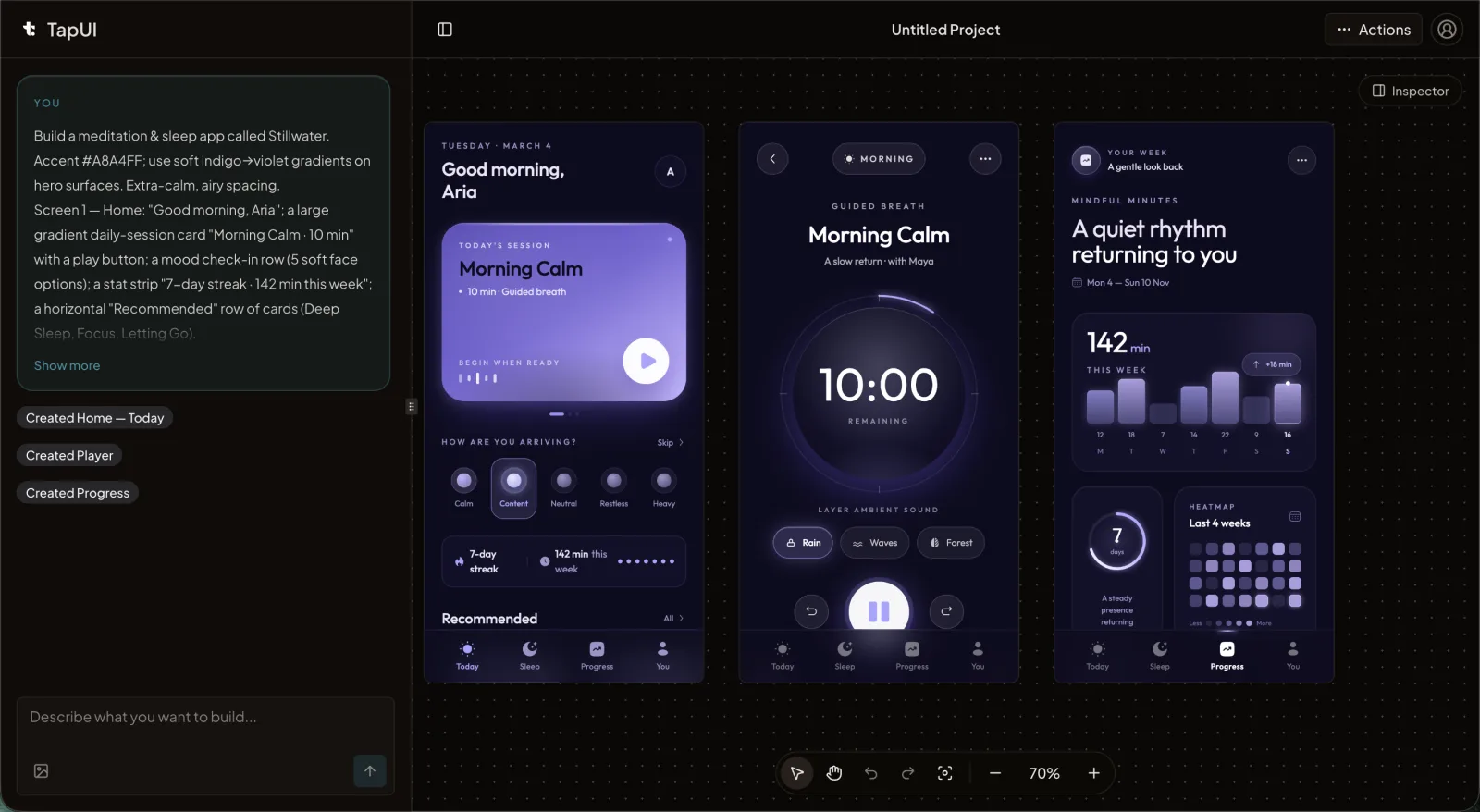 The TapUI editor turns a plain-language app description into editable mobile screens.
The point of TapUI is compression. The gap between "I can picture this app" and "I have screens I can react to" is usually where momentum dies — you stall waiting on a designer, or you fight a canvas you don't know how to drive. TapUI collapses that gap to a prompt and an edit pass. You describe a flow, get screens back, and shape them into something you can put in front of people or hand to your developers.
On handoff, TapUI keeps a project history and lets you export your designs to share with the team — it does not generate React Native, Swift, or Flutter code. You leave with screens, not a native codebase.
Pricing: a free tier to start, then Starter at $20/mo ($17/mo billed yearly, 100 screen generations/mo, project history plus exports, email support) and Pro at $40/mo ($27/mo billed yearly, 650 generations/mo, everything in Starter plus priority support). Start free, move up if the workflow earns a place in how you build.
Pros: prompt-to-screen speed for mobile UI, easy editing, project history and exports for developer handoff. Cons: mobile-app UI only — not a website builder, and no native code export.
Where TapUI stops
The same honesty applies in reverse. TapUI is for mobile app UI. It is not a website builder. If you need a landing page, a blog, or anything that publishes to a URL and gets crawled by Google, TapUI is the wrong tool and Framer (or a web builder) is the right one. Don't try to bend it into a job it isn't for.
How they line up
| TapUI | Framer | |
|---|---|---|
| Output | Mobile app UI screens | Responsive websites |
| AI generation | App UI from a text prompt | Multi-page sites from a text prompt |
| Best audience | Founders, PMs, mobile designers | Marketers, web designers |
| Hosting/publishing | Not its job — designs, not live sites | Built in (CDN, CMS, analytics) |
| Motion & interaction | Mobile-screen focused | Advanced web animation |
| Figma integration | — | Strong (paste-from-Figma) |
| Code export | No native code; designs/exports for handoff | Web output is hostable, not handoff source code |
Read that table as two specialists, not a scoreboard. The empty cells aren't failures — they're each tool declining to do the other one's job.
So which one do you actually use?
A quick gut check by what you're building:
Reach for Framer when the deliverable lives in a browser — a marketing site, a landing page, a portfolio, a launch page with real animation. You want it hosted, indexable, and live, and you'd rather not stitch together a separate hosting stack. Framer takes you prompt-to-published.
Reach for TapUI when the deliverable lives on a phone — you're shaping the screens of a mobile app and want a polished starting point fast, without hand-building every layout. You're a founder validating a concept, a PM aligning a team on what a flow looks like, or a designer who wants AI to handle the first eighty percent so you can spend your time on the last twenty.
And plenty of teams use both, because they're not competing for the same task: Framer for the marketing site that sells the app, TapUI for the app's screens themselves. That's not a compromise — it's just using each tool for what it's good at.
FAQ
Can Framer generate mobile app screens?
No. Framer builds responsive websites that display on phone browsers, but it doesn't generate native app UI or mobile-app-specific layouts. For app screens, use TapUI.
Can TapUI build a website?
No. TapUI is focused exclusively on mobile app UI. For websites, landing pages, or anything that publishes to a URL, use Framer or another web builder.
Does TapUI export React Native, Swift, Flutter, or other native code?
No. TapUI generates polished mobile screens and design exports you can hand to developers—not platform code. You get the designs themselves, not a native codebase to compile.
What does TapUI cost?
Free tier to start. Starter is $20/mo ($17/mo yearly) with 100 screen generations/month, project history, and exports. Pro is $40/mo ($27/mo yearly) with 650 generations/month and priority support.
Can I use both Framer and TapUI in the same project?
Absolutely. Many teams use Framer for the marketing site and TapUI for the app's screens—they're specialists in different domains, so using both is the practical choice.
So which one should you pick?
Route by your finish line:
- Need a website, landing page, or anything that publishes to a URL? → Framer.
- Need mobile app screens fast to validate, align a team, or hand to developers? → TapUI.
- Need both — a marketing site that sells the app and the app's screens? → Use Framer for the site and TapUI for the screens.
Framer is a strong, mature web builder with excellent design output, deep Figma support, and a full hosting stack. TapUI is the one to reach for when your project ends on a phone and you want app screens fast. Pick by the finish line, not the feature list.
Building mobile app screens? Start with TapUI free.