TapUI vs Glide: Which One Fits the App You Are Building?
TapUI generates polished mobile UI screens from text; Glide turns spreadsheets into working apps. Here is how to pick the right one.
TL;DR: Glide turns a spreadsheet into a working app (data, login, logic) and ships it as an installable PWA — best when you need an internal tool live fast. TapUI generates polished mobile UI screens from a plain-text description — best when the missing piece is the design itself. They solve different halves of "I have an app idea," so the right pick depends on whether you are short on a working app or short on a design.
People compare TapUI and Glide as if they are competing for the same job. They are not. Glide turns a spreadsheet into a working app with data, login, and logic baked in. TapUI takes a sentence about the app you have in your head and gives you back polished mobile UI screens. One ships a tool; the other shapes a design.
The honest answer to "which is better" is "better at what?" If you need an internal inventory tracker running by Friday and your data already lives in Google Sheets, Glide will beat TapUI every time. If you are pitching a consumer app and need screens that look like a real iOS or Android product, that is where TapUI earns its place. Most of this article is about helping you figure out which of those two situations you are actually in.
The short version
| TapUI | Glide | |
|---|---|---|
| What it produces | Polished mobile app UI screens | A working app (data + logic + auth) |
| Starting point | A plain-text description of your app | A spreadsheet (Google Sheets, Excel, Airtable) |
| Output type | Design screens you can prototype and hand to developers | A Progressive Web App (PWA) |
| App Store / Play Store | Designs to build toward; you build and ship separately | No native store distribution; runs as an installable PWA |
| Data, login, workflows | Not its job — it is a design tool | Built in |
| Best for | Founders, PMs, and designers who need UI fast | Teams turning data into an internal tool quickly |
If you remember one thing: Glide is an app builder, TapUI is a UI design generator. They solve different halves of "I have an app idea."
What Glide actually does
Best for: teams turning existing spreadsheet data into a working internal tool quickly.
Glide is a no-code platform that turns a spreadsheet into a mobile-styled app without writing code. Point it at a Google Sheet, Excel file, or Airtable base and it structures the screens for you — list views, detail pages, forms — based on your data. It is backed by Y Combinator and has been actively developed for years, with recent releases leaning hard into AI. You can now describe an app in plain language and have Glide draft a data schema and layout, and its newer workflow automation can pull data out of images, audio, or text and run scheduled triggers.
Glide is genuinely good at a specific thing: getting a functional internal tool live fast. A few areas where it is the stronger choice (pros):
- You already have the data. If your records live in a spreadsheet, Glide binds to them automatically. No migration, no API wiring.
- You need logic, not just looks. Auth, role-based access, real-time sync with CRMs and ERPs — that comes with the platform. A design tool cannot give you any of that.
- It is an internal tool. Directories, inventory, event schedules, simple CRUD apps. This is Glide's home turf, and it has a deep template library and community to lean on.
Where Glide runs into walls — and this matters for the comparison (cons):
- The output is a PWA, not a native app. Glide apps can be installed to a home screen and run full-screen, but they are not native iOS or Android apps and are not distributed through the App Store or Google Play. For a consumer product that needs to live in the stores, that is often a dealbreaker.
- The screens look like web apps. That is fine for an internal tool. It is a harder sell when you are trying to look like a polished, native mobile product.
- No code ownership. Glide does not export your app's source code. You are committed to the platform — there is no taking your build elsewhere.
- Customization has a ceiling. Complex layouts, custom animations, and advanced logic tend to require workarounds, and its model is spreadsheet-centric, so very large or relationship-heavy data eventually strains.
- It is not a design-handoff tool. Glide does not produce Figma files or design tokens. If your goal is a clean design to prototype or hand to developers, that is not what Glide is built to give you.
On pricing, Glide has a free tier and several paid plans that scale with rows, editors, and features up to an enterprise tier. The tiers shift fairly often, so check glideapps.com/pricing for current numbers before you commit.
What TapUI actually does
Best for: founders, PMs, and designers who need polished mobile UI screens fast, without doing the design work by hand.
TapUI generates polished mobile app screens from a plain-text description — layouts, components, the visual feel of a real product. You describe the app you want and it gives you back screens you can prototype, iterate on in plain language, and hand to your developers to build. It is aimed at founders, product managers, and designers who need working app UI quickly and do not want to grind through manual design work first.
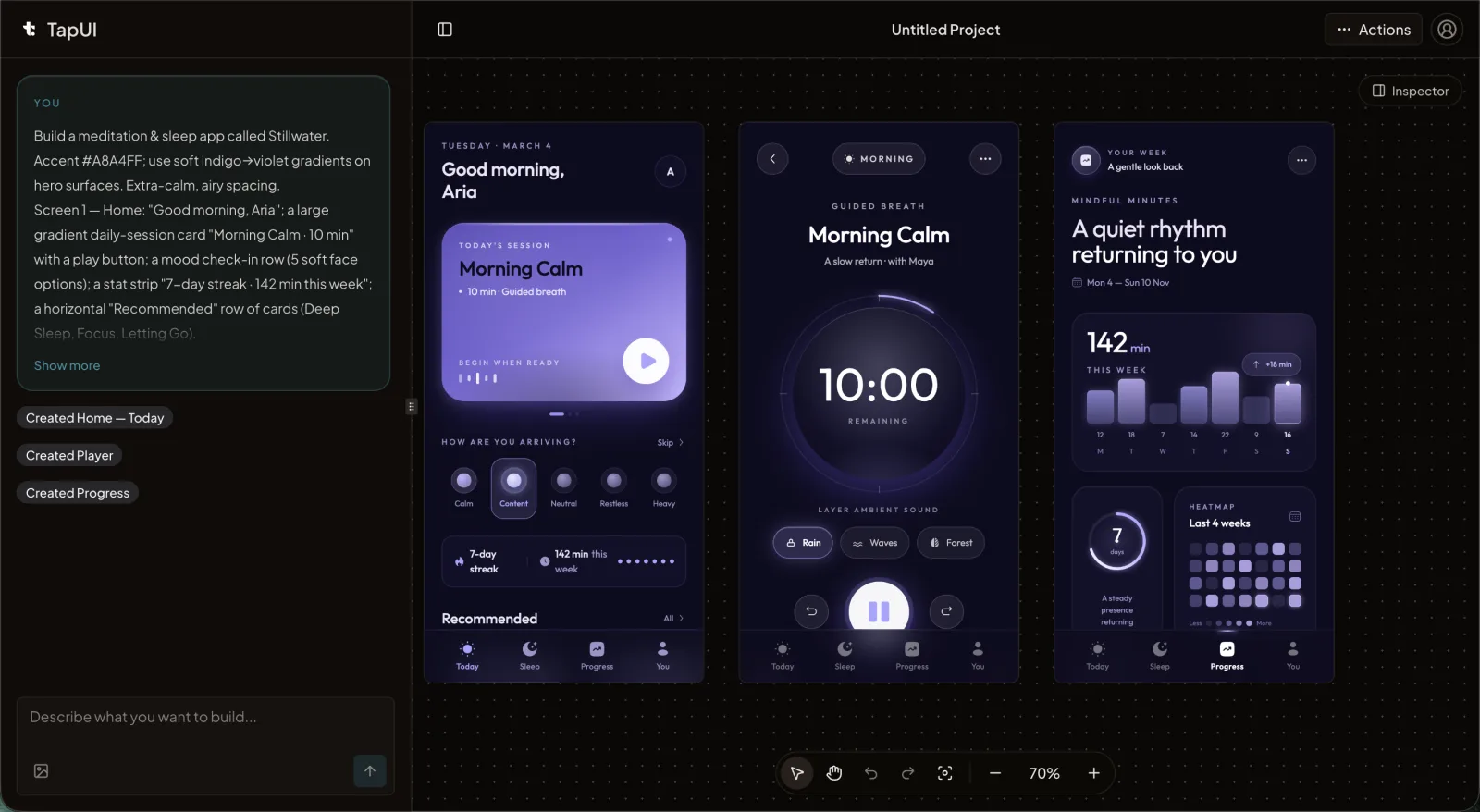 The TapUI editor turns a plain-text app description into polished mobile screens you can iterate on.
The thing to be clear-eyed about: TapUI generates design, not a deployed application. It does not connect to your spreadsheet, handle your login, or run your business logic. It gives you screens — designs you can use to prototype, validate a concept, and hand to your developers to build.
Where that is the right tool (pros):
- You need to look like a real mobile app, fast. Describe the concept, get screens back, iterate in plain language. No blank canvas, no design backlog.
- You are pitching or validating. Investors, early users, and stakeholders respond to something that looks shipped. Polished screens make an idea feel real before a line of production code exists.
- Design is the bottleneck, not data. If you have engineering covered but no designer, TapUI fills the gap that Glide cannot — Glide assumes you want it to own the whole app, design included, on its terms.
Where TapUI is honestly not the answer (cons):
- You need a working tool today. TapUI produces designs, not a live app with data and auth. If your goal is "internal CRM running by Monday," Glide is the better fit and it is not close.
- You have no appetite to build. Screens are a starting point, not a finished product. Someone still has to build the app behind them.
- Your app is fundamentally a spreadsheet view. If the whole product is "show this data, let people edit it," Glide's automatic data binding is a more direct path than designing screens and building separately.
TapUI offers a free tier plus two paid plans. Starter is $20/mo ($17/mo billed yearly) and includes 100 screen generations per month, project history and exports, and email support. Pro is $40/mo ($27/mo billed yearly) with 650 generations per month, everything in Starter, plus priority support. Start on the free tier to see whether the generated screens match what you have in mind before paying for anything.
How to actually choose
The decision comes down to two questions — and they cut through most of the confusion quickly.
What do you need at the end — a running app or a design? Glide hands you a working PWA. TapUI hands you mobile UI screens. If you cannot ship without live data and login, you need an app builder, and TapUI is not one. If what is missing is the design itself, an app builder will not fix that gracefully.
Where is this app going to live? Internal tool that your team opens in a browser or installs to a phone? Glide's PWA model is fine, often ideal. Consumer app that needs to feel native and eventually reach the App Store or Play Store? A PWA is a hard constraint to design around, and you will likely want polished native-style screens to build toward — which is the gap TapUI fills.
A simple gut check:
- "I need an internal tool running this week, and my data is in a spreadsheet." → Glide.
- "I need professional mobile screens to prototype, pitch, or hand to my developers." → TapUI.
- "I need both a great-looking native product and the working app behind it." → TapUI for the screens, then a real build (in-house or with developers). Glide will not get you to a native, store-ready product.
There is no shame in using both. Plenty of teams design the experience first and build the backend second; the two tools sit at different points in that line.
FAQ
Is TapUI a replacement for Glide?
No — they solve different problems. Glide builds a working app from your data; TapUI generates mobile UI screens from a description. If you need an app builder, TapUI won't fill that role. If you need design, Glide is not built for it.
Can TapUI export to React Native, Swift, Flutter, or native code?
No. TapUI generates mobile UI designs — layouts and components you can prototype and hand to developers. It does not export to React Native, Swift, Flutter, or any platform-specific code. Developers build the actual app from the designs.
Does Glide produce native iOS and Android apps?
No. Glide generates Progressive Web Apps that can be installed to a phone's home screen and run full-screen, but they are not native apps and are not available in the Apple App Store or Google Play.
Can I export my Glide app's source code?
No. Glide does not export source code, so you stay on the platform. If portability and long-term independence matter to you, that is a key constraint worth understanding upfront.
Which tool gets me to a working result faster?
For an internal tool built from existing spreadsheet data, Glide is faster — that is its core strength. For getting from an idea to polished mobile screens, TapUI is faster because you skip manual design work entirely.
What is TapUI's pricing?
TapUI has a free tier, Starter at $20/mo ($17/mo billed yearly, 100 screen generations), and Pro at $40/mo ($27/mo billed yearly, 650 generations). Try the free tier first to see whether the generated screens fit your project before committing to a paid plan.
Bottom line
Glide and TapUI get lumped together because both promise to get you to "an app" faster, but they hand you different things. Glide is the better choice when you have data and need a working internal tool quickly, and you are comfortable living on its platform with a PWA as the output. TapUI is the better choice when the missing piece is the design — when you need professional mobile screens to prototype, pitch, or hand off, fast, without doing the design work by hand.
Figure out whether you are short on a working app or short on a design, and the choice makes itself. If it is the design, try TapUI — the free tier is enough to see whether the screens land before you decide anything.
Related: TapUI vs AppyPie comparison • Validate app ideas without coding • Accessible app design guide