TapUI vs ScreensDesign: Which Mobile UI Tool Fits Your Workflow?
TapUI generates app screens from a prompt; ScreensDesign is a reference library with AI on the side. Here's how to pick the right one.
TL;DR: ScreensDesign is a reference library first — a large, curated collection of real iOS app flows you browse, study, and borrow from, with AI generation added on the side. TapUI is a generator first — you describe a screen in plain text and it produces polished mobile UI you can iterate on and hand to developers. Choose ScreensDesign when you're still researching patterns; choose TapUI when you already know what you want and need it as screens now.
These two tools get compared a lot, and on the surface that makes sense: both deal in mobile app screens, both lean on AI, both promise to get you to a polished UI faster. But they're built around opposite starting points. ScreensDesign begins with what other apps already did — a searchable library of real iOS flows you study and borrow from. TapUI begins with what you want to build — you describe a screen, it generates one.
That difference shapes almost everything else, and it's the thing worth understanding before you pick. I work on TapUI, so take the framing for what it is, but I've tried to be straight about where ScreensDesign is genuinely the better tool. For a lot of people, it is.
TapUI vs ScreensDesign at a glance
| Tool | Best for | Key strength | Pricing | Notes |
|---|---|---|---|---|
| TapUI | Knowing what to build and wanting it fast | Generates polished mobile UI from a plain-text prompt | Free tier; Starter $20/mo ($17/mo yearly); Pro $40/mo ($27/mo yearly) | ⚠️ No inspiration library; designs to hand to developers (no native code export) |
| ScreensDesign | Researching patterns before you build | Large curated library of real iOS flows + frame-by-frame Animation Explorer | Free tier (limited); single paid plan | ⚠️ iOS-only, web-only; AI generation is secondary; ✅ editable Figma export on paid plan |
The short version
ScreensDesign is a reference library first. Its core asset is a large, curated collection of real iOS app screens — onboarding flows, paywalls, settings, the kind of thing you'd otherwise screenshot manually from apps you admire. It later added an AI "Create" feature, but the heart of the product is still browse, study, borrow. If you like to research patterns before you build, that library is excellent.
TapUI is a generator first. You write a plain-text description of an app or screen and it produces polished mobile UI you can iterate on, then hand to your developers. There's no inspiration-browsing step — the assumption is that you already roughly know what you want and you'd rather see a draft than scroll a gallery.
Neither approach is "more advanced." They suit different moments in the process.
What ScreensDesign is actually good at
ScreensDesign's biggest strength is its library of real, shipped iOS patterns — a curated collection of flows from well-known apps that's hard to assemble yourself. If you're still researching before you commit to a direction, that's where it earns its place.
I'll be specific, because the strengths here are real and not every AI generation tool matches them.
The library itself. ScreensDesign indexes thousands of real iOS app flows from well-known apps — think the onboarding sequence of an app you use daily, frame by frame. That's genuinely useful when you're trying to understand why a flow works, not just copy a layout.
The Animation Explorer. You can step through mobile app animations frame by frame. I don't know of another tool that does this as cleanly, and motion is exactly the kind of thing static screenshots miss. If you're sweating the details of a transition, this is a real differentiator.
Figma export with editable layers. On their paid plan, screens come out as native, editable Figma layers — not a flattened image. If your team lives in Figma, that's a meaningful workflow win.
It's grounded in what shipped. Because the library is built from apps that are actually in the App Store, the patterns you study are battle-tested, not hypothetical. ScreensDesign even surfaces install and revenue context on referenced apps, which is a nice nudge toward learning from things that worked commercially.
Pros
- Large, curated library of real iOS flows
- Frame-by-frame Animation Explorer for studying motion
- Editable Figma layers on the paid plan
- Patterns grounded in apps that actually shipped
Cons
- AI generation is a secondary, bolted-on feature
- iOS only — no Android patterns
- Tight free tier: one-time, non-renewing AI credits and blurred library screens
- Web-only — no desktop or offline app
What TapUI is actually good at
TapUI's core strength is turning an idea you already hold into developer-ready screens, fast — you describe a screen in plain text and get a polished mobile UI draft without browsing a gallery first.
TapUI's bet is that the fastest path from idea to a working screen is describing it, not finding the nearest match in a gallery.
You type something like "a habit-tracking app with a weekly streak view, a daily check-in screen, and a settings page," and it generates polished mobile UI for it. From there you iterate in plain language. The audience it's built for — founders sketching a product, PMs spec'ing a feature, designers who want a fast first draft — usually already knows the shape of what they need. For them, skipping the research phase entirely is the whole point.
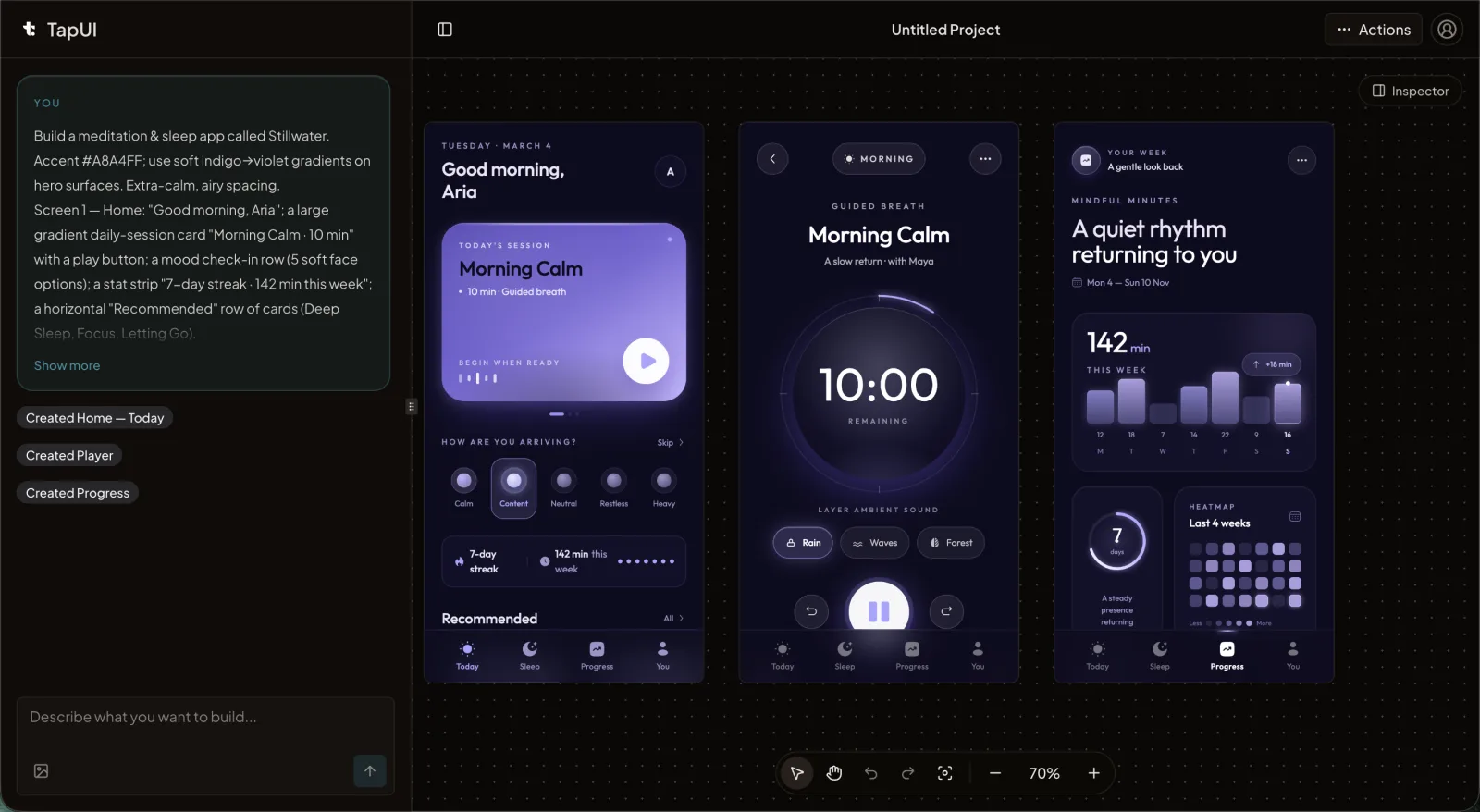 The TapUI editor: describe an app in plain text and iterate on the generated mobile screens.
TapUI offers a free tier so you can try real generations, plus paid Starter and Pro plans billed monthly or yearly. When you're ready to build, you get polished designs you can hand to your developers.
Pros
- Generation-first: describe a screen and get a polished draft immediately
- Iterate in plain language, no gallery-scrolling step
- Built for founders, PMs, and designers who already know the shape of what they need
- Free tier to try real generations before paying
Cons
- No inspiration library — pair it with ScreensDesign or your own screenshot folder if browsing is part of your process
- Rewards a clear point of view; a vague prompt gives a vague result
- Frame-by-frame animation study isn't its focus — ScreensDesign owns that
- Outputs designs/screens you hand to developers, not native code (no React Native, Swift, or Flutter export)
A practical way to choose
The question that actually sorts this out is: do you know what you want to build yet?
If you're still figuring out the shape of the product — exploring how good apps handle onboarding, what a strong paywall looks like, how a transition should feel — you want ScreensDesign. The library and the Animation Explorer are made for that phase, and the Figma export drops your findings straight into a design file.
If you already have the idea in your head and you want to see it as screens now — to validate a concept, fill out a pitch, or get a developer-ready draft without manual design work — that's where TapUI fits. Describe it, iterate, move on.
Plenty of teams could reasonably use both: ScreensDesign to research and gather references, TapUI to generate the actual screens once the direction is clear. They're not really competing for the same minute of your day.
On price
Both tools have free entry points, but what's behind the paywall differs meaningfully.
ScreensDesign's free tier is more of a teaser — limited one-time AI credits and blurred library screens — with a single paid plan that unlocks the full library, unblurred screens, and Figma export. Pricing on tools like this changes, and third-party comparison sites disagree on ScreensDesign's exact number, so check their site directly before deciding on cost.
TapUI keeps a free tier, then adds two paid plans: Starter at $20/mo ($17/mo billed yearly) with 100 screen generations per month, project history and exports, and email support; and Pro at $40/mo ($27/mo billed yearly) with 650 generations per month, everything in Starter, plus priority support.
Decision routing
- Need to research patterns and study real, shipped flows? → ScreensDesign.
- Need frame-by-frame animation study or editable Figma layers? → ScreensDesign.
- Already know the idea and want developer-ready screens now? → TapUI.
- Want to skip gallery-browsing and just describe a screen? → TapUI.
- Doing both — researching then building? → Use ScreensDesign for references, then TapUI to generate the screens.
FAQ
Does TapUI export React Native, Swift, or Flutter code?
No. TapUI generates polished mobile UI screens you can iterate on and hand to your developers. It does not export native platform code or app code; project history and exports refer to your designs only.
Can I use TapUI and ScreensDesign together?
Yes, and many teams do. Use ScreensDesign to research and gather references while figuring out direction, then use TapUI to generate the actual screens once you know what you want.
What's TapUI's pricing?
TapUI has a free tier to try real generations. Paid plans are Starter at $20/mo ($17/mo billed yearly, with 100 generations/mo), and Pro at $40/mo ($27/mo billed yearly, with 650 generations/mo). Both paid tiers include project history, exports, and email support; Pro adds priority support.
Is ScreensDesign available for Android?
No. ScreensDesign's library is iOS-only, so if you need Android patterns you'd need to pair it with another tool or use your own screenshot references.
Which tool is better for studying animations and motion?
ScreensDesign is better for studying animations and motion. Its Animation Explorer lets you step through mobile app animations frame by frame, studying how transitions actually feel — something TapUI doesn't focus on.
When should I choose TapUI over ScreensDesign?
Choose TapUI if you already know what you want to build and want developer-ready screens immediately. Choose ScreensDesign if you're still researching patterns and need to study how real apps solve problems.
Bottom line
ScreensDesign is the better tool if your work starts with research — its library of real iOS flows and its Animation Explorer are genuinely strong, and the Figma export fits cleanly into a designer's workflow. TapUI is the better tool if your work starts with an idea you want to see as screens immediately, without the browsing step in between.
Pick based on where you actually spend your time. If you'd rather describe a screen than go find one, try TapUI's free tier and generate your first screens.
Related: TapUI vs App Alchemy comparison • Best v0 alternatives • Ship mobile UI faster with AI