TapUI vs Supernova: Which Fits Your Mobile UI Workflow?
TapUI generates mobile app screens from a text prompt. Supernova manages design systems and code from Figma. Here is how they actually differ.
TL;DR: TapUI and Supernova solve different problems. TapUI generates polished mobile UI screens from a plain-text prompt with zero setup — ideal when you're starting from nothing. Supernova is a design system platform that turns an existing Figma setup into tokens, docs, and code — ideal for mature product teams. Starting from a blank canvas? Choose TapUI. Already running a Figma design system? Choose Supernova.
People put TapUI and Supernova in the same sentence because both touch the space between "I have an idea" and "I have screens." But once you actually use them, they pull in opposite directions. TapUI is a fast-start tool: you describe an app in plain language and it generates mobile UI screens, no setup, no existing files. Supernova sits at the other end — it's a design system platform that assumes you already have a Figma file, tokens, and a brand, and it turns that scaffolding into documentation, specs, and code.
So this isn't really a head-to-head on the same job. It's a question of where you are in your process. If you're staring at a blank canvas, one of these tools is built for you and the other will frustrate you. Let's get into which is which.
TapUI vs Supernova at a glance
| Tool | Best for | Key strength | Needs Figma? | Pricing |
|---|---|---|---|---|
| TapUI | Starting from zero | Prompt-to-mobile-UI in seconds, no setup | ❌ No | Free; Starter $20/mo ($17/mo yearly); Pro $40/mo ($27/mo yearly) |
| Supernova | Mature design system teams | Token sync, docs, design-to-code pipeline | ✅ Yes | Free tier; per-seat Pro; Enterprise |
✅ = built for it · ⚠️ = partial · ❌ = not the tool's job. TapUI wins on cold-start speed; Supernova wins on system management. Neither is the universal winner.
The short version
- TapUI is built for starting from nothing. Describe a screen, get a polished mobile layout in seconds. No Figma, no design system, no configuration.
- Supernova is built for teams that already run a design system in Figma. It syncs design tokens to code, publishes documentation, and pushes generated code into developer tools.
- If you're a solo founder or a small team without an established design system, TapUI gets you moving faster.
- If you're a larger product org with a mature Figma setup and engineers who live in tokens and pipelines, Supernova does things TapUI doesn't attempt.
Neither one is "better" in the abstract. They solve different problems for different people.
What Supernova actually is
Best for: product orgs with a mature Figma design system that need token automation, docs, and a real handoff pipeline.
Supernova is a design-system-first platform — that's the clearest way to understand it before anything else. It bills itself as an AI-powered product development and design system platform, and since its 3.0 release in late 2025, the pitch covers the full pipeline: idea, exploration, alignment, specs, and code delivery — all anchored to your design system.
A few things are worth being precise about, because Supernova is easy to mischaracterize:
It is design-system-first. The center of gravity is your existing system in Figma. Supernova's standout capability is its design token pipeline: it syncs Figma variables and tokens and auto-exports them to formats like CSS, Sass, JSON, Swift, Android XML, and Tailwind, typically delivered through GitHub pull requests. If you've ever hand-maintained tokens across web and native, that automation is the real draw.
It publishes documentation. Supernova can stand up a public or internal design system site — component docs, token references, usage guidelines — comparable to tools like Zeroheight.
Its AI generation is context-aware. Supernova 3.0 added the ability to describe a feature and have AI generate a prototype and draft specs (PRDs). The catch, and it's an important one, is that this works because it pulls from your brand and design system — what Supernova calls Product Contexts. The output stays on-brand precisely because there's a brand already loaded in. There is no "generate from zero" path.
It's developer-friendly at the handoff. Supernova exports code through MCP integrations into editors like VS Code, Cursor, Claude, and ChatGPT, and can create tickets in Linear or Jira. For engineering-heavy teams, that pipeline is genuinely useful.
The company behind it is established: founded in Prague in 2016, a Y Combinator alum, and well-funded, with a Series A closing in 2025. This is not a tool at risk of disappearing.
Supernova pricing
Supernova's free tier covers a single design system, one code pipeline, and a handful of seats. Paid plans are billed per seat — a Pro plan for most teams and an Enterprise tier for SSO, approval workflows, and adoption tracking. The per-seat model is worth flagging: for a small team it's reasonable, but it scales with headcount, so a larger org should run the math before committing.
Where Supernova is genuinely the stronger choice
Supernova is the right call — not a close one — in several real situations:
- You already have a design system in Figma. Supernova's token sync and documentation publishing are built exactly for this, and they operate at a scale TapUI doesn't target.
- You need on-brand output for an existing product. Because Supernova's AI works from your tokens and brand, its generated UI fits an established product better than a from-scratch generator can.
- You own the full design-to-code handoff. Tokens, specs, docs, tickets, code pushed to the editor — Supernova covers the whole pipeline, not just the screen.
- Your developers want MCP-based delivery. Pushing generated code straight into Cursor or VS Code and opening tickets in Linear is a legitimately strong workflow.
Where Supernova gets in your way
The flip side of being design-system-first is that Supernova assumes you already did a lot of work:
- Setup is heavy. Expect days of configuration, not minutes. You need Figma expertise and a real understanding of design systems to get value out of it.
- It's useless from zero. If you don't have a design system, there's nothing for Supernova's pipeline to operate on. It is not the tool for validating a brand-new app idea on a Friday afternoon.
- AI UI generation is the newer, secondary capability. Supernova's identity is design system management; the prompt-to-UI generation arrived more recently and sits on top of that foundation rather than being the core.
None of these are flaws, exactly — they're consequences of who Supernova is built for. They just happen to be the opposite of what an early-stage builder needs.
What TapUI is
Best for: founders, PMs, and designers who want polished mobile screens fast, starting from nothing.
TapUI is an AI design tool for mobile that generates polished app UI screens from a plain-text description — no Figma file to prepare, no design system to configure, no tokens to wire up first. That "no setup" part is the whole point — it's what lets a founder, a PM, or a designer go from a sentence to a screen they can actually look at.
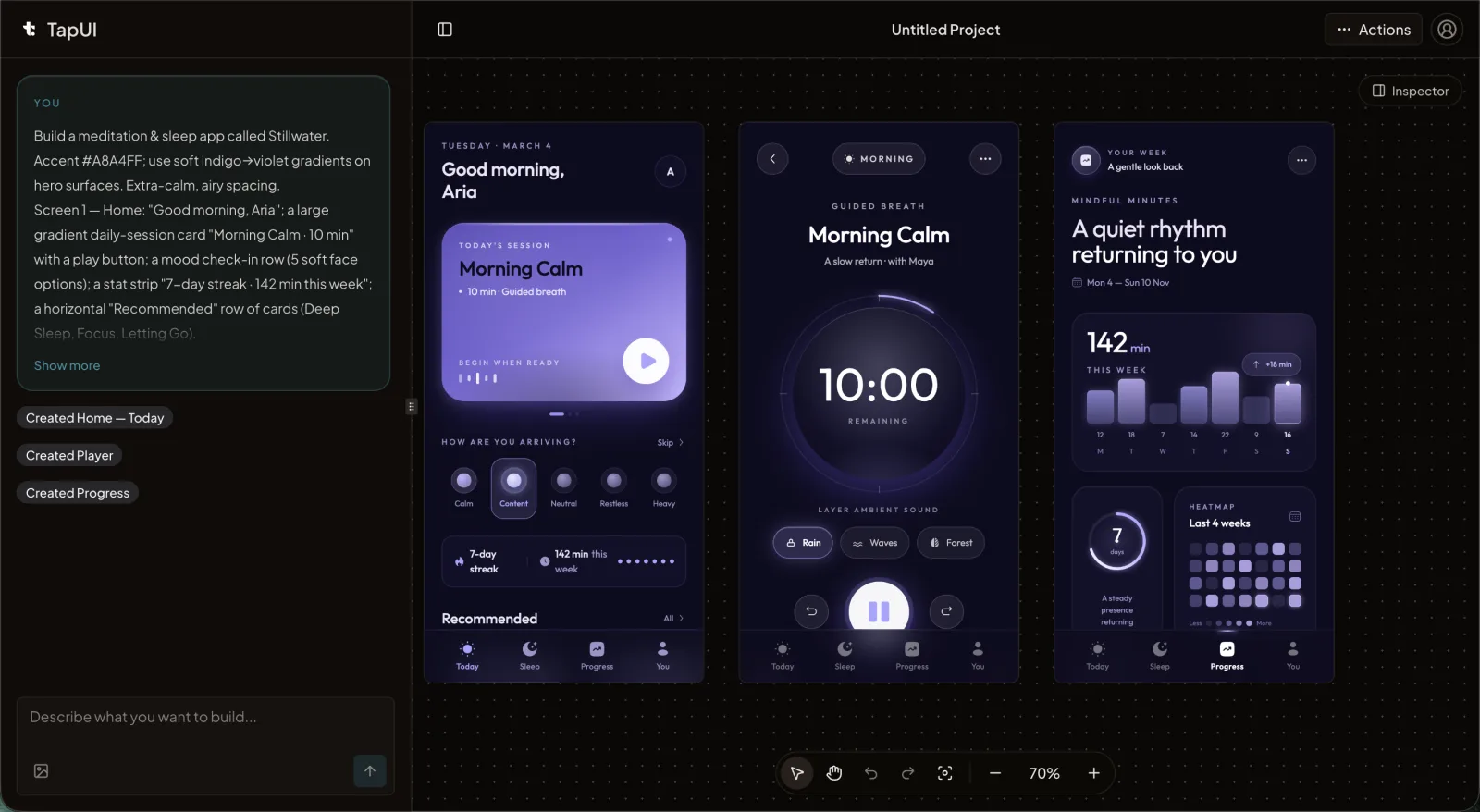 The TapUI editor: describe an app in plain language and get polished mobile screens back.
The audience TapUI is built for is people who want working app UI fast without doing manual design work. A solo founder sketching a product. A PM who needs a credible mockup for a stakeholder review tomorrow. A designer who'd rather start from a generated draft than a blank artboard.
What you do with those screens afterward is flexible — they're designs you can hand to your developers to build from. TapUI does not generate React Native, Swift, or Flutter code; it produces the screen designs, plus project history and exports on paid plans.
TapUI pricing
TapUI has a free tier so you can try generating screens before paying anything. The Starter plan is $20/mo ($17/mo billed yearly) and includes 100 screen generations per month, project history and exports, and email support. The Pro plan is $40/mo ($27/mo billed yearly) and includes 650 generations per month plus everything in Starter and priority support.
Where TapUI is the stronger choice
- You're starting from nothing. No design system, no Figma file, no brand guide. TapUI is built for exactly this cold start; Supernova is not.
- Speed matters more than process. When you need a screen in front of someone today, a prompt-to-UI generator beats a configuration-heavy pipeline.
- You're not a designer, or you don't want to do manual design work. TapUI does the visual heavy lifting so you can focus on the product idea.
- Mobile is the whole job. TapUI is purpose-built for mobile app screens rather than treating mobile as one output among many.
Where TapUI has limits
Being honest about this matters:
- It's not a design system manager. If your need is token governance, documentation publishing, and code pipelines across a large org, that's Supernova's territory, not TapUI's.
- It generates from scratch, not from your existing brand library. That's the source of its speed, but it also means it isn't pulling from a pre-loaded set of your components the way a context-aware tool does.
- AI output still needs a human eye. Generated screens are a strong starting point, not a finished, reviewed spec. You'll want to refine.
Picking between them
Here's how I'd actually decide, depending on who's asking.
A solo founder validating a mobile app idea. Go with TapUI. You have no design system for Supernova to operate on, and the last thing you want at the idea stage is days of setup. Describe the app, get screens, put them in front of someone, iterate.
A small team without a formal design system. TapUI, most likely. You'll get moving faster, and you can introduce heavier tooling later if and when you build a real system worth managing.
A product org with a mature Figma design system. Supernova. The token pipeline, documentation site, and MCP-based handoff are built for your reality, and they automate work that's genuinely painful to do by hand at scale. A from-scratch generator doesn't address the problem you have.
A team somewhere in between. It's reasonable to use both for different jobs — TapUI to explore and generate early mobile screens quickly, and a design-system platform like Supernova once you've matured into needing token governance and structured handoff. They aren't mutually exclusive, because they don't actually do the same thing.
A few honest caveats
Tool comparisons go stale fast, and AI features especially. Supernova's prompt-to-UI generation is relatively new and still evolving, so check its current docs before assuming any specific capability. TapUI's plans and feature set move too. Pricing and seat structures on both sides change, so treat anything here as a starting point and verify on each product's site before you commit a team to it.
FAQ
Does Supernova generate UI from a text prompt like TapUI?
Supernova 3.0 can generate prototypes from a prompt, but only using your existing design system and brand context — not from a blank slate. TapUI generates mobile screens from scratch with zero prior setup. The difference matters: Supernova needs your brand loaded in first; TapUI needs nothing.
Do I need Figma to use Supernova?
Yes, effectively. Supernova's core strengths — token sync, documentation, and on-brand AI generation — are built around an existing Figma design system. TapUI requires no Figma file at all and is designed to work from a blank canvas.
Does TapUI export React Native, Swift, or Flutter code?
No. TapUI generates mobile UI designs that you can hand to developers to build from. It produces screens, project history, and exports on paid plans, but does not generate platform-specific or native code.
What's the best entry point for a solo founder or early-stage team?
TapUI is the better fit. It's built for starting from nothing and moving fast — describe a screen, get a polished design back in seconds, no setup required. Supernova's strength depends on having a design system already in place, which early-stage teams typically don't have yet.
Can I use both TapUI and Supernova?
Yes. They solve different problems — fast from-scratch mobile screen generation versus design system management and handoff. Early-stage teams often use TapUI to explore and generate screens quickly, then add Supernova once they've matured into needing token governance and structured handoff pipelines.
Bottom line: which should you pick?
Supernova and TapUI get compared a lot, but they're really answers to different questions. Route yourself by what you actually need:
- Need polished mobile screens from a blank start, fast? → TapUI.
- Need to validate an app idea with no Figma file or design system? → TapUI.
- Need token sync, documentation, and design-to-code handoff on an existing system? → Supernova.
- Need on-brand AI output for an established product? → Supernova.
- Need both — explore early, then manage a real system later? → Use TapUI up front and add Supernova once you've matured into needing it.
Figure out which of those describes you, and the choice mostly makes itself.
Want to see what generating from a prompt feels like? Try TapUI.