TapUI vs v0 by Vercel: Which AI Tool Fits Your Project?
TapUI generates mobile app UI from a prompt; v0 by Vercel builds React web apps. Here is an honest look at where each one actually fits.
TL;DR: v0 by Vercel turns prompts into production React/Next.js web apps and deploys to Vercel. TapUI turns a plain-text description into polished mobile app UI screens you can refine and hand to developers. They aren't really competitors — pick by platform: web app, choose v0; mobile app, choose TapUI.
If you typed a prompt into v0 hoping to get a native mobile app and ended up with a web page that merely looks like one on a phone, you already understand the core of this comparison. These two tools both turn plain English into interface, but they aim at different targets. v0 builds web apps. TapUI designs mobile app screens. Most of the "which is better" debate dissolves once you know which of those you're actually building.
So this isn't a leaderboard. It's a fit question. Below is what each tool does well, where each falls short, and how to tell quickly which one belongs in your workflow.
TapUI vs v0 at a glance
| TapUI | v0 by Vercel | |
|---|---|---|
| Best for | Mobile app UI screens, fast | Web apps in React / Next.js |
| Input | Plain-text app description | Natural-language prompts |
| Output | Polished mobile UI screens you refine | Production-ready React/Next.js code |
| Native mobile UI | ✅ Built for it | ❌ Web output only |
| Web apps / dashboards | ❌ Out of scope | ✅ Core strength |
| Deployment | ❌ Not a hosting/deploy tool | ✅ One-click to Vercel |
| Design-system memory | ✅ Consistent mobile UI | ⚠️ Can lose visual identity between sessions |
| Ecosystem maturity | ⚠️ Newer, focused | ✅ Larger, older, big community |
| Pricing | Free tier; Starter $20/mo, Pro $40/mo | Free tier + paid plans; token-based billing |
There isn't a universal winner here. There's a right answer per project.
The short version
- v0 by Vercel turns prompts into production-grade React and Next.js code, deploys to Vercel in a click, and now handles full-stack web apps. If you ship to the browser, it's hard to beat.
- TapUI takes a plain-text description of an app and generates polished mobile UI screens, then lets you refine them. It's built for founders, PMs, and designers who want working mobile app UI without doing the design from scratch.
- They overlap less than the keyword "v0 alternative" suggests. v0 is web-first. TapUI is mobile-UI-first. Pick by platform before you pick by feature.
What v0 by Vercel actually is
Best for: shipping web apps fast, especially inside the React/Next.js and Vercel ecosystem.
v0 is a full-stack web app builder that turns natural-language prompts into production-ready React and Next.js code — then deploys it straight to Vercel. It launched publicly in late 2023 as v0.dev and moved to v0.app in early 2026. Starting as a component generator, it has since grown to handle API routes, server actions, and database connections inside its sandbox runtime.
Pros
- The output is real code, not a mockup. You get React and Next.js you can drop into a codebase, refine, and ship.
- GitHub is wired in. It can create branches, open PRs, and show diffs in the chat, and it can import an existing repo to work on.
- Deployment is one click to Vercel if that's already your stack.
- The ecosystem is mature. It's an actively developed product with a very large developer base and deep community resources behind it.
That maturity matters. If your problem is "I need a working web app fast and I live in the React/Next ecosystem," v0 is a serious tool, not a toy.
Where v0 isn't the answer
v0's biggest constraint is that it is a web tool — it does not generate native mobile UI, and it only targets one stack.
Cons
- It outputs React and Next.js only. No Vue, Svelte, or Angular. You're committing to one stack.
- It does not generate native mobile UI. This is the big one for a mobile project. v0 produces web code; it does not natively generate iOS or Android apps. Vercel's own v0 iOS app was built with React Native and Expo, but the v0 tool itself doesn't emit React Native — community threads confirm native generation is a known gap. To get a real mobile app out of v0 output, someone adapts the web result by hand or reaches for other tools.
- It doesn't carry a design system between sessions. Start a new chat and it can lose the visual identity you established earlier.
- Billing is token-based (it moved off fixed credits in early 2026), with several model tiers. Costs vary by model, and some users reported the credit change effectively reduced usable output at the same price point. Credits can also be spent on generations that come back wrong.
None of that makes v0 bad. It makes it a web tool. Ask it for a "mobile app login screen" and you'll get a browser page styled to resemble one — fine for a responsive site, wrong foundation for an App Store app.
What TapUI is
Best for: founders, PMs, and designers who want polished mobile app UI from a plain-text idea, without designing every screen by hand.
TapUI is an AI design tool for mobile. You describe the app you have in mind in plain text, and it generates polished mobile app UI screens you can then adjust. The audience it's built for is people who need working app UI quickly without doing manual design work — founders sketching a product, PMs pressure-testing a flow, designers who'd rather start from a real draft than a blank artboard.
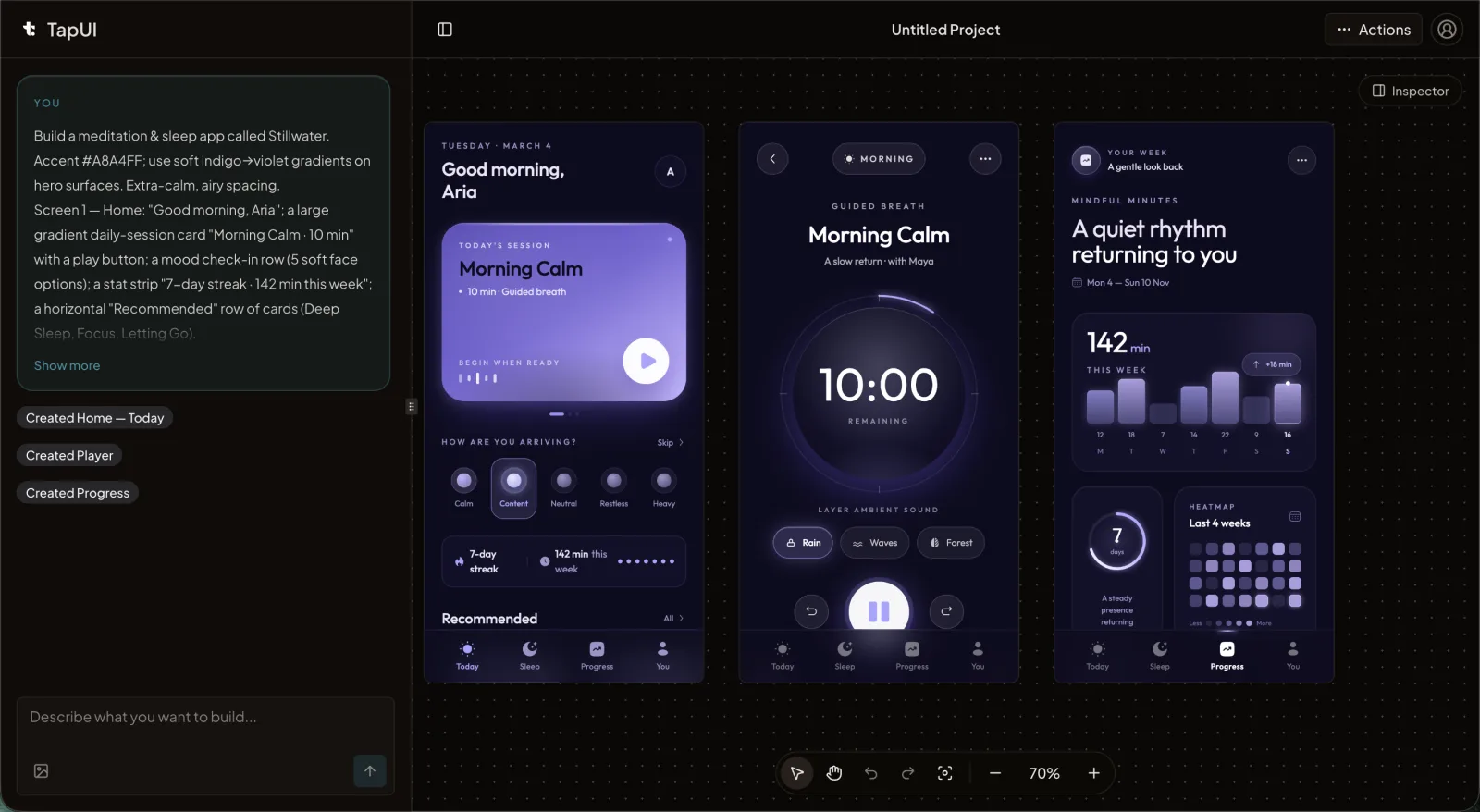 The TapUI editor turns a plain-text app description into polished mobile screens you can refine.
Where v0's unit of output is a chunk of working web code, TapUI's unit of output is a mobile screen that already respects how mobile interfaces are supposed to look and behave. That framing is the whole point: it's thinking in app screens and mobile patterns, not in browser components.
Pros
- Mobile-native by design. Output respects real mobile look, feel, and screen patterns instead of browser components.
- Fast from idea to draft. Go from a written description to screens you can react to before any engineering.
- Consistent UI. It's built around a coherent mobile design rather than restarting visual identity each session.
On pricing, TapUI has a free tier plus paid plans: Starter is $20/mo ($17/mo billed yearly) with 100 screen generations a month, project history and exports, and email support; Pro is $40/mo ($27/mo billed yearly) with 650 generations a month plus priority support. Start free, move up when the volume or the feature set justifies it.
Where TapUI is the wrong tool
TapUI is the wrong tool the moment your project targets a browser. Web and desktop are out of scope — full stop.
Cons
- Web and desktop are out of scope. If you're building a website, a marketing page, a SaaS dashboard, or anything that lives in a browser, TapUI is not your tool. v0 (or another web-focused tool) is the right call, full stop.
- Younger ecosystem. v0 has a larger, older ecosystem and a bigger community behind it. If broad community resources and a long track record are decisive for you, weigh that honestly.
On handoff, TapUI's value is producing designs you can hand to your developers to build against, rather than asking your design team to start every screen from zero.
How to decide in about thirty seconds
The deciding question is simple: is the thing you're shipping a mobile app, or a web app?
- Building a mobile app (iOS, Android, something people install from a store)? Start with TapUI. You want a tool that thinks in screens and mobile patterns, not one that produces browser code you'd have to reinterpret for mobile.
- Building a web app, dashboard, marketing site, or web SaaS? Use v0. It generates real React/Next code, deploys to Vercel instantly, and now handles full-stack web work. TapUI doesn't operate in this space at all.
- Living in the Vercel/Next ecosystem already? That tilts strongly toward v0 regardless — the GitHub and deploy integration compounds.
- Need a visual draft of an app to react to before any engineering? TapUI's strength is getting you from a sentence to something that looks like a real app fast.
A real example of using both: a team running a marketing site and a companion mobile app might reach for v0 on the web side and TapUI on the app side. That's not a contradiction — it's each tool doing what it's actually built for.
A note on the "v0 for mobile" question
v0 is a web tool and does not plan, as far as any public roadmap shows, to add native mobile generation. People search for a "v0 alternative" mostly because they hit this gap. Worth being precise: v0's responsive web output is genuinely good for the browser. If your "mobile" requirement is really "a website that works well on phones," v0 already covers you and you don't need a second tool. It's only when you need an actual app — installed, behaving like a native mobile experience — that the gap becomes the deciding factor and a mobile-UI tool like TapUI earns its place.
FAQ
Can v0 generate native mobile apps?
No. v0 outputs React and Next.js for the browser, which render on mobile devices but are not native mobile apps. v0 does not generate iOS or Android UI, and mobile generation is a known gap.
Does TapUI work for web apps or dashboards?
No. TapUI is built exclusively for mobile app UI. For websites, dashboards, or web SaaS products, v0 or another web-focused tool is the right choice.
Which tool should I choose for a new mobile app?
Choose TapUI for a new mobile app. It's purpose-built for founders, PMs, and designers who need working app UI quickly — you go from a written description to polished mobile screens without manual design work.
What's the pricing for TapUI?
TapUI has a free tier, plus Starter at $20/mo ($17/mo billed yearly) for 100 monthly screen generations, and Pro at $40/mo ($27/mo billed yearly) for 650 monthly generations. Both paid tiers include project history, exports, and support.
Can I use both v0 and TapUI in the same project?
Yes. Many teams use v0 for the web side (marketing site, dashboard) and TapUI for the mobile app side. Each tool handles what it was built for.
Which tool has a more mature ecosystem?
v0 has the more mature ecosystem. It launched earlier, has a larger developer community, and more extensive resources. If community depth and track record are priorities, that's a meaningful advantage for v0.
Bottom line: which should you pick?
Neither tool wins outright — they're not competing for the same job. Route by what you're shipping:
- Need a web app, dashboard, or marketing site? → Choose v0 by Vercel, especially inside the Vercel/Next ecosystem.
- Need polished mobile app UI from a written idea? → Choose TapUI.
- Running both a site and a companion app? → Use v0 for web and TapUI for mobile — each does what it was built for.
Decide by platform first. Web project, choose v0. Mobile app, start with TapUI and see how far a single description gets you.
Related reading: