Is TapUI Cheaper Than Other AI UI Design Tools?
An honest look at how TapUI's pricing stacks up against Galileo AI, Uizard, Figma AI and others — including where rivals genuinely win.
TL;DR: No — on raw price, Google Stitch is free and hard to beat. TapUI is a paid tool with a free tier, then Starter at $20/mo ($17/mo billed yearly) and Pro at $40/mo ($27/mo billed yearly). Where it wins is value-per-dollar against the paid field: more usable generation, no per-seat math, and a free tier you can actually evaluate with. Pick the tool that fits the job, not the lowest sticker price.
Let's get the awkward part out of the way first: if "cheapest" is the only thing you care about, TapUI is not the answer. Google Stitch is free. No card, no trial clock, no paid tier to upsell you into. For a category where most tools start somewhere in the low-to-mid double digits per month, that's hard to beat on raw price alone.
So why would anyone pay for an AI UI tool when a Google-backed one costs nothing? Because price-per-month and cost-per-result are two different things. This post walks through where TapUI sits in the market, who it genuinely undercuts, and — just as importantly — when one of its rivals is the smarter buy. If you're a founder or PM trying to turn a text description into polished mobile screens without hiring a designer, the goal here is to help you spend money well, not to crown a winner.
At a glance: how the field compares
| Tool | Best for | Key strength | Pricing | Evaluate free? |
|---|---|---|---|---|
| Google Stitch | Throwaway prototypes, zero budget | Genuinely free; Figma + HTML/CSS export | Free | ✅ |
| TapUI | Polished mobile screens from plain text | Value-per-dollar, no per-seat pricing | Free tier; $20/mo Starter, $40/mo Pro | ✅ |
| Uizard | Sketch-first workflows | Turns sketches + prompts into mockups | ~Low double digits/mo | ⚠️ (tiny free tier) |
| Figma AI / Make | Teams already living in Figma | Zero context-switching | ~Mid-teens per editor/mo | ⚠️ (credit pool) |
| UX Pilot | Design + journey analytics in one | Predictive heatmaps, user-journey features | Mid-range/mo | ⚠️ (few screens) |
| Banani | Wanting multiple flow variants | Several variants per prompt | ~Low double digits/mo | ✅ |
| Visily | Early structure / wireframing | Low↔high fidelity switching | ~Low double digits per user/mo | ✅ |
Pricing for non-TapUI tools is approximate and changes often — confirm current rates with each vendor before buying.
The one tool that's actually free
Google Stitch is the most important competitor to understand, because it reframes the whole "cheaper" question — it's genuinely free, with no paid tier, no card required, and no trial clock.
Stitch is the rebranded version of Galileo AI, the text-to-UI startup Google acquired and folded into Google Labs, now powered by Gemini. It generates mobile and web screens from a prompt, runs entirely in the browser, and exports to Figma and HTML/CSS. A 2026 update added multi-screen generation, an infinite canvas, and interactive prototyping.
Best for: quick prototypes, internal tools, and throwaway concepts on zero budget.
The catches are real, though:
- It runs on daily credits, not unlimited use. You get a pool of generation and redesign credits that reset each day, and you can't buy more when you run dry. Heavy days hit the ceiling fast, and credit burn can be unpredictable.
- The output tends toward generic. Stitch is good at "a clean, conventional screen" and weaker at anything with a distinct brand voice. You'll often spend time pushing it toward something that doesn't look like every other Gemini-generated app.
- It's a Labs experiment. Google has a long, well-documented history of sunsetting products. Stitch is active and improving today, but "free" carries an asterisk when there's no paid tier funding its survival.
If your project is a quick prototype, an internal tool, or a throwaway concept, that asterisk may not matter at all. Use Stitch. Genuinely. It's the right call more often than a paid-tool blog post likes to admit.
So where does TapUI fit?
TapUI wins on value-per-dollar against the paid field — not on raw price. It's a paid product with a free tier and paid plans: Starter at $20/mo ($17/mo billed yearly) with 100 screen generations a month, project history and exports, and email support; and Pro at $40/mo ($27/mo billed yearly) with 650 generations a month plus everything in Starter and priority support. We're not going to pretend that beats free.
What it does beat is the value-per-dollar of the other paid tools in the category — the ones you'd actually compare against once you've decided a free experiment isn't enough. That's the honest framing of "cheaper": not cheaper than everything, but more screen-output per dollar than most of the mid-priced field, with fewer of the free-tier handcuffs that make cheaper tools expensive in practice.
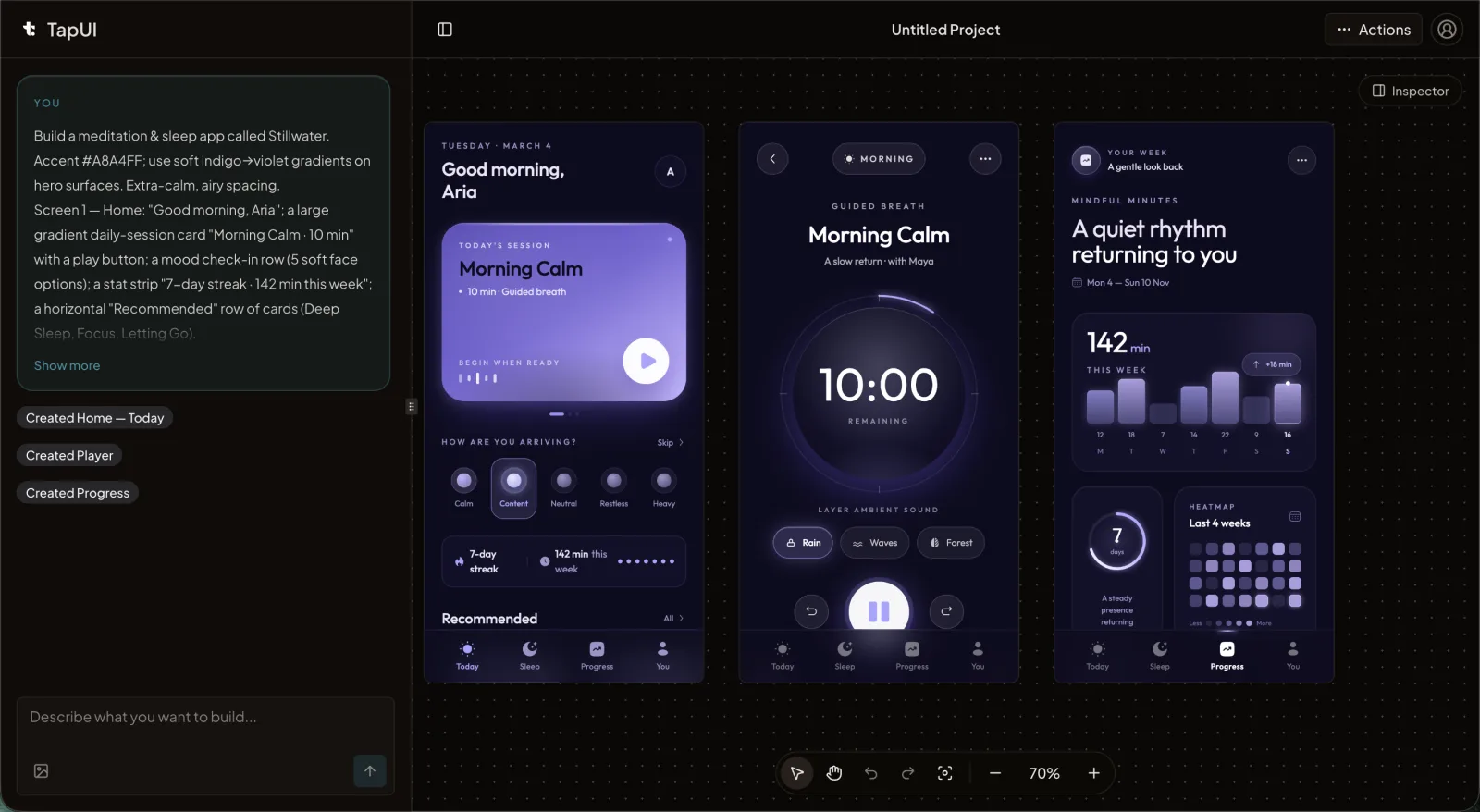 The TapUI editor: describe an app in plain text and get polished mobile screens back.
Best for: founders, PMs, and designers who want polished mobile screens from a plain-text description, are past the free-experiment stage, and don't want per-seat pricing or a tiny free tier in the way.
Pros:
- A free tier you can actually use to evaluate the tool.
- Flat plans, no per-seat math punishing small teams.
- Built specifically around text-to-mobile-screen generation, not a general tool with AI bolted on.
Cons:
- Not the cheapest — Stitch is free.
- For a Figma-native team, it may not be the lowest-friction option.
Here's how the paid landscape looks.
How the paid field compares
A few tools worth weighing TapUI against, based on what each is actually good at:
Uizard
Best for: sketch-first workflows where you want the tool to clean things up.
Around the low double digits per month on its paid plan. The catch is the free tier — it's capped at a tiny number of AI generations per month, so you essentially can't evaluate it seriously without paying. It's mobile-focused and turns sketches plus prompts into multi-screen mockups. If you sketch first and want the tool to clean things up, Uizard's input model suits that workflow well.
Figma AI / Figma Make
Best for: teams already living in Figma.
This is the one to take seriously if your team already lives in Figma. The Professional plan runs around the mid-teens per editor per month, with a monthly pool of AI credits on paid plans. The strength is obvious: zero context-switching, and everything lands in the design environment your team already knows. The weakness is just as obvious — it's per-seat, so a five-person team adds up quickly, and the AI is layered onto an existing product rather than built around generation from the ground up. If you're a Figma shop, this is often the right answer even at a higher total cost. Friction has a price too.
UX Pilot
Best for: wanting design plus user-journey analytics in one tool.
Mid-range monthly pricing, with a free tier capped at a handful of screens. Its differentiator is the extras: predictive heatmaps and user-journey features that go beyond raw screen generation. If you want analysis baked in alongside the design, that's a real reason to pay more.
Banani
Best for: wanting several flow variants to choose from per prompt.
Low-double-digits per month for individuals, a bit more per seat for teams, with a usable free tier of a few hundred credits a month. It generates several UI flow variants per prompt across mobile and desktop — handy when you want options to choose from rather than a single output.
Visily
Best for: early structure work and wireframing.
Around the low double digits per user per month, with a reasonably generous free credit pool. It leans toward wireframing with switching between low and high fidelity, so it's strong for early structure work and lighter on polished final screens.
A couple of tools you'll see mentioned in roundups — v0 by Vercel, for instance — aren't really direct comparisons. v0 generates React web components, not mobile app screens; it's a developer tool wearing a designer's name tag. Worth knowing so you don't waste a trial on the wrong category.
Where TapUI lands among them
TapUI's pitch against this group is straightforward: a free tier you can actually use to evaluate the tool, then Starter and Pro plans priced to give you more usable generation per dollar than the mid-tier competitors, without per-seat math punishing small teams. It's built specifically around describing an app in plain text and getting polished mobile screens back — that focus is the point, not a feature checklist.
It is not the cheapest, and for a Figma-native team it may not be the lowest-friction. Those are real tradeoffs, not footnotes.
"Cheaper" is the wrong question for a lot of people
The harder number isn't the monthly invoice — it's what a tool costs you in time and rework, and that's where a slightly more expensive tool can come out ahead.
A free tool that produces generic screens you then spend two evenings fixing isn't free. A tool with a free tier capped at three generations a month can't actually be evaluated, so you either pay blind or walk away. A per-seat tool that fits your existing workflow perfectly might be the cheapest option overall once you count the hours not lost to context-switching.
So before optimizing for the lowest sticker price, it's worth asking:
- How many screens do I realistically need this month? Daily-credit tools and tiny free tiers punish bursty work.
- Do I need to evaluate before I commit? Tools with real free tiers (Stitch, TapUI, Banani, Visily) let you test; ones with token free tiers (Uizard, UX Pilot) don't.
- Where does the output need to go next? If it needs to land in Figma or in a developer's hands, check that the tool exports cleanly into your pipeline.
- Is brand distinctiveness important? Free and generic-leaning tools save money up front and cost it back in polish.
On exports and handoff
If your decision hinges on a specific export format, verify it directly with each tool before you buy — this is exactly the kind of feature that changes between releases.
A common reason teams move past the free tools is needing designs that don't just live in the generator. TapUI produces screens you can hand to your developers to build from, and Stitch's Figma and HTML/CSS exports cover a lot of common handoff needs too.
When you should not pick TapUI
In the spirit of being useful rather than promotional:
- You need a throwaway prototype and zero budget. Use Google Stitch.
- Your whole team already works in Figma. Figma AI's lack of friction will probably beat any savings elsewhere.
- You want design plus user-journey analytics in one tool. UX Pilot's extras may justify its price.
- You sketch first and want the tool to refine. Uizard's input model fits that.
- You have hard enterprise procurement requirements — specific security certifications, custom contracts, on-prem deployment. Lighter-weight tools, TapUI included, may not clear those bars, and a heavier enterprise vendor is the honest fit.
TapUI is a strong pick when you want polished mobile screens from a plain-text description, you're past the free-experiment stage, and you'd rather not pay per seat or fight a tiny free tier to evaluate. That's a specific buyer — and if it's you, the value math works out well.
Which one should you pick?
- Need a free throwaway prototype? → Google Stitch.
- Already a Figma shop? → Figma AI / Figma Make.
- Need design plus user-journey analytics? → UX Pilot.
- Sketch first, want the tool to refine? → Uizard.
- Want options to choose from per prompt? → Banani.
- Doing early-stage wireframing? → Visily.
- Want polished mobile screens from plain text, past the free stage, and tired of per-seat pricing? → TapUI.
FAQ
Is TapUI the cheapest AI UI design tool?
No. Google Stitch is free, so on raw price it wins. TapUI competes on value-per-dollar against the paid field — more usable generation and a genuinely testable free tier compared to most mid-priced rivals.
Should I just use Google Stitch since it's free?
For prototypes, internal tools, and quick concepts, often yes — it's genuinely the right call. The tradeoffs are daily credit limits you can't top up, more generic output, and uncertain long-term availability as a Google Labs experiment. If those matter for your project, a paid tool may pay for itself.
What makes TapUI worth paying for over free tools?
A free tier you can actually evaluate with, paid plans that don't charge per seat, and a product built specifically around turning text descriptions into polished mobile screens rather than a general design tool with AI bolted on.
How much does TapUI cost?
There's a free tier, then Starter at $20/mo ($17/mo billed yearly) with 100 screen generations a month, project history and exports, and email support; and Pro at $40/mo ($27/mo billed yearly) with 650 generations a month plus priority support.
Which tool is best for a team already using Figma?
Usually Figma AI / Figma Make, despite the higher per-seat cost. Keeping everything in one environment removes friction that's hard to price but real. We'd rather tell you that than pretend otherwise.
Can I try TapUI before paying?
Yes. TapUI has a free tier, so you can test how it handles your actual project before deciding on a Starter or Pro plan.
The bottom line
"Cheaper" depends entirely on what you're measuring. If it's the monthly invoice, Google Stitch's free tier is tough to argue with, and you should use it when it fits. If it's the cost of getting polished, usable mobile screens without a tiny free tier or per-seat pricing getting in the way, TapUI is built to be the better value in the paid field — and we've tried to be honest about exactly where it isn't.
Pick the tool that fits the job in front of you. If that's TapUI, start on the free tier and see how it handles a real screen before you spend anything.