Is There a Free AI UI Generator? What the Free Tiers Actually Get You
Yes, free AI UI generators exist. Here's an honest look at what TapUI, Figma, Visily, Uizard, and Google Stitch give you for free in 2026.
TL;DR: Yes, free AI UI generators exist in 2026. TapUI is the one to start with if you want to turn a plain-text description into polished mobile UI screens and hand them to developers fast — the free plan uses the same AI as the paid tiers, no card required. After that: Visily is the most generous for ongoing projects (unlimited projects, full collaboration), Figma wins for teams already in it and real-time co-editing, and Uizard and Google Stitch are best for quick experiments. Match each tool to the job you actually have.
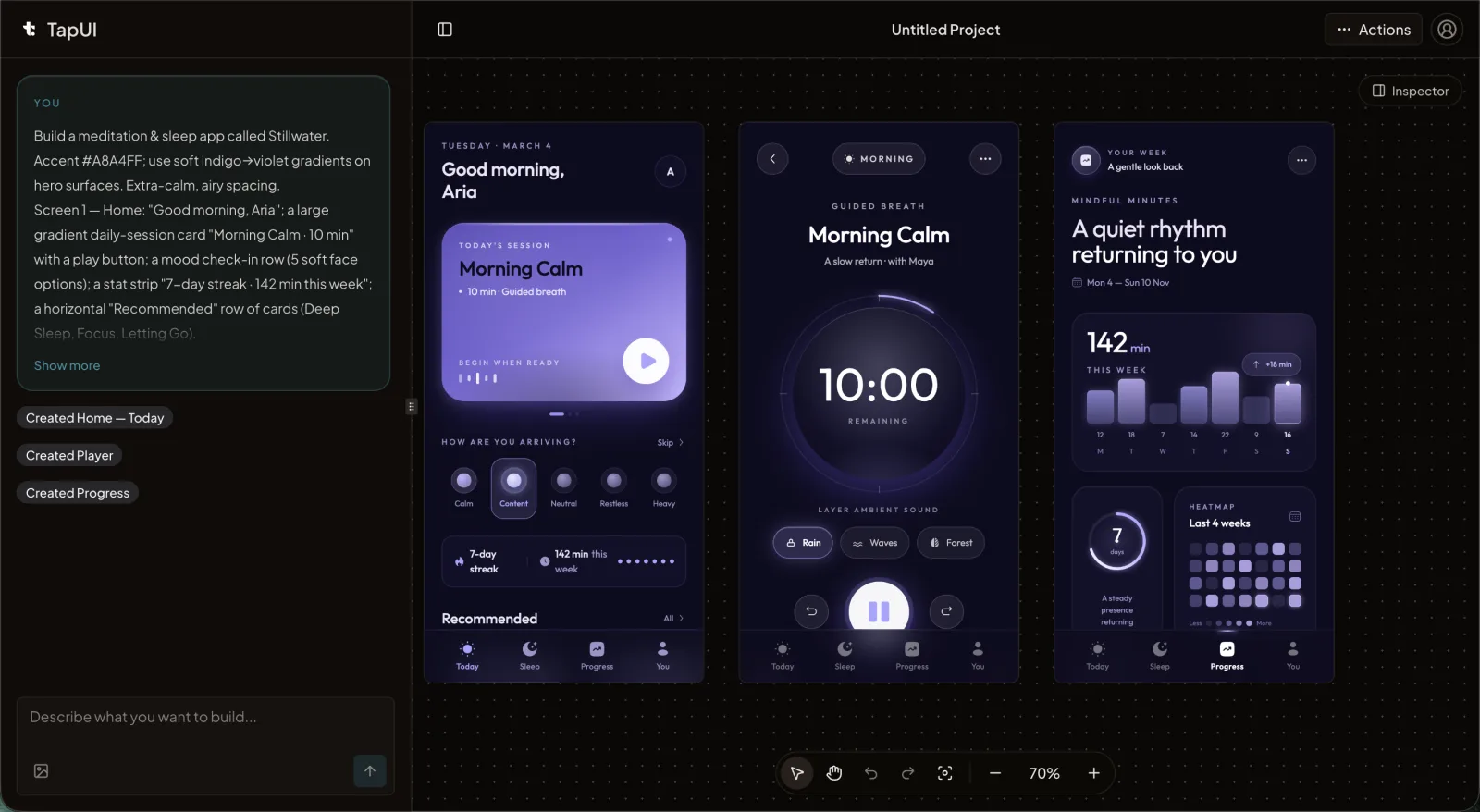 The TapUI editor turns a plain-text app description into polished mobile UI screens.
Short answer: yes. Several AI tools will turn a text prompt into app screens without asking for a card. The longer, more useful answer is that "free" means something different in each one — a permanent free plan, a trial that expires, a tool that's generous on projects but stingy on AI runs, or one that's free today mostly because it's still in beta.
I've spent enough time inside these tools to have opinions about where each one earns its keep. This is a walk through the free options worth knowing in 2026, what they actually hand you, and where they quietly cap you.
A quick note on TapUI, since I work on it: I'll be specific about what the free plan does, and equally specific about where other tools beat it. If a competitor is the better pick for your situation, I'd rather tell you than pretend otherwise.
How to read a "free" AI design plan
Four things tend to decide whether a free tier is real or a glorified demo. Before looking at any specific tool, run through this checklist:
- Project or file count — how many separate designs you can keep alive at once.
- AI runs per month — the number that quietly throttles you. A tool can give you "unlimited projects" and still cut you off at a handful of generations.
- Export — whether you get clean images, whether they're watermarked, and what you can hand to a developer.
- Collaboration — whether anyone else can edit alongside you, or just look.
Most free plans are generous on one or two of these and tight on the rest. The trick is matching the generous parts to what you're actually doing.
TapUI Free
TapUI's free plan lets you run the full prompt-to-screens loop without paying first — write a description, get polished mobile UI screens, refine, iterate. The AI behind the free plan is the same one behind the paid plans; you're not being routed to a weaker model to nudge you into upgrading.
The pitch is speed: you describe the thing, you get real screens to react to, instead of starting from a blank artboard. You can hand the resulting screens to your developers as a visual reference for what to build.
What the free plan doesn't include are the things meant for ongoing or team work: higher usage ceilings, project history with exports, and priority support. Those come with the paid tiers:
- Starter — $20/mo, or $17/mo billed yearly. 100 screen generations per month, project history plus exports, and email support.
- Pro — $40/mo, or $27/mo billed yearly. 650 generations per month, everything in Starter, plus priority support.
A note on scope: TapUI generates the designs — the mobile screens you react to and hand off. It does not export production code (React Native, Swift, or Flutter); think of the output as a visual spec for your developers, not a finished codebase.
Where TapUI fits: a solo founder pressure-testing an app idea, a designer who wants a fast first draft to push past the blank-canvas stage, someone who thinks in product descriptions rather than in component trees. If your whole goal is generating mobile screens from a description, this is the tool built around that one job.
Where it doesn't: if you need real-time multiplayer editing or a mature, plugin-rich design environment, the next two tools are stronger.
Figma (free Starter plan)
Figma is the strongest free option if your team already lives in it or you need true real-time co-editing — that gravity matters more than any single AI feature. It isn't an AI generator in the TapUI sense; it's the design environment a huge share of the industry works in, with AI features and community plugins layered on top.
The free Starter plan is real but tight. As of 2026 it gives you one team with a single project capped at three Figma design files, up to two editors per file, up to three pages per file, and version history that only goes back 30 days. Personal drafts (files you haven't moved into a project) are unlimited, and the plan includes a monthly allotment of AI credits. The big catch for handoff: full Dev Mode — the inspection and code-readout developers lean on — isn't on Starter. You get a basic preview; the real thing needs a paid seat.
Where Figma wins outright: collaboration. Real-time, multiple-cursors-on-one-canvas editing is genuinely better here than in most generator-style tools, and the plugin ecosystem lets you bolt on AI where you want it.
The honest catch: three files per team disappears fast on anything beyond a small project, and you'll feel the missing Dev Mode the moment you try to hand off cleanly.
Visily (free Starter plan)
Visily has the most generous free tier of any tool in this roundup — unlimited projects, unlimited editors, and access to the same AI features and high-fidelity templates that paid users get. It leans toward wireframing and structure rather than highly bespoke visual design, but that's often the right altitude early on — wireframes communicate the skeleton without dragging stakeholders into arguments about button shades.
You can go from a text prompt to a wireframe, or screenshot an existing app and have Visily rebuild the layout as something editable. The free plan also includes real-time collaboration, commenting, and an inspect mode where developers can pull CSS from elements.
Where Visily wins: if you want unlimited projects and full collaboration without paying, and you're comfortable working at the wireframe-to-mid-fidelity level, it's hard to beat for the price of nothing.
Where it trails: for richly art-directed, pixel-specific UI, a dedicated visual tool or a polished generator will get you further.
Uizard (free plan)
Uizard's best feature is converting rough input into digital designs — sketch a screen on paper, photograph it, and it produces an editable version; screenshot an app and it extracts the structure. As an ideation bridge between paper and pixels, that's a nice idea.
The free plan, though, is best treated as a look-around rather than a workspace. It caps you at a small number of projects (around two), limits screens per project, and — the real bottleneck — gives you only a handful of AI generations per month. Exports carry Uizard branding. That generation ceiling is low enough that properly evaluating the tool on free alone is tough; you'll burn through your monthly runs before you've really tested it.
Where Uizard fits: you sketch by hand and want those sketches digitized quickly, and you're fine upgrading if it clicks.
Where it doesn't: as an ongoing free home for projects. The generation cap forces the decision early.
Google Stitch (formerly Galileo AI)
Google Stitch is free during its current beta — no card required, just a Google account — making it the easiest tool to try right now if you want to experiment with prompt-to-UI generation. Worth flagging because older comparison posts still list "Galileo AI" as a standalone trial — it isn't one anymore. Galileo AI was acquired by Google and folded into Google Stitch, a Gemini-powered tool that turns text prompts into UI designs.
As of 2026 Stitch offers daily usage credits rather than a hard paywall. "Free because it's still beta" comes with the usual asterisk: terms, limits, and the product itself can shift, so don't build a long-term workflow on the assumption it stays exactly as-is.
Where Stitch fits: experimenting with prompt-to-UI generation at no cost right now, especially if you're already in Google's orbit.
The caveat: beta-stage products move. Treat it as a great thing to try, not a foundation to commit to.
Free plans at a glance
A snapshot — check each tool's current pricing page before committing, since free tiers shift often:
| Tool | Free project/file limit | AI runs | Collaboration | Export notes |
|---|---|---|---|---|
| TapUI Free | Core generation available | Same model as paid | Solo | Screens for developer handoff (no code export) |
| Figma Starter | 3 files per team | Monthly AI credits | Real-time, up to 2 editors/file | No full Dev Mode |
| Visily Starter | Unlimited | Full AI features | Real-time | Inspect mode included |
| Uizard Free | ~2 projects | Few per month | Solo | Uizard branding |
| Google Stitch | Beta (no fixed cap) | Daily credits | Varies | Beta-stage |
So which free tool should you actually start with?
The right answer depends less on which is "best" and more on what you're doing:
- You think in product descriptions and want mobile screens fast. Start with TapUI Free — it's built around one job: turning a written idea into polished app UI that you can react to and hand off to developers. The free plan runs the same AI as the paid tiers.
- You or your team already live in Figma, or you need true real-time co-editing. Figma Starter is the right call, eyes open about the three-file ceiling.
- You want the most generous free tier with no project cap. Visily is the standout, especially if wireframe-to-mid-fidelity covers your needs.
- You sketch on paper. Uizard for digitizing those sketches — just expect to upgrade quickly.
- You're curious what Google's prompt-to-UI generation feels like. Stitch, while the beta lasts.
Honestly, the strongest move is combining a couple of these: generate polished screens in TapUI, then bring them into a collaboration-first environment if your team needs to iterate together. Free tiers are good enough that the cost of trying several is just your time.
When it's worth paying
Free covers learning, validation, and small projects well. The signals that it's time to upgrade are consistent across tools:
- You're hitting the ceiling constantly — deleting old projects to make room, or waiting out a monthly generation reset. When the limit interrupts your flow, the paid plan has already paid for itself.
- You need team features — shared workspaces, version control, more than one or two editors.
- You're shipping commercially — read the free tier's terms; some restrict commercial use, and once revenue depends on the work, you want that clarified.
A few honest limitations of free AI design
So the expectations are right going in:
- Generation has a quality ceiling. AI is excellent for first drafts and exploring directions; it leans toward safe, common patterns. The distinctive stuff still comes from a human steering it.
- Support is thin. Free usually means community help, not a fast response when you're stuck.
- It augments, it doesn't replace. These tools get more people to a working draft faster. Judgment about what's actually good, and what your users need, is still on you.
FAQ
Is there a completely free AI UI generator with no limits?
No — every free tier limits something: project count, monthly AI runs, export quality, or collaboration. Visily is among the most generous (unlimited projects and full AI features for free), but even there you'll find paid-only extras.
Can I design a whole app interface using only free tools?
Yes, depending on what you mean by "whole." You can generate and refine real screens and hand them off as a visual spec for developers to build from (these tools produce designs, not production code). What typically needs paid plans is heavy team collaboration, higher usage volume, and the more advanced handoff tooling.
Do free AI design tools watermark exports?
Some do, some don't. Uizard's free exports carry its branding, for example. Always check a specific tool's free terms before you commit to important work.
Why was Galileo AI's free trial removed?
Galileo AI was acquired by Google and became Google Stitch. The old standalone trial is gone; Stitch is the current Gemini-powered successor, free during its beta.
Can I use multiple free tools together?
Yes, and it's often the smartest play — sketch or wireframe in one, generate polished screens in another, refine in a third. Just know that editable components rarely transfer cleanly between tools, so plan to finalize in one place.
Decision guide: Should you use TapUI or v0 for your project? →