8 Sleek.design Alternatives Worth Trying for App UI Design
A practitioner's look at Sleek.design alternatives for app UI design, where each tool wins, where it falls short, and how TapUI fits in.
TL;DR: Sleek.design is a fast prompt-to-screens tool that stalls once you need real refinement. The best alternative depends on the job: Google Stitch for a free option, Uizard for sketch input, Figma + UX Pilot for design depth and handoff, ProtoPie for true interactivity, FlutterFlow if you actually want code, and TapUI if you like Sleek's describe-it-and-get-screens flow but want more room to iterate before handoff. None of these, including TapUI, exports native app code — treat them as design tools, not app builders.
Sleek.design does one thing well: you type a prompt, and a few seconds later you have a clean set of iOS or Android screens. For a founder who needs something to put in front of an investor by Friday, that's genuinely useful. The trouble starts when you outgrow it.
Push Sleek past rapid prototyping and the cracks show. Its Figma export lands as flat-ish layers that senior designers tend to rebuild rather than refine. Highly branded work and anything with conditional logic or careful accessibility handling gets inconsistent. It's a fast first draft, not a finishing tool, and its own roadmap doesn't pretend otherwise.
So the real question isn't "what's better than Sleek.design" in the abstract. It's "better at what." Below are eight tools I'd actually reach for, grouped by the job you're trying to get done, with honest notes on where each one beats Sleek and where it doesn't.
The alternatives at a glance
| Tool | Best for | Key strength | Pricing | Native code export |
|---|---|---|---|---|
| TapUI | Sleek's flow with more refinement | Iterate on screens before handoff | Free; Starter $20/mo, Pro $40/mo | ❌ |
| Google Stitch | Zero-budget exploration | Free daily credits, clean Figma/HTML export | Free (Labs beta) | ❌ |
| Uizard | Sketches and wireframes | Converts hand-drawn input to designs | Free; Pro ~$12/mo | ⚠️ exports code |
| Figma + UX Pilot | Established design teams | Editing depth, components, handoff | Figma Pro ~$16/mo + plugin | ❌ |
| ProtoPie | Real working interactions | Sensors, logic, hardware inputs | Paid (learning curve) | ❌ |
| FlutterFlow | Shipping code, not designs | Generates actual Flutter apps | Free; paid ~$39/mo | ✅ Flutter |
Related: If you're specifically weighing Google's tool, see best Google Stitch alternatives, and for design-system work, best Figma AI alternatives.
If you want the closest like-for-like swap: TapUI
TapUI sits in the same lane as Sleek.design. You describe an app in plain language and it generates polished mobile UI screens. The audience is the same too: founders, PMs, and designers who want working app UI fast without sitting down to draw it by hand.
Where it differs is intent. Sleek leans toward "here's a mockup, good luck." TapUI is built around iterating on the output until the screens are something you'd actually ship a design review with, then handing those designs off to your developers.
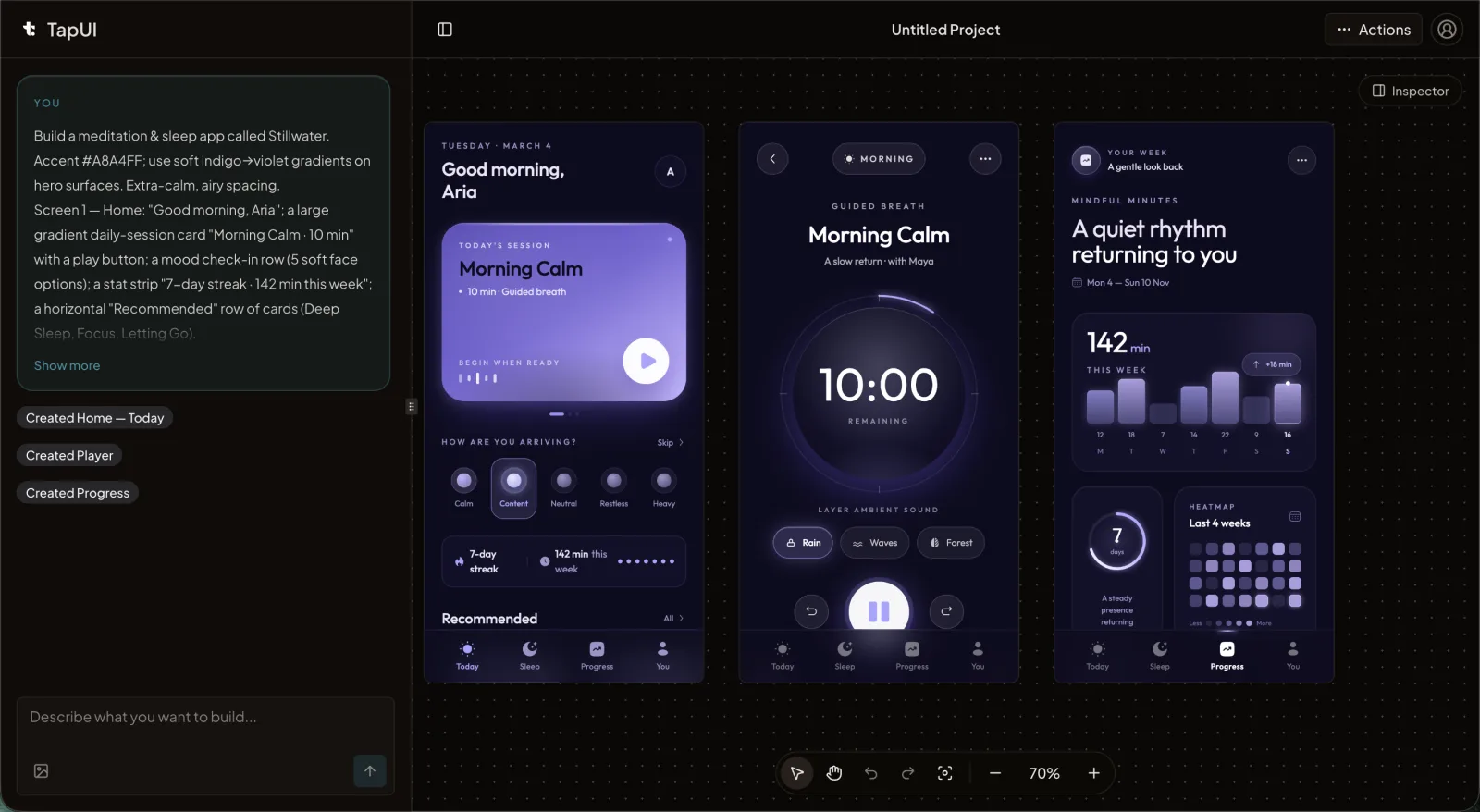 The TapUI editor: describe an app in plain language and refine the generated screens before handoff.
One honest caveat. TapUI does not export native app code — it produces designs and screens you hand to developers, not a running app. So if your dream is "prompt to running app," this is not that tool, and neither is Sleek. Treat both as UI-design tools, not app builders.
Pricing: a Free tier to test the waters, then Starter at $20/mo ($17/mo billed yearly, 100 screen generations/mo with project history and exports) and Pro at $40/mo ($27/mo billed yearly, 650 generations/mo plus priority support). Try the free tier on a real screen before you commit.
- Best for: anyone using Sleek today who likes the prompt-to-screens flow but wants more room to refine before handoff.
- Pros: same fast describe-it-and-get-screens flow as Sleek; built for iteration; project history and exports; free tier to test.
- Cons: does not generate native or production code; you still bring the design judgment for branded, accessible work.
Pro tip: Start with one real screen from a project you're already working on. Generic prompts give you generic UI from any of these tools.
If you want free and don't mind a beta: Google Stitch
Stitch is Google Labs' design tool, built on top of Gemini and grown out of the Galileo AI acquisition. It turns prompts, sketches, and screenshots into UI and interactive prototypes, and the March 2026 "2.0" update added multi-screen generation and an infinite canvas.
The pitch is hard to argue with: it's free, with daily design credits, and there's no signup friction beyond a Google account, no credit card. Exports to Figma and HTML/CSS are clean, and it'll spin up several variations quickly.
- Best for: early exploration and anyone whose budget is zero. Just don't build a production workflow on top of a beta you can't pin down.
- Pros: genuinely free; no credit card; clean Figma and HTML/CSS export; fast variations.
- Cons: visuals can feel generic; shaky beyond ~three screens; no way to top up daily credits; uneven regional availability; Labs status means pricing could change.
If you start from sketches and wireframes: Uizard
Uizard's strength is its input flexibility. Hand it a hand-drawn sketch or a rough wireframe and it converts it to a digital design. It also takes text prompts, supports collaboration, and exports code, which makes it a comfortable fit for design sprints where you're turning whiteboard scribbles into something clickable.
It has a free plan, with Pro starting around $12/month on annual billing. Compared to Sleek, the draw isn't prettier output, it's the number of ways you can get into the tool.
- Best for: teams that think on paper first and want to skip the manual digitization step.
- Pros: accepts sketches, wireframes, and text prompts; collaboration; exports code; affordable Pro tier.
- Cons: output quality is comparable to other generators, not a step above; still a starting point, not a finished design.
If you live in Figma already: Figma + UX Pilot
For a lot of teams, the most realistic "alternative" is the tool they already pay for. Figma is the industry standard for a reason, the editing depth, components, and developer handoff are in a different class from any prompt-to-screens generator, and AI plugins like UX Pilot bolt on generation without forcing you to leave.
The trade-off is obvious: it's not a one-prompt-to-finished-screens experience, and you're paying for Figma (Pro lands around $16/month) plus the plugin. You bring the design skill; the AI just accelerates it.
- Best for: established design teams maintaining real design systems, where handoff and collaboration matter more than raw generation speed.
- Pros: unmatched editing depth, components, and handoff; AI plugins add generation without leaving the tool.
- Cons: not a one-prompt flow; cost stacks (Figma plus plugin); you supply the design skill.
If you need real working interactions: ProtoPie
None of the AI generators above are built for genuinely complex interaction design, sensors, conditional logic, hardware inputs, prototypes that behave like real apps. ProtoPie is. It imports from Figma and adds the kind of interactivity that static mockups can't fake.
The catch is a real learning curve, and it's a prototyping tool, not a screen generator, so it pairs with one of the tools above rather than replacing it.
- Best for: interaction designers and product teams testing nuanced flows or hardware-connected experiences.
- Pros: true interactivity including sensors and conditional logic; imports from Figma.
- Cons: steep learning curve; doesn't generate screens, so it complements rather than replaces a design tool.
A few others worth a quick look
- FlutterFlow generates actual Flutter apps, not just screens, with a free tier and a paid plan around $39/month. If your real goal is shipping code rather than designing UI, it's a different category of tool, and worth knowing about.
- Lovable, Firebase Studio, and Pencil.dev show up on alternative lists, but they lean toward full-stack app building rather than pure UI design. Useful if your needs have crept past "I just want screens."
How to actually choose
Strip away the marketing and the decision comes down to a few questions:
- Budget at zero? → Start with Google Stitch, accept the beta caveats.
- You sketch first? → Uizard.
- You already own Figma and have design chops? → Figma plus an AI plugin.
- You want the Sleek.design flow but more refinement before handoff? → TapUI.
- You need prototypes that behave like real apps? → ProtoPie, alongside whatever you design in.
- You actually want shippable code, not designs? → FlutterFlow, and reset your expectations — that's app building, not UI design.
One thing that's true across the whole list: AI generators get you to a strong first draft fast, and every one of them needs a human to take it the rest of the way. Branded, nuanced, accessible work is still your job. The tools just shorten the boring part.
Related: For more on getting good output from these tools, read how to design app UI with AI.
FAQ
How is TapUI different from Sleek.design?
Both tools turn plain-text descriptions into polished mobile UI screens. TapUI is oriented toward iterating on the generated screens and handing finished designs to developers, whereas Sleek tends toward treating the first generation as the finish line. Neither tool exports native app code—treat both as design tools, not app builders.
Does TapUI export code?
No. TapUI generates designs and screens you hand to developers, not production code or running apps. If you need native code export, that's not the right tool for the job—consider FlutterFlow if you actually need Flutter apps.
What's the best free Sleek.design alternative?
Google Stitch is the strongest fully free option: daily design credits, no credit card required, and clean Figma and HTML/CSS exports. The caveat is that it's a Google Labs beta, so pricing and availability could change. TapUI also has a free tier if you want a closer match to Sleek's describe-it-and-get-screens flow.
How much does TapUI cost?
TapUI offers a free tier to test, Starter at $20/month ($17/month billed yearly with 100 screen generations/month, project history, and exports), and Pro at $40/month ($27/month billed yearly with 650 generations/month and priority support). Start with the free tier on a real screen before committing.
Do I need design experience to use these tools?
No, but design skill shows in the output. AI generators lower the barrier so non-designers can produce credible early-stage work, especially for investor pitches. The closer you get to branded, production-ready work, the more a designer's judgment matters—the tools give you a starting point, not a finished identity.
The short version
There's no universal winner here, and anyone who tells you otherwise is selling something. Google Stitch wins on price, Uizard on sketch input, Figma on depth and handoff, ProtoPie on real interactivity, FlutterFlow if you actually want code. TapUI is the most natural swap if you like Sleek.design's describe-it-and-get-screens flow but want more room to refine before handoff.
The best way to decide is to run the same real screen through two or three of them and see whose output you'd be least embarrassed to put in front of your team.
Try it on a real screen: Start with TapUI's free tier and compare the output against whatever you're using now.