The Best v0 Alternatives for AI UI Generation in 2026
A practitioner's look at the strongest v0 alternatives, where each one wins, and which tool fits mobile app UI versus web.
TL;DR: There's no single "best v0 alternative" — pick by destination. For full-stack web apps from a prompt, use Bolt.new or Lovable. For React components on Vercel, stay with v0. For free web + mobile ideation, try Google Stitch. For native mobile app UI from plain text, use TapUI. For Flutter / React Native export from a Figma design, look at Anima.
v0 by Vercel does one thing extremely well: you type a prompt, and it hands back production-ready React and Next.js components you can drop into a project and deploy in a click. That's a real workflow, and millions of developers use it. But "v0 alternative" gets searched for a lot of different reasons, and most of them come down to one of three frustrations.
The first is cost. v0 runs on token-based billing, and the free tier's credit allowance gets eaten quickly on anything non-trivial. Heavy users have watched the credit system quietly shrink how much they can actually do per month.
The second is reliability. Through late 2025, some users reported quality regressions — hallucinated imports, layouts that came back broken — that made the output less of a sure thing than it used to be.
The third, and the one I care most about here, is platform. v0 is web-only. It generates React and Next.js. If you're designing a mobile app — actual iOS or Android screens, not a responsive web page that mimics one — v0 was never built for you. And here's the thing worth saying up front: almost none of the popular "v0 alternatives" were either. Most of them are web tools competing with v0 on v0's home turf.
So this isn't a ranked listicle where one tool wins everything. It's a map. I'll group the alternatives by what they're actually for, tell you where each genuinely beats v0, and be honest about where v0 (or another competitor) is the better pick. I work at TapUI, which is a mobile-UI tool, so I'll flag that bias plainly and tell you exactly when TapUI is not the right answer.
v0 alternatives at a glance
Here's the quick map before the detail. Match the row to what you're actually building.
| Tool | Best for | Key strength | Native mobile UI? | Pricing model |
|---|---|---|---|---|
| v0 | React/Next.js web components | Tight Vercel integration, sandbox, one-click deploy | ❌ | Token-metered (free tier + paid plans) |
| Bolt.new | Full-stack web apps from a prompt | In-browser full stack, autonomous debugging | ❌ | Token-based (free + Pro/Teams) |
| Lovable | Web MVPs, fast | Editable full-lifecycle source code | ❌ | Free daily credits + Pro |
| Google Stitch | Free web + mobile ideation | Text-to-UI, multi-screen canvas, free in beta | ⚠️ (screens, Labs experiment) | Free during beta |
| Uizard | Wireframes for non-designers | Autodesigner mockups from a prompt | ⚠️ (mockups only) | Modest monthly + Pro/Business |
| Framer / Builder.io / TeleportHQ | Marketing / CMS-driven web | Site building, Figma-to-code | ❌ | Varies by tool |
| TapUI | Native mobile app UI from plain text | Sentence → polished mobile screens to hand to devs | ✅ | Free tier; Starter $20/mo, Pro $40/mo |
| Anima | Flutter / React Native export | Exports native targets — but from a Figma file | ⚠️ (export, not text-to-UI) | Paid plans |
First, what is v0 actually good at?
Before replacing a tool, it helps to know what you'd be giving up. As of 2026, v0 runs a multi-model system (Mini, Pro, Max, and Max Fast tiers), ships a VS Code-style editor with Git integration, connects to databases like Snowflake and AWS, runs a sandbox so you can preview live, and deploys straight to Vercel with one click. There's an agentic mode for longer multi-step builds.
That's a serious, well-integrated product. If your destination is a React or Next.js web app hosted on Vercel, most "alternatives" below will feel like a downgrade on integration. The reasons to leave are pricing pressure, the occasional quality dip, or — the big one — that you're not building for the web at all.
Pricing, for reference: v0 has a free tier with a small monthly credit allowance, then Team and Business plans priced per user, plus custom Enterprise. It's all token-metered, which is the part people either love (pay for what you use) or resent (usage is hard to predict).
The full-stack web builders: Bolt.new and Lovable
If your real goal is "ship a working web app, not just components," two tools go further than v0 in one specific way: they build the whole stack from a single prompt.
Bolt.new, from StackBlitz, runs entirely in your browser using WebContainer technology — frontend, backend, database, the lot, no local setup. It generates full-stack web apps and, with its v2 release, leans hard into autonomous debugging to cut down on the error loops that plague prompt-driven builders. Pricing is token-based: a free tier with a monthly token allowance, then Pro and Teams plans, with consumption scaling by project complexity (a single project can burn anywhere from tens of thousands to a few million tokens). That last point is the catch — on a large project, token costs climb fast, and that's the most common complaint.
- Best for: a deployable full-stack web app from one prompt, with no local setup.
- Pros: runs entirely in-browser; full stack in one shot; strong autonomous debugging.
- Cons: token costs climb fast on big projects; web-only, no mobile UI.
Lovable is an independent startup that's grown quickly, and it plays a similar game: describe an app, get real editable source code spanning the whole lifecycle. It's genuinely good at getting an MVP from idea to deployed fast. Pricing runs from a free daily-credit tier up to a Pro plan.
- Best for: getting a web MVP from idea to deployed quickly.
- Pros: real editable source code; fast across the full app lifecycle.
- Cons: web app builder only — no native iOS or Android UI.
Where these beat v0: scope. v0 hands you components; Bolt and Lovable hand you a running application with a backend. If you want a deployable web product and not a pile of UI pieces, that's a real edge.
Where they don't help: mobile. Both are web app builders. Neither produces native iOS or Android UI. If you came here looking for mobile, keep reading.
The design-focused generators: Google Stitch and Uizard
Sometimes you don't want a deployed app. You want screens — UI to think with, share, and iterate on.
Google Stitch is the one to know about, partly because of a common mix-up. Stitch is what used to be Galileo AI. Google acquired Galileo in early 2025, the original founders joined, and the product relaunched as Stitch at Google I/O in May 2025 (with updates rolling out into 2026). If you still see "Galileo AI" listed as a separate, current tool somewhere, that list is out of date — Galileo as a standalone product is gone, and former users had a migration window to move over.
Stitch does text-to-UI generation, powered by Gemini, with a multi-screen canvas, interactive prototyping, and exportable design and code. It covers both web and mobile app UI screens. And it's free during its beta, which is a strong draw.
- Best for: fast, free ideation across both web and mobile screens.
- Pros: text-to-UI, multi-screen canvas, prototyping; free in beta; covers mobile.
- Cons: Google Labs experiment — no SLA, real sunset risk; no deployment or backend.
The honest caveat: Stitch is a Google Labs experiment. There's no SLA, no long-term commitment, and Google has a well-earned reputation for sunsetting Labs projects. It's also not production-grade end to end — no deployment, no backend. For rapid ideation, especially on a budget, it's excellent. For something you're betting a roadmap on, factor in the risk that it changes shape or disappears.
Uizard takes a different angle: AI-powered mockups and wireframes aimed at non-designers and early founders. Its Autodesigner feature spins up multi-screen mockups from a text prompt. Pricing sits in the modest monthly range with Pro and Business tiers. It's a solid way to get a wireframe-level concept across, but it stays at the mockup level — don't expect production code, and its mobile specificity is limited.
- Best for: non-designers who want a quick wireframe-level concept.
- Pros: Autodesigner builds multi-screen mockups from a prompt; modest pricing.
- Cons: stays at mockup level — no production code; limited mobile specificity.
The web-only crowd: Framer, Builder.io, TeleportHQ, Dora
A lot of "v0 alternative" lists pad themselves with tools that are really solving adjacent problems. Worth a quick, honest pass so you can rule them in or out:
- Framer AI is a no-code site builder optimized for marketing websites. Great at landing pages. Not an app UI tool.
- Builder.io pairs a visual headless CMS with AI code generation — Figma-to-code, design-to-code, and a Fusion feature that turns Slack or Jira messages into production PRs. Powerful for web teams with a CMS need. No mobile UI generation.
- TeleportHQ is a low-code website builder with AI generation and Figma-to-code, supporting React, Next.js, Vue, Angular, Gatsby, and plain HTML/CSS. Despite occasional claims otherwise, it has no Flutter, React Native, or native mobile export — it's web frameworks only.
- Dora AI generates 3D, animated websites from prompts. Visually striking, genuinely a niche of its own. Not mobile app UI.
If your destination is the web, one of these might fit better than v0. If it's a phone, none of them do.
The mobile question — and where TapUI fits
Here's the pattern across everything above: v0 is web/React-only, the full-stack builders are web, the design generators lean web (Stitch covers mobile screens but as a Labs experiment), and the rest are explicitly websites. The category that's thin on the ground is native mobile app UI from a plain-text prompt.
That's the gap TapUI is built for. You describe an app in plain language and TapUI generates polished mobile app UI screens — the kind of work founders, PMs, and designers usually need before any engineering starts. The point of comparison with v0 isn't "better code"; it's a different target entirely. v0 gives you React for the browser. TapUI gives you mobile screens designed for a phone, which you can then hand to your developers to build.
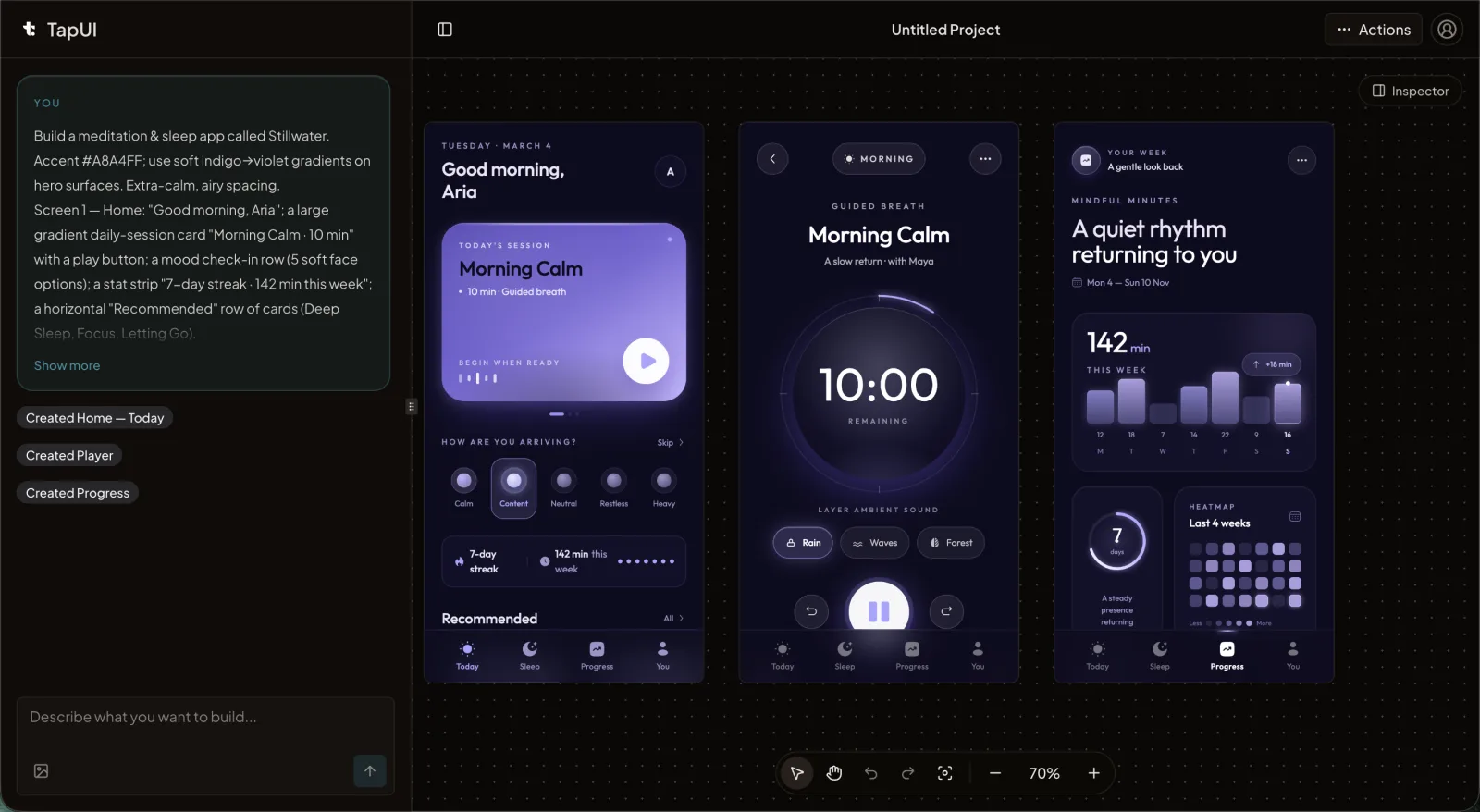 The TapUI editor: describe an app in plain language and get polished mobile screens to hand to your developers.
On pricing, TapUI keeps it simple: a free tier to try it, then Starter at $20/mo ($17/mo billed yearly, 100 screen generations/mo, project history and exports, email support) and Pro at $40/mo ($27/mo billed yearly, 650 generations/mo, everything in Starter plus priority support).
- Best for: turning a sentence into credible mobile app UI screens without designing by hand.
- Pros: built specifically for native mobile screens; founder/PM/designer-friendly; simple pricing.
- Cons: doesn't deploy a backend and doesn't generate native code — it produces designs you hand to developers.
I'll be straight about the trade-offs, because that's the whole point of this piece:
- If you need a deployed web app, TapUI is the wrong tool — go to Bolt.new or Lovable.
- If you need production React components for a Next.js site, stay with v0. That's its home, and it's good at it.
- If you want free, fast mobile and web ideation and can tolerate Labs-level uncertainty, Google Stitch is a legitimate alternative worth trying before anything paid.
- If you specifically need Flutter or React Native code export from a design, look at Anima — it's one of the few tools that exports to those targets, though it takes a Figma file as input rather than a text prompt, so the workflow is different from everything else here.
TapUI's case is narrow and specific: getting from a sentence to credible mobile app UI screens without doing the design work by hand. That's it. It doesn't deploy your backend, and it isn't trying to.
A note on "code editors as alternatives"
You'll sometimes see Cursor (by Anysphere) on these lists. Cursor is an excellent AI code editor used by a huge number of developers, but it's an IDE assistant, not a UI screen generator. It belongs in a different comparison. If what you want is to generate UI from a prompt, Cursor isn't really the same category — it's a tool for editing code you've already got.
So which one should you pick?
Match the tool to the destination, not to the hype:
- Need React/Next.js web components, Vercel-hosted? → v0. Leave only if pricing or the late-2025 quality wobbles push you out.
- Need a full web app, backend and all, from one prompt? → Bolt.new or Lovable. Watch Bolt's token costs on big projects.
- Need fast, free UI ideation across web and mobile screens? → Google Stitch, with eyes open about its Labs status.
- Need quick wireframes for non-designers? → Uizard.
- Need marketing sites / CMS-driven web? → Framer, Builder.io, or TeleportHQ.
- Need native mobile app UI from plain text? → TapUI.
- Need Flutter / React Native export from an existing design? → Anima.
The honest summary: there's no single "best v0 alternative," because v0 isn't one thing to everyone. The web crowd has strong, mature options. The mobile-from-a-prompt corner is much emptier — which is exactly why the right answer depends entirely on what you're building.
FAQ
Can v0 generate native mobile app UI?
No. v0 generates React and Next.js code that runs in a browser, with no Flutter, React Native, or native iOS/Android output. For native mobile app UI, use a mobile-focused tool like TapUI or Anima instead.
What happened to Galileo AI?
Google acquired Galileo AI in early 2025 and relaunched it as Google Stitch at I/O 2025. Galileo is no longer available as a standalone product; Stitch is its successor with expanded web and mobile screen generation.
What's the best free alternative to v0?
Google Stitch is the strongest free option—it generates web and mobile UI screens and is free during its beta. Keep in mind it's a Google Labs experiment with no guaranteed longevity. TapUI also offers a free tier for trying mobile UI generation.
Should I choose Bolt.new or Lovable for a web MVP?
Both generate full-stack web apps from a prompt. Lovable excels at shipping fast across the entire app lifecycle, while Bolt.new runs entirely in-browser with strong autonomous debugging. Bolt's token costs can scale significantly on larger projects, so factor that into your decision.
Which tool exports Flutter or React Native?
Anima is one of the few tools that exports to Flutter and React Native, but it requires a Figma design as input rather than a text prompt. Most prompt-based generators here, including v0 and TapUI, don't export native code—TapUI produces mobile UI designs you hand to developers to build.
How does TapUI compare to v0?
They target different platforms: v0 produces React web components for browser deployment, while TapUI generates mobile app UI screens from plain text for founders and designers to hand to developers. If you're building a Next.js site, v0 is the better fit; for mobile UI, TapUI is purpose-built.
Related: Ship mobile UI faster with AI • Validate app ideas without coding