AI Design Tools for Flutter Apps: What Actually Helps in 2026
A practical look at AI tools for Flutter UI work, where Google Stitch and FlutterFlow fit, and how TapUI handles fast screen design.
TL;DR: There's no single best AI design tool for Flutter, because designing a screen and shipping Dart are different jobs. FlutterFlow gets you closest to deployable Flutter code, Google Stitch gives a free multi-framework first draft, and TapUI is the fastest way to produce polished mobile screens you can hand to developers as a visual spec (it's a design tool, not a code generator). Pick for the bottleneck you actually have.
There is a gap most "AI for Flutter" roundups skip over: the difference between designing a screen and shipping a Flutter widget. A tool can spit out a gorgeous settings page in seconds, and you can still be hours away from a StatelessWidget that compiles, themes correctly, and survives a hot reload. Those are two different jobs, and the tools on the market handle them very differently.
This piece sorts the current options by what they're genuinely good at — design, code, or the messy handoff in between — so you can match a tool to where you actually lose time.
Related: AI design tools for iOS, Android UI tools, and React Native with Expo.
The tools at a glance
| Tool | Best for | Key strength | Flutter code? | Pricing |
|---|---|---|---|---|
| TapUI | Fast, polished mobile screens to spec | Idea → good-looking UI in plain language | ❌ Design only | Free tier; Starter $20/mo, Pro $40/mo |
| FlutterFlow | Deployable Flutter/Dart | Real Flutter output, not a web wrapper | ✅ Native | Tiered subscription; tight AI limits on low plans |
| Google Stitch | Free multi-framework first draft | Broad export incl. Flutter | ⚠️ Secondary target | Free (Google Labs) |
| Vercel v0 | Web UI (React/Next.js) | Excellent web output | ❌ No Flutter path | Tiered |
| Locofy.ai | Figma → code | Solid Figma-to-code quality | ❌ React Native only | Tiered |
| Workik | Dart coding assistant | Free Flutter/Dart code help | ⚠️ No design canvas | Free |
Two jobs, not one
No single AI tool nails both design and Flutter code today — and knowing which problem you're actually solving is most of the battle. A Flutter feature usually moves through three stages:
- Design — deciding what the screen looks like: layout, hierarchy, states, the empty and error cases nobody remembers until QA.
- Code — turning that design into Dart: widget composition, theming, state management, navigation.
- Handoff — the part where a design becomes something a developer can actually build from.
The tools that generate Flutter code tend to be weaker on visual polish and exploration. The ones that produce beautiful screens fast usually stop at the design and leave the Dart to you or your AI coding agent.
Google Stitch: free, broad, and Flutter-second
Google Stitch is the best free starting point for multi-framework UI, but Flutter is a secondary target — expect a solid first draft, not production-ready Dart. It came out of Google Labs at I/O in 2025 and got a substantial update in early 2026 that added multi-screen generation, an infinite canvas, and interactive prototyping. You describe a screen — or hand it a sketch — and it returns a UI design, often with a few variants. It's powered by Gemini, and as of mid-2026 it's still free, with a generous monthly allotment of standard and experimental generations and no credit card required.
For Flutter people, the interesting part is export. Stitch can output code across several frameworks — HTML/CSS, Tailwind, Vue, Angular, SwiftUI, and yes, Flutter — plus a clean Figma export with editable layers. So the Flutter target is real, not marketing.
Here's the honest caveat, and it's a real one: Flutter is a secondary target for Stitch. Its primary output is web-flavored — HTML/CSS and React-style code. The Flutter export uses proper widget composition and is, by most accounts, a usable starting point — but it's not production-final. It doesn't ship animations or interactive states, and it won't hand you a runnable app on its own. The common pattern people use is Stitch for the design, then an MCP-connected agent (Antigravity, Cursor) to push it toward real Dart. There's also a DESIGN.md artifact it produces that other AI tools can read, which is a genuinely nice touch for that agent workflow.
Where Stitch struggles: without careful prompting the visuals come out generic, mobile-specific UX patterns (navigation, gestures, platform conventions) aren't deeply modeled, and cohesion frays past roughly five screens. There have also been intermittent availability complaints. None of that is disqualifying — it's free and backed by Google, which is hard to argue with — but go in expecting a strong first draft, not a finished feature.
Best for: a free, multi-framework starting point when you already have an AI coding agent to finish the Dart.
- Pros: free, broad framework export including Flutter, multi-screen generation,
DESIGN.mdartifact for agent workflows. - Cons: Flutter is a secondary target, generic visuals without careful prompting, cohesion frays past ~5 screens, intermittent availability.
FlutterFlow: the most Flutter-native option
FlutterFlow is the deepest AI tool for Flutter because it outputs real, deployable Flutter/Dart — not a web wrapper. It's a visual, low-code builder that targets iOS, Android, web, and desktop, with AI features (Prompt to Component, Prompt to Page, Image to Component, an AI agent builder) layered on top of that visual builder rather than replacing it.
The trade-offs are well known. You're working inside FlutterFlow's proprietary visual model, and complex apps often still need hand-written Dart. The generated code is functional but can run verbose. Pricing is tiered and subscription-based, with AI request limits that are tight on the lower plans — the free tier in particular gives you only a handful of lifetime AI requests, so it's more of a trial than a workflow.
Best for: generating deployable Flutter code when you're comfortable living inside its builder.
- Pros: real Flutter/Dart output, multi-platform targets, AI features layered on a mature visual builder.
- Cons: proprietary visual model, complex apps still need hand-written Dart, verbose generated code, tight AI limits on lower plans.
Where TapUI fits — and where it doesn't
TapUI is the fastest way to go from idea to polished mobile screens — but it's a design tool, not a Flutter code generator. Let's be precise, because this is where most roundups overpromise. TapUI generates polished mobile UI screens from plain-language descriptions — the kind of fast, good-looking output you want when you're exploring a flow, pitching an idea, or filling in the screens nobody had time to mock. The audience is founders, PMs, and designers who need working app UI without sitting down to design it by hand.
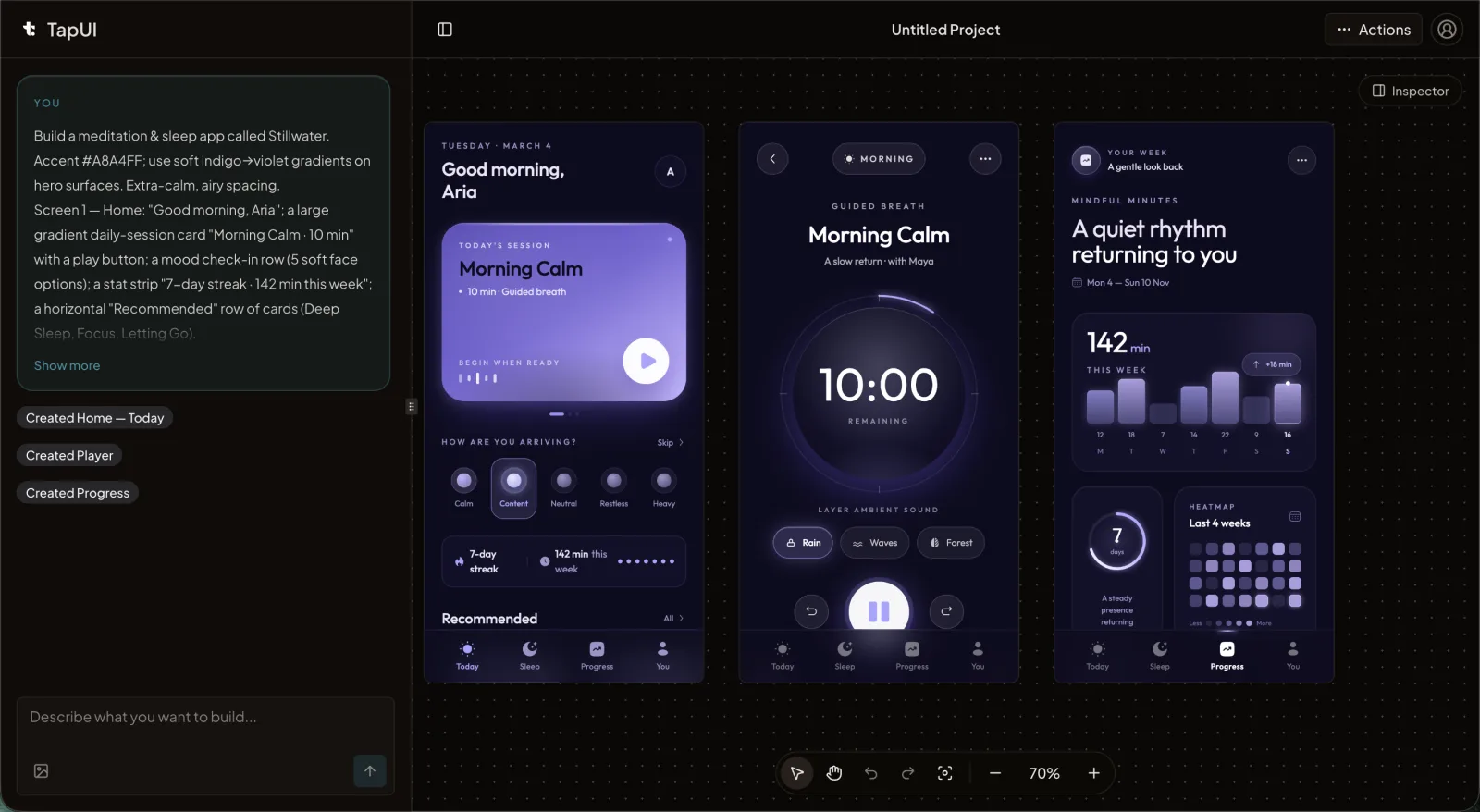 The TapUI editor: describe an app in plain language and get polished mobile screens you can hand to developers.
What TapUI is not is a Flutter code generator. It doesn't export Dart or any other platform code, and you shouldn't pick it expecting StatelessWidget trees to drop into your project. What it gives you is clean, considered mobile screens you can hand to your developers as a clear visual spec — which, if you've ever tried to brief a build from a vague description, is worth more than it sounds.
So the realistic place TapUI sits in a Flutter workflow is the design stage. Use it to get from idea to a coherent set of screens quickly, then take those screens into your Flutter build the way you'd take any design — by hand, or through a code-gen tool or AI agent. On pricing, TapUI has a free tier plus paid plans: Starter at $20/mo ($17/mo billed yearly, 100 screen generations a month with project history and exports) and Pro at $40/mo ($27/mo billed yearly, 650 generations a month plus priority support), so you can try the workflow before committing.
Best for: producing good mobile UI fast when your bottleneck is design, not generating Dart.
- Pros: idea-to-polished-screens in plain language, strong visual quality, project history and exports, low-friction free tier.
- Cons: design only — no Flutter/Dart (or any platform code) export, so you still need a separate build path.
Tools that don't fit Flutter (worth knowing anyway)
A couple of popular names come up in Flutter searches but don't actually target it:
- Vercel v0 generates excellent UI — for the web. It outputs React/Next.js and assumes a DOM. There's no Flutter path, and web output can't be submitted to the App Store or Play Store. Great tool, wrong platform here.
- Locofy.ai turns Figma designs into code with solid quality, but its mobile output is React Native, not Flutter. If your source of truth is a well-labeled Figma file and you're on React Native, it's worth a look — just not for Dart.
- Workik is a free AI Flutter/Dart code generator, but it's more of a coding assistant than a design tool — no visual canvas, no screen exploration.
Why Flutter trips up generic AI tools
Flutter's no-DOM rendering model is why web-first AI tools struggle — every <div> and CSS rule has to be translated into a widget. Flutter renders to its own engine, and everything is a widget — Row, Column, Stack, Text, even padding. A tool trained mostly on web code reaches for <div> and CSS, and every one of those has to be translated: a div becomes a Container or Column, a span becomes a Text, CSS becomes BoxDecoration and TextStyle, web event handlers become GestureDetector. Add Dart's null safety and async model, and "export to Flutter" can quietly mean "rewrite most of this."
That's the real reason to separate the design job from the code job. Get the design right with whatever produces the best screens fastest; then use a Flutter-native path — FlutterFlow, an MCP agent, or your own developers — for the Dart.
How to choose
Route by your actual bottleneck — there's no forced winner:
- Need beautiful screens fast and a clear spec to build from? → a design-first tool like TapUI, then hand the screens to your dev or code-gen step.
- Need a free first draft across multiple frameworks? → Google Stitch, paired with an AI coding agent for the Flutter finish.
- Need deployable Flutter code and willing to live in a builder? → FlutterFlow.
- Actually on web or React Native? → v0 or Locofy, respectively.
When you evaluate any of them, test the part that matters to you. If you care about code, generate a real screen and check whether it compiles and themes correctly on both an iOS and Android target — not just whether the preview looks nice. If you care about design speed, see how far you get across five or six related screens before the output loses cohesion.
FAQ
Does TapUI export Flutter or Dart code?
No — TapUI is a design tool only. It generates polished mobile app UI screens from text descriptions, not Dart widgets, and it doesn't export native code for any platform. For Flutter code generation, look at FlutterFlow or an AI coding agent paired with a design tool.
Can Google Stitch output production-ready Flutter?
No, not without additional work. Stitch supports Flutter as an export target, but Flutter is secondary to its web output. The generated code is a reasonable starting point, but you'll need to hand-edit it before it's production-ready. It works best paired with an MCP-connected coding agent that can finish the Dart work.
What's the most Flutter-native AI tool?
FlutterFlow is the most Flutter-native option. It outputs real, deployable Flutter/Dart code rather than a web wrapper, with AI features layered on a visual builder. The trade-off is that you're locked into its proprietary visual model, and complex apps still need hand-written Dart.
How much do TapUI, FlutterFlow, and Google Stitch cost?
Google Stitch is free. FlutterFlow uses tiered subscriptions with limited AI requests on lower plans. TapUI has a free tier, plus Starter at $20/mo ($17/mo billed yearly, 100 generations/month) and Pro at $40/mo ($27/mo billed yearly, 650 generations/month).
Can AI tools replace Flutter developers?
No. They speed up UI and scaffolding work, but you still need developers for state management, API integration, complex logic, and code review before shipping. Treat generated output as a draft, and test on real devices.
Should I use an AI design tool or an AI code tool for Flutter?
Use both, for different stages. Use a design tool like TapUI to generate polished screens fast, then hand those designs to a Flutter-native path — FlutterFlow, an AI coding agent, or your dev team — to build real Dart. Separating design from code avoids the conversion tax and leverages each tool's strengths.
The short version
There's no single "best AI design tool for Flutter," because design and code are different problems. Google Stitch gives you a free, multi-framework draft. FlutterFlow gets you closest to deployable Dart. TapUI is the fastest way to get polished mobile screens you can build from — as long as you remember it's a design tool, not a code generator. Pick for the bottleneck you actually have.
Want to design app screens fast? Try TapUI and see how quickly a plain-text description becomes a polished mobile UI.