TapUI vs App Alchemy: Which AI Mobile Design Tool Fits You?
An honest comparison of TapUI and App Alchemy for generating mobile app UI from text, including where each tool wins and who each is for.
TL;DR: Both TapUI and App Alchemy turn a text prompt into mobile app UI screens in seconds. App Alchemy is best if you want to clone an existing app from a screenshot or fork community templates for a quick pitch deck. TapUI is best if you want a free tier to try before paying and hands-on control to steer designs toward brand consistency. Neither replaces a designer for production work — both buy you a credible first draft fast.
Both TapUI and App Alchemy do the same headline trick: you type a description of an app, and a few seconds later you're looking at mobile screens that would have taken a designer hours to mock up. If you're a founder racing toward a pitch, or a PM who needs something real to react to in standup, that trick alone is worth a lot.
But the two tools make different bets about what happens after that first generation, and they price themselves very differently. I work on TapUI, so treat this as a comparison written by someone with a stake in the outcome. I've tried to be straight about where App Alchemy is the better pick, because for some people it genuinely is.
TapUI vs App Alchemy at a glance
| TapUI | App Alchemy | |
|---|---|---|
| Best for | Trying before paying; brand/design-system consistency | Cloning an app from a screenshot; fast pitch prototypes |
| Text-to-UI generation | ✅ | ✅ |
| Screenshot-to-design | ❌ | ✅ |
| Community template cloning | ❌ | ✅ |
| Post-generation editing | ✅ Direct control over screens | ⚠️ Chat-based refinement (element-level control limited) |
| Free tier | ✅ Yes | ❌ Paid from day one |
| Pricing | Free; Starter $20/mo ($17/mo yearly); Pro $40/mo ($27/mo yearly) | Credit-based paid tiers |
| iOS / Android | ✅ Both | ⚠️ Both (some reviews note iOS bias) |
| Developer handoff | ✅ Designs/screens to hand off (no native code export) | ⚠️ Image export; "code export" on higher tiers (formats undocumented) |
What each tool actually does
TapUI turns a plain-text description into polished mobile app UI screens. It's aimed at founders, product managers, and designers who want working app UI fast without grinding through manual design work. There's a free tier to start with, plus a Starter plan at $20/mo ($17/mo billed yearly) and a Pro plan at $40/mo ($27/mo billed yearly).
Best for: anyone who wants to evaluate the tool for free first, then keep designs on-brand with direct, hands-on control.
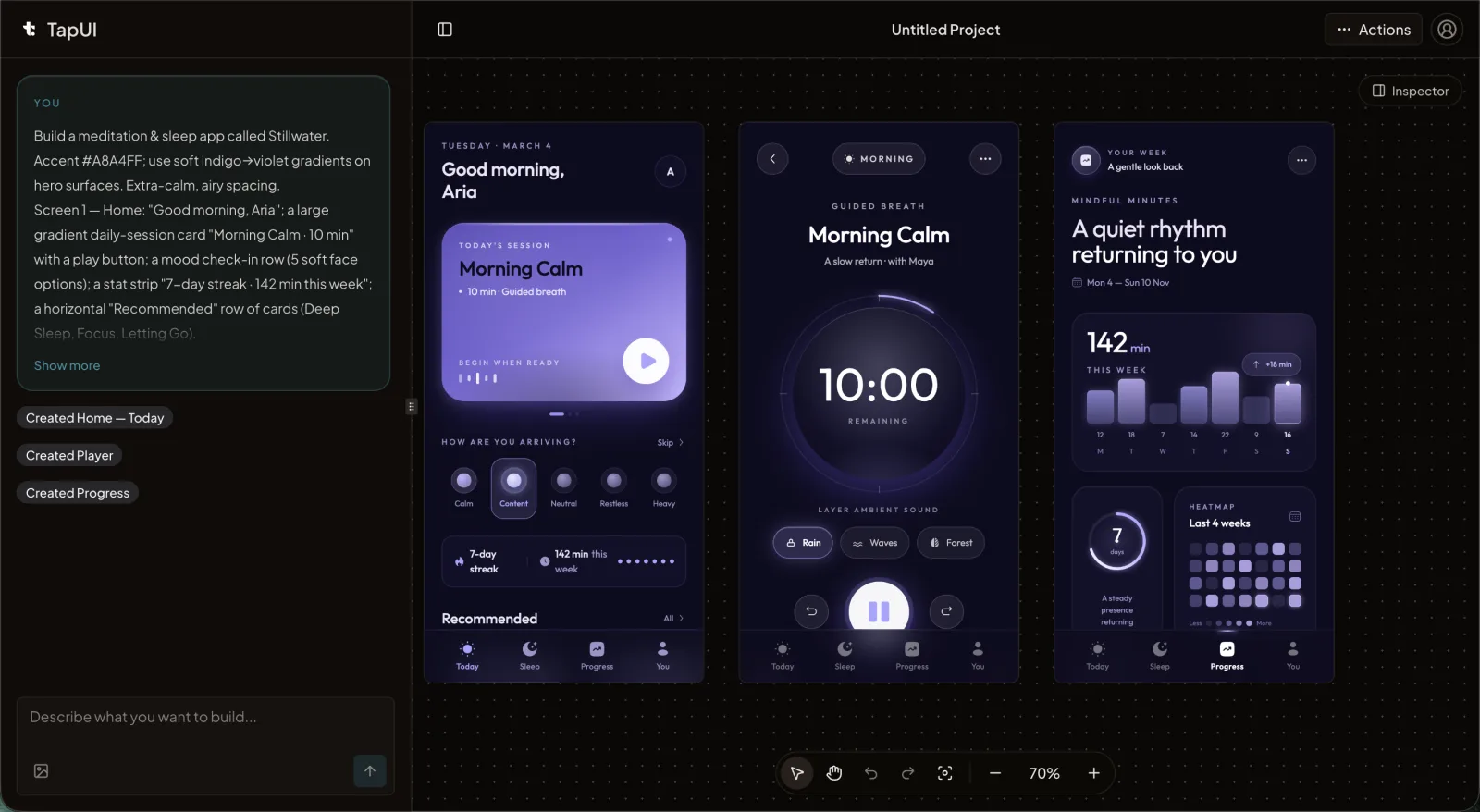 The TapUI editor turns a plain-text description into polished mobile screens you can refine directly.
App Alchemy (appalchemy.ai) is also an AI mobile UI mockup generator. You describe an app in plain English and get multi-screen iOS and Android mockups in roughly 30 seconds. It accepts a few kinds of input: a text prompt, an uploaded screenshot, or a community template you can clone. After the first pass, you refine the design through a chat-based editor.
Best for: founders who want to imitate a known app style from a screenshot or template and ship throwaway screens for a pitch.
On the surface they overlap heavily. The differences show up in three places: how you iterate, how you get designs out of the tool, and what it costs to get started.
Where App Alchemy is genuinely strong
I'll start here, because it's the part most TapUI-authored comparisons skip.
Screenshot-to-design is a real advantage. Point App Alchemy at a screenshot of an app you admire and it'll generate something in that direction — a fast, low-friction way in if your goal is "make me something that feels like that fintech app everyone's copying." TapUI starts from your description rather than an existing screenshot.
Template cloning suits founders who want to imitate a known style. App Alchemy leans into a community template library you can fork. For someone assembling an investor deck who wants a familiar, proven look, that's a sensible shortcut.
It's tuned for fast first drafts and prototyping. App Alchemy is squarely a prototyping and pitch-deck tool. If you need a stack of plausible screens to show a concept and you're not going to take them all the way to production, it does that job quickly.
If those describe your situation, App Alchemy is a reasonable choice and you can stop reading here.
Pros: screenshot-to-design input, community template library, fast first drafts, image and (higher-tier) code export. Cons: no clear free tier, credit-based caps on lower plans, chat-only editing limits element-level control, some reviews note weaker Android output.
Where the two tools diverge
Getting started: free tier vs paid from day one
TapUI has a free tier; App Alchemy does not — that's the most concrete difference, and it cuts in TapUI's favor.
With TapUI you can generate screens and see whether the output suits you before paying anything.
App Alchemy doesn't advertise a free tier or a prominent free trial. Its pricing page is paid-only, starting at a monthly Starter plan and climbing through Pro, Ultimate, and Enterprise tiers. Some third-party reviews mention a handful of complimentary credits, but I wouldn't plan around that. If you want to kick the tires before committing a card, App Alchemy asks you to commit first.
App Alchemy's plans are also credit-based, with monthly AI-credit caps and limits on how many apps you can have going at once on the lower tiers. Annual billing knocks the effective price down meaningfully. None of that is unusual for the category, but it's worth knowing the lower tiers cap your generation volume.
TapUI's pricing is flat and easy to compare: a free tier to start, Starter at $20/mo ($17/mo billed yearly) with 100 screen generations a month plus project history and exports, and Pro at $40/mo ($27/mo billed yearly) with 650 generations a month and priority support. You can see the whole output on the free tier before deciding which plan, if any, fits.
Iteration: chat refinement vs hands-on control
The two tools take opposite approaches to iteration — App Alchemy uses chat, TapUI gives you direct control over screens.
App Alchemy's path is its chat editor. You describe the change in words and the AI reinterprets. That's approachable, especially if you don't think in terms of design properties. The trade-off is the one every chat-driven editor has: you're negotiating with a model rather than directly setting a value, and a tweak to one thing can nudge something you didn't want touched. Several reviews note that element-level control is limited.
TapUI's emphasis is on giving you more direct control over the generated screens so you can shape them toward something on-brand and consistent, rather than only re-rolling a prompt and hoping. If you have strict brand guidelines or a design system to respect, that direct control matters more than it sounds.
Pros: free tier to evaluate before paying, direct hands-on control over screens, transparent flat pricing (Starter $20/mo, Pro $40/mo), project history and exports. Cons: no screenshot-to-design input, no community template library, no native code export (designs are handed to developers, not generated as Swift/Kotlin/Flutter source).
Handoff to your team
Neither tool is a complete substitute for developer handoff — but they approach it differently.
App Alchemy exports high-resolution images, and its higher-priced tiers advertise a code export. The specific languages and frameworks behind that code export aren't clearly documented, so I won't characterize them — verify exactly what you'd get before paying for it.
TapUI produces polished design screens you hand to your developers to build from. It does not generate native code — no Swift, Kotlin, React Native, or Flutter source — so treat the output as the design layer, not a shortcut around engineering. Project history and exports are included on paid plans. What matters for most readers is that the screens aren't a dead end: they give your team a clear, concrete target to implement. If your pipeline depends on a specific export format, confirm it directly with each tool before you buy. Don't take any comparison's word for the exact formats, including this one.
Platform coverage
Both tools target iOS and Android. A caveat worth flagging on App Alchemy: a few reviews describe a stronger iOS bias with less polished Android output. I haven't independently verified that, so weigh it as a signal to test rather than a settled fact, especially if Android is your primary platform.
A note on speed claims
Both tools collapse hours of manual mockup work into seconds for the first draft — take any "Nx faster" marketing figure, from any vendor including this comparison, with skepticism. The real time cost lives in iteration, and that depends entirely on how picky you are and how close the first generation lands. Test both on your actual use case before believing a multiplier.
So which should you pick?
The right pick depends on how you like to input designs, iterate, and whether you want to evaluate for free first. Route by what you actually need:
- Need to clone an app's look from a screenshot? → App Alchemy. Its screenshot-to-design input is built for exactly that.
- Want proven, familiar templates to fork for a pitch? → App Alchemy. The community library is the shortcut.
- Want to try a tool for free before paying? → TapUI. The free tier lets you judge the output first.
- Care about brand and design-system consistency? → TapUI. Direct control beats re-prompting when you have guidelines to respect.
- Prefer describing every change in chat? → App Alchemy. Its chat editor is the whole workflow.
Neither tool replaces a designer for a polished, production app, and you shouldn't expect that from either. What they both buy you is speed to a credible first draft. The right choice comes down to how you like to iterate and whether you want to evaluate the tool before opening your wallet.
If a free starting point sounds right, you can try TapUI at tapui.app and see what it generates for your idea before deciding anything.
FAQ
Does TapUI or App Alchemy have a free tier?
TapUI has a free tier you can use to generate and export screens before paying. App Alchemy doesn't advertise a free tier — you must commit a payment method to test it.
What's the difference in TapUI's pricing tiers?
TapUI offers a free tier with basic generation, Starter at $20/mo ($17/mo yearly) with 100 screen generations and exports, and Pro at $40/mo ($27/mo yearly) with 650 generations and priority support.
Can TapUI export native code like React Native, Swift, or Flutter?
No. TapUI generates polished mobile UI designs you hand to developers to build. It does not export native or cross-platform source code — treat the output as the design layer, not a shortcut around engineering.
Which tool is better for copying an existing app's design?
App Alchemy is the better choice if you want to clone an app from a screenshot or use community templates. TapUI starts from your text description only and has no screenshot-to-design input or template library.
Do both tools support iOS and Android?
Yes, both generate iOS and Android designs. Some reviews note App Alchemy has stronger iOS output with weaker Android, so test your primary platform before deciding.
Related: TapUI vs ScreensDesign comparison • Ship mobile UI faster with AI • Validate app ideas without coding