TapUI vs Sleek: Choosing an AI Mobile App Design Tool
TapUI and Sleek both turn text prompts into mobile UI. Here is an honest look at where each one fits, and which suits your workflow.
TL;DR: TapUI and Sleek both turn a text prompt into a polished mobile UI in seconds. Sleek is the stronger pick if your next step is editing in Figma or exporting code (React + Tailwind, HTML), or if you start from reference images. TapUI is the better fit if you want the fastest path from a written idea to a shareable mobile UI you can hand to your developers. Google Stitch is a capable free alternative with an experimental-status asterisk.
Both of these tools start in the same place: you type a description of an app screen, and you get a polished mobile UI back a few seconds later. That shared starting point is where most "X vs Y" articles stop being useful, because the interesting differences only show up once you look at what each tool is actually built to do with the screens it generates.
I work at TapUI, so treat this as a comparison written by someone with a side in the game. I've tried to keep it honest: there are real reasons to pick Sleek over TapUI, and I'll say so plainly. If you just want the short version, it comes down to what you do after generation — handing designs to a developer, or moving them into a design file you'll keep editing.
Quick comparison
| Tool | Best for | Key strength | Pricing | Reference-image input | Code export |
|---|---|---|---|---|---|
| TapUI | Fast, shareable mobile UI to hand to developers | Speed from idea to presentable screens; usable free tier | Free; Starter $20/mo ($17/mo yearly); Pro $40/mo ($27/mo yearly) | ❌ | ❌ |
| Sleek | Designers who refine in Figma or export code | One-click Figma layers, React + Tailwind, HTML | Free, Starter, Pro, Team (credit-based) | ✅ | ✅ |
| Google Stitch | Free, exploratory experimentation | Multi-screen, infinite canvas, broad framework export | Free (Labs experiment) | ⚠️ | ✅ |
The two-line summary
- TapUI generates mobile app screens from plain-text descriptions and is aimed at people who want working app UI fast — founders, PMs, and designers — without doing the manual design work themselves.
- Sleek (sleek.design) generates iOS and Android screens from text or reference images, and leans hard into design-file and code export — one-click Figma, HTML, and React + Tailwind.
If your next step is "open this in Figma and keep refining," Sleek's export story is genuinely strong. If your next step is "show this to my team or hand a clean design to my developers," TapUI is built for that path.
What Sleek does well
Best for: designers who refine generated screens in Figma or export them straight to code.
Sleek's standout strengths are its export depth and its willingness to accept reference images alongside text prompts — capabilities that make it the right pick if your workflow runs through Figma or a code editor. It's a solo, indie-built product from Mattia Pomelli, a developer-designer who previously built a website design tool. It launched in late 2025 and found an audience quickly. That origin shows in the product: it's opinionated, focused, and clearly made by someone who has shipped real apps.
Pros:
- It enforces native platform conventions. Sleek isn't a general-purpose UI tool. It pushes you toward iOS Human Interface Guidelines and Material Design — correct device dimensions, native navigation patterns, sensible tap-target sizing. If you've ever received an AI mockup with buttons too small to actually tap, you'll appreciate this.
- Reference-image input. You can feed it an existing screen or a look you like, not just a text prompt. That's a real capability TapUI's text-first flow doesn't replicate.
- Export breadth. One-click to Figma as native, editable layers (no plugin), plus HTML and React + Tailwind. It also works with AI coding agents like Claude Code, Cursor, and Codex on its higher tiers.
- Transparent, granular pricing. Sleek publishes four tiers — Free, Starter, Pro, and Team — with credit allowances spelled out per plan, plus full ownership of generated designs and code and a short refund window.
Cons:
- The free plan is genuinely limited — a single project and capped credits — so it's more of a trial than a place to live.
- It's a young, solo-run project, so its long-term roadmap depends on one person's bandwidth. That's not a knock, just a fact to weigh if you're betting a team workflow on it.
What TapUI does well
Best for: founders, PMs, and designers who want a shareable mobile UI fast, then clean designs to hand to engineering.
TapUI's core strength is speed from idea to something you can actually show people — no detour through a design tool required. It's built for founders, product managers, and designers who want presentable app UI quickly. You describe the app; you get screens you can show people.
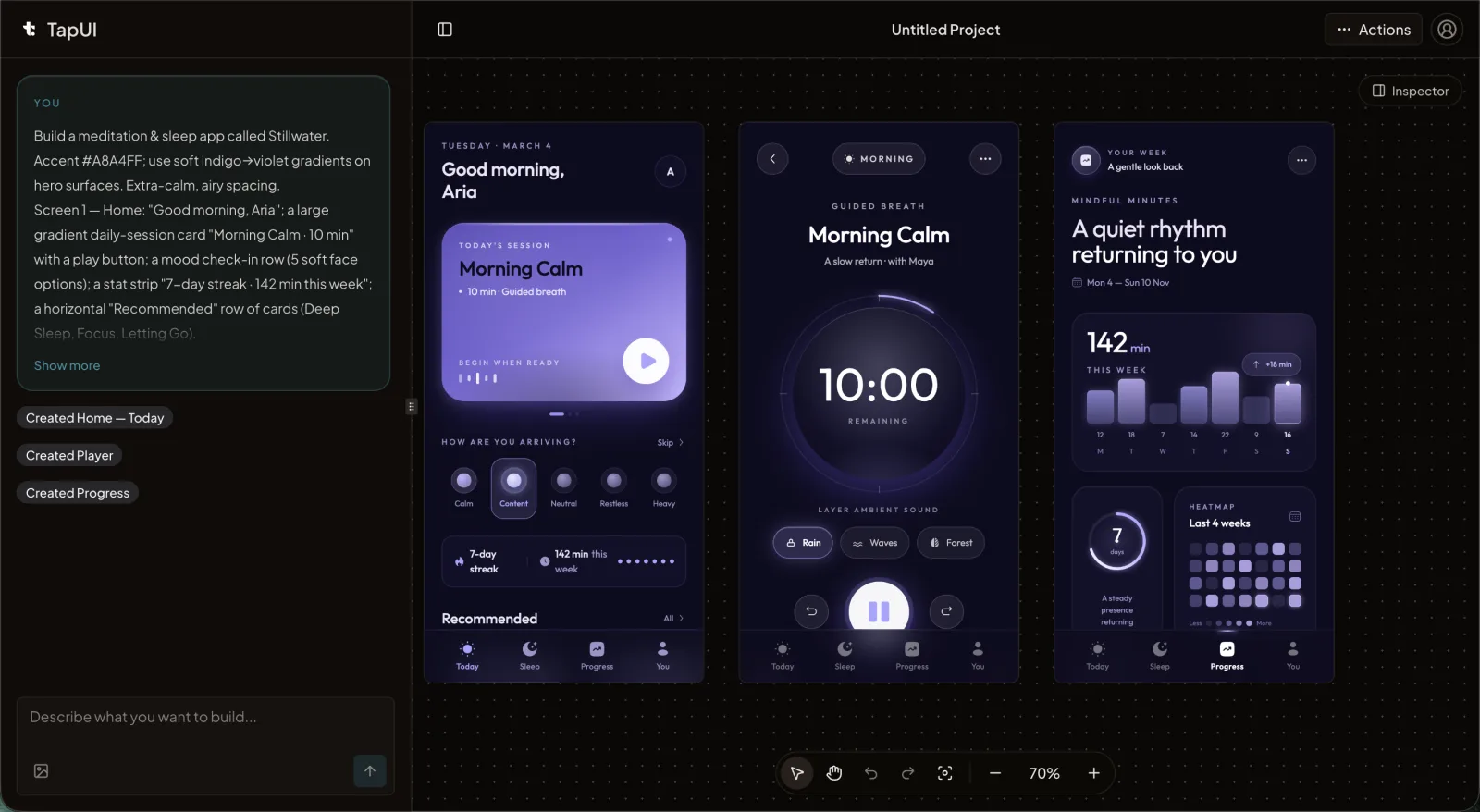 The TapUI editor turns a plain-text description into a polished mobile app screen in seconds.
Pros:
- Speed to a shareable result. The flow is built around getting from an idea to something you can put in front of a teammate or investor without a detour through a design app.
- A free tier you can actually use. TapUI offers a free tier alongside paid Starter and Pro plans (monthly or yearly). The free tier is meant to let you do real work, not just kick the tires.
- Designs you can hand to your developers. TapUI's output is meant to move into a build, not die in a slide deck.
Cons:
- No code export. TapUI does not generate or export native code (React Native, Swift, Flutter) — treat developer handoff as clean, presentable designs your engineers work from, not a code pipeline.
- No reference-image input. TapUI's flow is text-first; you describe the screen rather than feeding it an existing image.
For pricing: TapUI's Starter plan is $20/mo ($17/mo billed yearly) with 100 screen generations per month, project history and exports, and email support. Pro is $40/mo ($27/mo billed yearly) with 650 generations per month, everything in Starter, plus priority support.
A note on handoff, because this is exactly the kind of claim these comparisons tend to inflate: TapUI does not export React Native, Swift, or Flutter code. If you've read older write-ups that said it did, that capability isn't part of the product. The general "exports" you'll see refer to project history and design exports — clean, presentable designs your engineers can work from — not platform code generation.
A third option worth knowing about: Google Stitch
Best for: free, exploratory experimentation when long-term reliability isn't a requirement.
Google Stitch is free and capable, but its Labs status means it carries real reliability risk for any production workflow. It's a Google Labs experiment, powered by Gemini, that's currently free to use with a generous monthly generation allowance. A 2026 update added multi-screen generation, an infinite canvas, interactive prototyping, voice commands, and export to a wide range of frameworks including HTML/CSS, Tailwind, Vue, Angular, Flutter, and SwiftUI. It covers both web and mobile.
Pros: free, broad framework export, multi-screen and infinite-canvas workflow, voice commands.
Cons: it's a Labs experiment with no announced pricing or enterprise roadmap, and Google has a long history of sunsetting Labs projects. It's excellent for exploration; be cautious about building a long-term commercial workflow on something with no availability guarantee. For a focused, mobile-first tool you can rely on, a dedicated product like Sleek or TapUI is the safer bet.
How to actually choose
Here's the decision the way I'd frame it for a friend:
Pick Sleek if:
- You live in Figma and want generated screens to land there as editable layers.
- You want React + Tailwind or HTML export, or you drive your build through AI coding agents.
- You sometimes start from a reference image rather than a text description.
- You want platform-correct iOS/Android conventions enforced for you.
- Transparent, itemized pricing tiers matter to you.
Pick TapUI if:
- Your priority is getting from a written idea to a shareable mobile UI fast, without learning a design tool.
- You want a free tier substantial enough to do real work in.
- Your handoff is "show the team, then give clean designs to engineering" rather than "export production code myself."
Try Google Stitch if:
- You want a free, exploratory tool and you're comfortable with its experimental status.
These aren't mutually exclusive. Plenty of people generate a first pass in one tool and refine in another. The cheapest way to decide is to run the same prompt — a real screen from your actual app, not a generic "login page" — through each free tier and see which output you'd rather start from.
FAQ
What's the core difference between TapUI and Sleek?
Both generate mobile app screens from text. Sleek leans into design-file and code export (Figma, HTML, React + Tailwind) and accepts reference images. TapUI focuses on getting you a shareable, presentable mobile UI fast, with designs you can pass to your developers.
Does TapUI export code or native frameworks?
No. TapUI does not generate or export React Native, Swift, Flutter, or any native platform code. Its output is polished, presentable designs you hand to your engineering team—not a code-export pipeline.
What are TapUI's pricing plans and free tier?
TapUI has a free tier, plus Starter ($20/mo or $17/mo yearly) with 100 screen generations per month, project history, and exports, and Pro ($40/mo or $27/mo yearly) with 650 generations per month and priority support.
Which tool should I choose for exporting code?
Sleek is the better choice if you need to export production code directly — React + Tailwind, HTML, or export to Figma. TapUI is designed for clean design handoff to developers, not code generation.
Can I use reference images with these tools?
Sleek accepts both text prompts and reference images to generate platform-specific iOS and Android screens. TapUI is text-first and doesn't support image input; describe the screen in words instead.
Is Google Stitch a reliable option for a production workflow?
No — not yet. Google Stitch is free and capable, but it's a Labs experiment with no announced pricing or availability guarantee. It's excellent for exploration and prototyping; if you need a tool you can depend on long-term, Sleek or TapUI are safer bets.
Bottom line
There's no universal winner here, and any article that declares one is selling you something.
- Need editable Figma layers or code export? → Sleek.
- Start from reference images? → Sleek.
- Want the fastest path from a written idea to a shareable mobile UI to hand to developers? → TapUI.
- Want a free playground and you're fine with experimental status? → Google Stitch.
The smartest move is to test your own real screens in each free tier before deciding. If you want to start there, try TapUI.
Related articles: